

What You Need to Know Before Buying a Floating Kayak Launch
A floating kayak launch is public infrastructure that floats. When one breaks loose during a storm, it’s seldom bad luck. The failure almost always occurs in the connection between the floating structure and its shoreline.
That’s why one of the most important questions to ask before you buy is simple: How is the dock engineered and connected to the shoreline?
THE MOST IMPORTANT CONNECTION: THE BULKHEAD MOUNTING ANGLE
A floating dock has to do two things at once. It must rise and fall as the water levels change, and it must stay firmly attached to the fixed shoreline. BoardSafe’s engineered bulkhead mounting angle makes both possible. Our metal bracket securely ties the floating dock to its foundation for a lasting connection.
When properly engineered, the bulkhead mounting angle creates a strong, rigid link between the dock and the bulkhead while still letting the dock move up and down with the water. It carries the forces created by current, waves, rising water, and the weight of the structure back into the solid shoreline, instead of letting those forces build up in the dock itself.
That’s fundamentally different from relying on a chain-and-anchor system, simple anchor poles, or other methods that hold the dock in place mainly through weight or friction.
Simply put, flotation makes a dock float, but the bulkhead mounting angle – a floating dock’s connection to the shoreline – keeps the system where it belongs.
This distinction matters most on rivers, tidal waterways, and anywhere the water level and current can change quickly and dramatically.
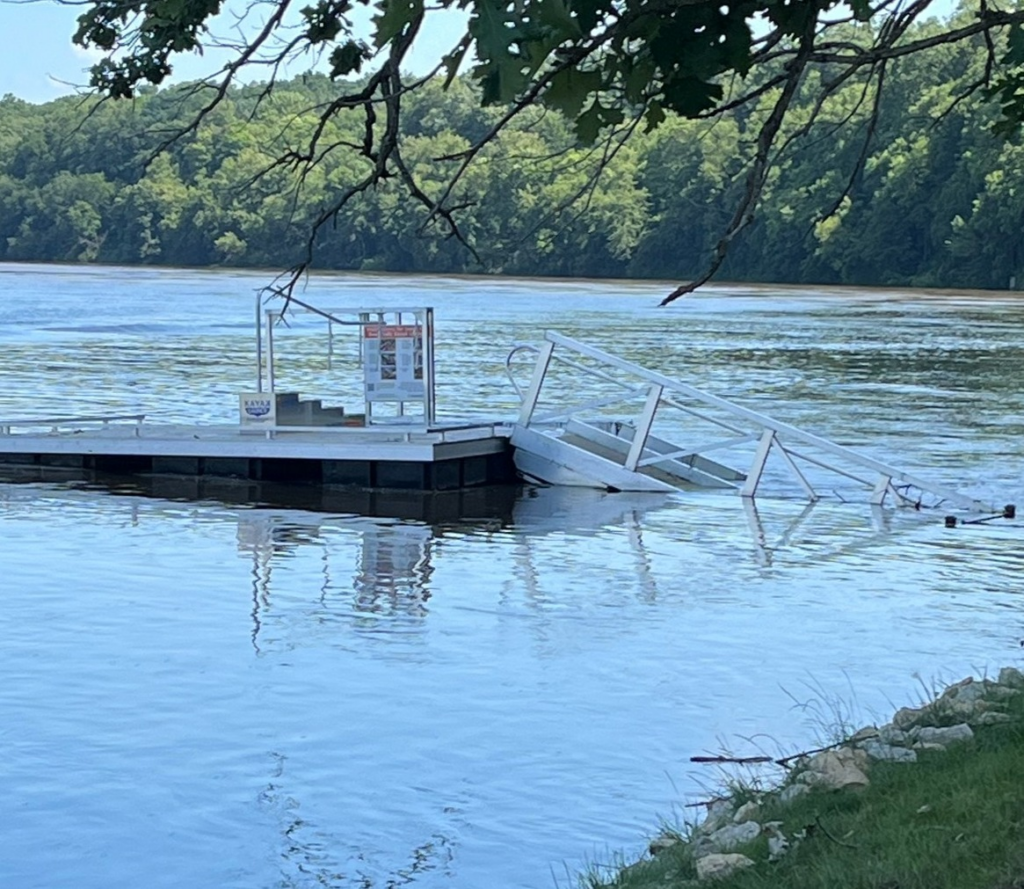
 A new launch washed away in its first flood
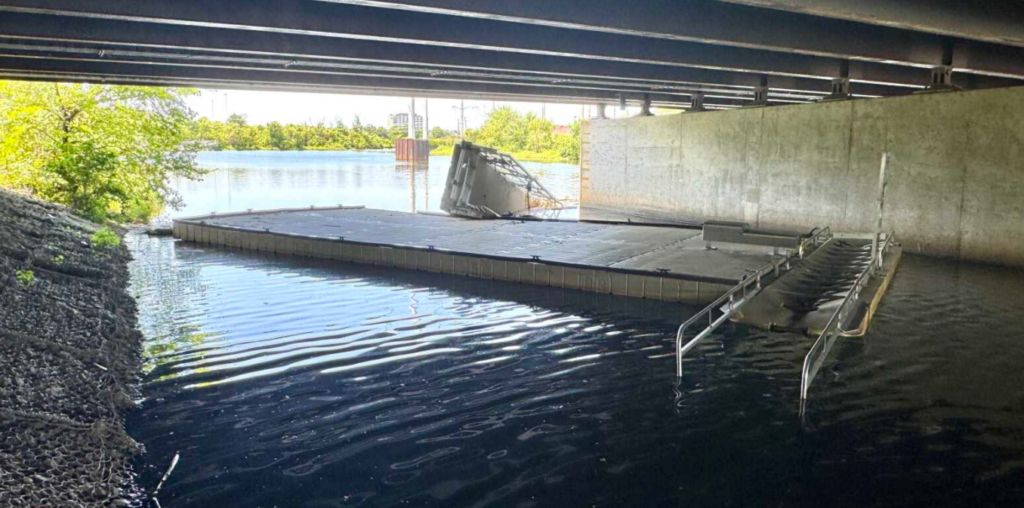 A new launch washed away in its first flood
WHAT CAN GO WRONG
- The shoreline connection fails. A connection that wasn’t properly engineered can pull apart when the water rises and the loads increase.
- The structure twists and flexes. Bolted or modular systems are more prone to movement, which loosens fasteners over time and can lead to sections separating under repeated loading.
- The launch can’t keep up with changing water levels. A well-designed floating system rises and falls with the water rather than fighting against it.
- Accessibility breaks down. An accessible launch has to keep a safe, usable path from shore to water across the full range of expected water levels.
Lake Chickamauga, TN BoardSafe Kayak Launch secured by Bulkhead Mounting Angle and Stiff Arm
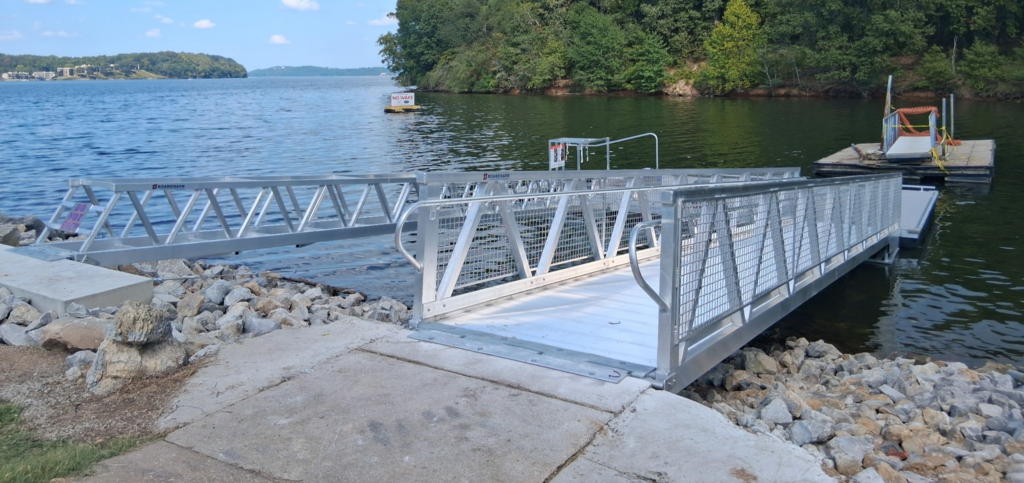 Lake Chickamauga, TN BoardSafe Kayak Launch secured by Bulkhead Mounting Angle and Stiff Arm
1. How is the dock connected to the shoreline?
Ask specifically about the bulkhead mounting angle, or whatever engineered shoreline connection the site calls for.
- Is the connection designed for the site’s flood stage and current?
- Is it engineered to let the dock move up and down with the water?
- Has it been structurally engineered for your actual bulkhead and site conditions?
- Are drawings and load calculations available?
What you want to see: a rigid, engineered connection designed specifically for your site.
What should concern you: a generic anchoring system with little or no site-specific engineering.
2. Is the structure welded or bolted together?
A continuously welded aluminum frame behaves as one rigid unit, built to handle repeated loading from users, current, and changing water conditions. Ask for the rated occupant and load capacity — and ask how those ratings were determined.
3. Is the flotation properly engineered?
Floats should be sized and positioned for the dock’s dimensions, the number of people it will carry, and how it will be used. When occupied, the launch should stay stable and keep enough of the deck above the water — its freeboard — including during transfers for paddlers using wheelchairs.
4. Does accessibility still work as the water level changes?
An accessible launch is more than a ramp and a transfer bench. The entire path — from shore, down the gangway (the ramp that connects land to the floating dock), and onto the floating platform — has to stay safe and usable as the water rises and falls. Features for paddlers with disabilities should be designed in from the start, not added as an afterthought.
5. Was the launch designed for your waterway?
A river is not a pond, and a tidal shoreline is not a lake. The design should account for the site’s current, flood range, tides, ice, shoreline construction, and gangway height. A reputable manufacturer will ask questions about your site before giving you a final design and price.
McMinnville, TN – BoardSafe Accessible Kayak Launch (connection runs width of the launch)
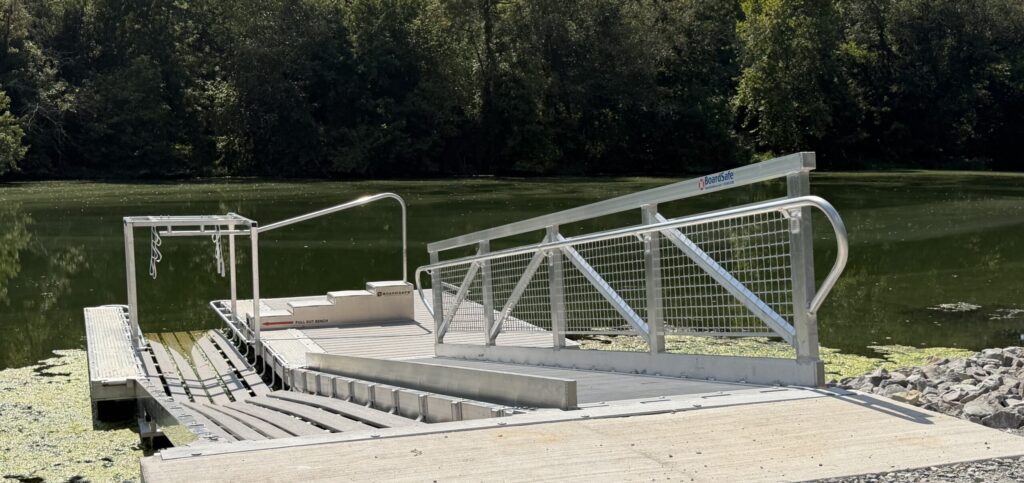 McMinnville, TN – BoardSafe Accessible Kayak Launch
 THE REAL NUMBER: COST OF OWNERSHIP OVER 25 YEARS
The purchase price is a single line on a single year’s budget. The launch, though, has to perform for 25 years or more — through storms, hurricanes, floods, ice, and daily public use. So the honest way to compare two launches isn’t the number on your bid; it’s the total cost of ownership across the life of the structure.
Seen that way, cheaper is usually more expensive. Many lower-priced units simply aren’t engineered to survive a major storm, flooding event, or hurricane — sometimes not even a full decade. When one fails, the cost doesn’t stop at another purchase. It includes emergency removal, repairs, the downtime while the public has no access, and the harder-to-quantify cost of a launch that washed downstream, making the news under your park’s name.
Replace a launch once over a 25-year horizon, and you’ve paid for it two or three times over. A properly engineered launch is a higher line item exactly once. It’s built to still be in service in year 25 — with one purchase and decades of return.
| Cost driver | Engineered to last 25+ years | Chosen on lowest bid |
| Upfront price | Higher line item, once | Lower line item |
| Expected service life | 25+ years by design | Often under 10 years in demanding water |
| Storm & hurricane survival | Engineered to stay put and stay whole | Not engineered for extreme events |
| Replacement cycle | None planned within the horizon | One or more replacements likely |
| Repairs & maintenance | Routine, predictable | Escalating; fasteners, floats, connections |
| Downtime & lost access | Minimal | Weeks or seasons of closure after a failure |
| 25-year total cost | Lowest — one structure that lasts | Highest — repeat purchases plus cleanup |
A launch that costs less on the bid can become the most expensive line on the balance sheet the first time it has to be pulled out of a river and replaced.
So when you evaluate a floating kayak launch, ask: “Will it still be here — and still doing its job — in 25 years?”
The answer starts with a properly engineered shoreline connection — including the bulkhead mounting angle where the site has a bulkhead — and continues with a welded frame, properly sized flotation, site-specific engineering, and accessibility designed for real-world water conditions. Those are the things that turn a purchase into a 25-year return.
Buffalo, NY BoardSafe Kayak Launch Secured to Bulkhead with Engineered Mounting Angle and Cables
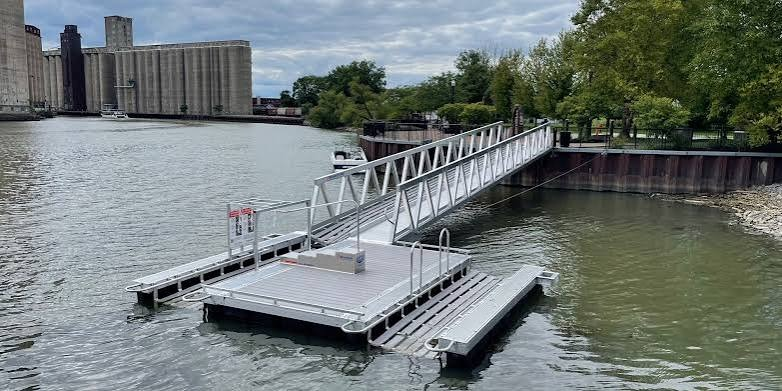 Buffalo, NY BoardSafe Kayak Launch Secured to Bulkhead with Engineered Mounting Angle and Cables
THE SIX QUESTIONS TO PUT IN YOUR RFP
- Shoreline connection: How is the floating dock connected to the shoreline, and is the bulkhead mounting angle (or other connection) engineered for our site conditions?
- Structure: Is the frame continuously welded aluminum, and what are the rated occupant and load capacities?
- Flotation: How were the floats sized and positioned for the dock’s dimensions and anticipated loads?
- Flood behavior: How does the launch handle rising and falling water, and what range of water levels is it designed for?
- Accessibility: Does the entire accessible path stay safe and usable across the expected range of water levels, and was the launch designed around the needs of paddlers with disabilities?
- Warranty & references: What is the structural warranty, and can you provide references for comparable installations that have remained in service?
ENGINEERED FOR THE WATER YOU ACTUALLY HAVE
BoardSafe Kayak Launch in Dixon, IL, still floating and secure during highest flood stage
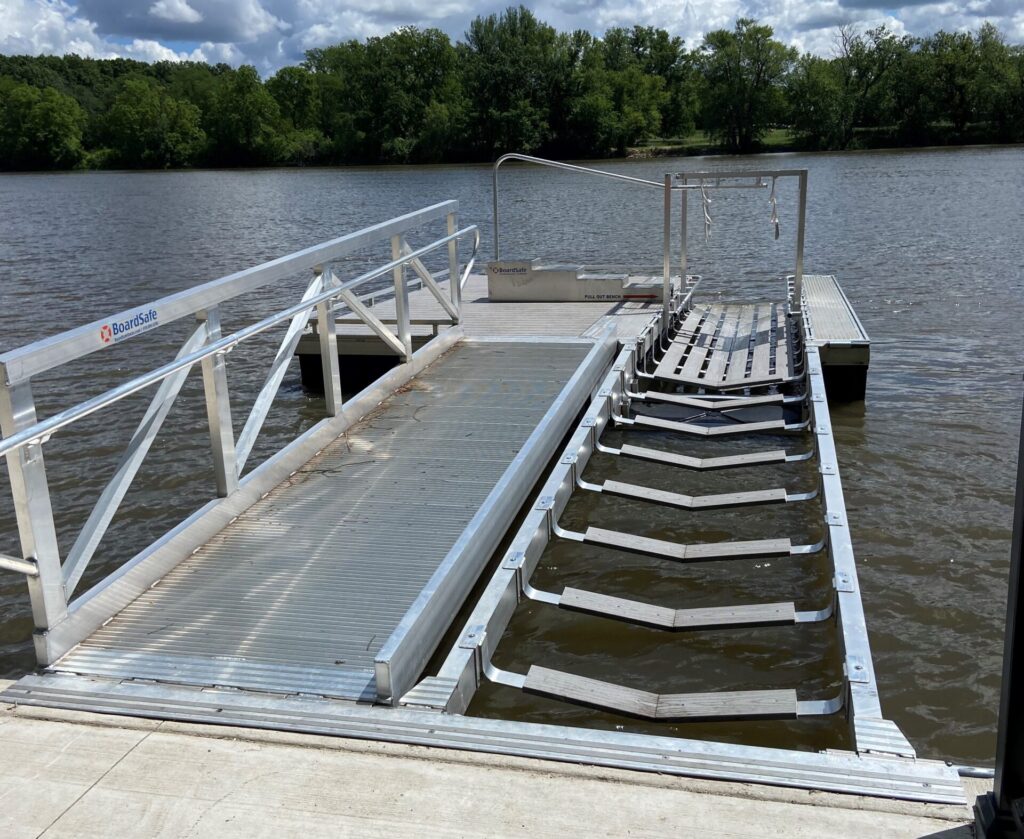
Same BoardSafe Kayak Launch in Dixon, IL, floated back into place post-flood
Every waterfront is different. BoardSafe designs the right floating dock system by starting with the shoreline, the water, and the loads the structure must withstand. With all floating infrastructure, flotation keeps it on the water—but proper engineering keeps it attached and in place for the long-term.
Watch a BoardSafe rowing center handle the flooding conditions on the Schuylkill River in Philadelphia, PA: Flooded Aluminum Floating Dock Rowing Center Survives Test.
BoardSafe Docks designs, engineers, and fabricates welded-aluminum waterfront infrastructure that includes: adaptive kayak launches, gangways, pedestrian bridges, accessible fishing piers, rowing docks, and courtesy boat docks. We don’t manufacture the same system and hope it works for all locations, or pull our system off a shelf. We work with you to design the best and lasting solution for the specific conditions at your site. With about 250 floating dock systems in service across the U.S., BoardSafe builds from experience. Learn more at boardsafedocks.com.
Disclaimer: This guide is for educational purposes and describes common considerations in floating launch design. Water conditions and engineering requirements vary by site and should be confirmed by a qualified engineer. BoardSafe Docks recommends site-specific engineering for waterfront structures.