


Seven Advantages of a BoardSafe Aluminum Floating Dock
BoardSafe Docks’ customers often ask about the advantages of using an aluminum floating dock system. BoardSafe Docks are used for municipal, commercial, and private projects. While traditional piling structures support stationary, fixed docks, floating docks are supported by flotation and rest on the water’s surface. Though fixed docks are a popular choice, floating docks offer advantages and benefits that cannot be offered with a stationary pier. These benefits may be ideal for your docking system project. Here are the unique advantages of a BoardSafe floating dock.
BoardSafe Aluminum Floating Docks Adjust to Tidal Conditions
Floating docks provide an ideal solution for projects that experience vast changes in water levels. During the change in seasons, tides may rise and fall, allowing floating docks to remain level with your boating vessel. When water levels drop too far below a stationary dock, boaters may experience difficulty boarding. When water levels rise too high, fixed docks become submerged. Floating docks will self-adjust with water levels and provide safe, constant access to your vessel. So whether you experience drought or flooding conditions, a BoardSafe aluminum floating dock maintains the same freeboard.
Click the following link to read and learn more about freeboard:
Five Most-Commonly-Asked Questions About Floating Dock and Rowing Dock Freeboard
BoardSafe Aluminum Floating Docks Offer Structural Integrity
According to the Federal Emergency Management Agency (FEMA), floating docks acclimate to weather conditions and provide greater protection for boats. During a storm or hurricane, stationary docks may succumb to submersion, damage, and collapse. Floating docks move with the water, and their elasticity reduces damage due to inclement weather.
[table id=3 /]
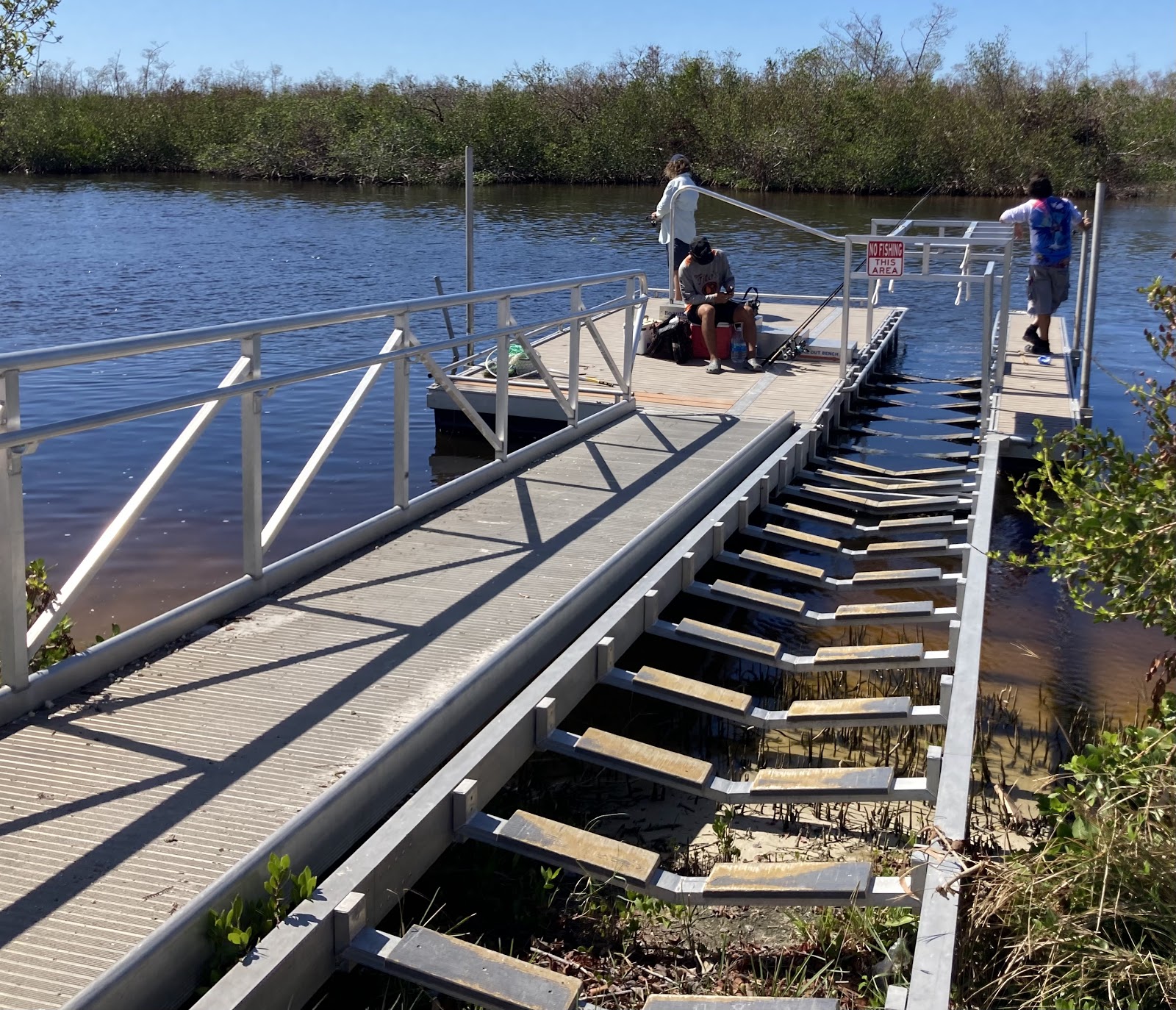
Sirenia Vista Kayak Launch and Park, three weeks after Hurricane Ian, 10/22/22. BoardSafe’s Kayak Launch system floated with the rising waters and maintained its structural integrity, withstanding sustained winds reaching 100–140 mph with significant tidal flooding.
BoardSafe Docks Are Built for Versatility
Floating docks offer increased versatility compared to stationary docks. With more options for customization, BoardSafe Docks can design floating dock configurations to meet their customer’s needs. They can reposition, remove, and add additional floating docks with ease. BoardSafe Docks are designed with proprietary extrusions and connecting hinge pins that allow them to be easily dismantled and stored for the winter.
User groups in the northern United States and Canada will be happy to know that BoardSafe’s docks and launches can remain in the water for the winter as long as there is no fluctuation in the body of water where the launch is located and there are no ice pack movements that could damage the floating dock system. That said, a floating dock, fishing pier, or adaptive launch that has a steady level and flow of water around it will endure the winter and can be left in the water. However, this decision should not be made in isolation without having conversations about winter weather conditions with both the park operations manager and BoardSafe Docks. The adaptability of floating docks makes modifying your space and dock easier and less expensive than a stationary dock.
BoardSafe Docks Offers Quick, Affordable Installation
Municipalities and park systems can install floating docks quickly and more affordably than stationary docks. Floating docks do not require pilings or substructures for support, making them simpler to install and potentially cheaper. For projects in deep waters, buyers can avoid the cost of expensive, lengthy pilings. Floating docks usually take less time to install than stationary docks, and some floating docks can even be installed and be ready to use in a day. BoardSafe Docks provides installation guidance and manuals to its customers and will even send an installation specialist to assist your crew with the floating dock system’s installation.
BoardSafe Aluminum Floating Docks Are Easy To Expand
For projects tight on space, floating docks grant a convenient opportunity for expansion. Marinas often choose to incorporate floating docks among stationary docks to increase boat docking capacity, or to separate their boat launch and docking areas from fishing piers and kayak launches. Should you desire more dock space, you can simply add another section of floating docks with a floating finger pier. BoardSafe Docks designs multiple configurations for its adaptive kayak launch.
![KA-2003 Sheet 1[4]- 20 std layouts](https://boardsafedocks.com/wp-content/uploads/2023/02/KA-2003-Sheet-14-20-std-layouts-300x232.jpg)
BoardSafe Docks Offers Accessibility and Inclusivity to Adaptive Paddlers
BoardSafe Docks works regularly with adaptive paddling groups, veterans groups, parks and recreation departments, government leaders, landscape architects, and design engineers looking to make their waterfront accessible to all. While the launch system is designed with adaptive paddlers in mind, it creates safer and easier access for novice paddlers, children, and paddlers with joint and mobility issues looking for an easier way in and out of their vessels. The features and stability offered by BoardSafe’s Adaptive Kayak Launch are truly a model for universal access to the water.
BoardSafe Docks understands the benefits and impact their adaptive launch system offers communities and park systems. Their inclusive launch is fitted for kayaks, canoes, and SUPS, and gets everyone in the water safely and easily. It is evident that paddlers want close-to-home recreation, safe, easy, and inclusive access to the water, and the ability to connect their families to nature and their local community.
Universal access is key to any program’s success. All too often, accessible docks are built to minimum standards and do not take into consideration the needs and abilities of the disabled paddlers using the launch system. BoardSafe Docks seeks continuous input and feedback from paddling groups and end users, making BoardSafe an industry leader in the design and manufacture of an all-inclusive launch system with specific adaptive features that will work for the widest range of users.
BoardSafe Docks Are a Floating Dock System Designed and Built To Last
In addition to structural integrity, versatility, safety, expandability, and inclusivity, BoardSafe’s aluminum-welded floating docks are manufactured with non-polluting materials, are corrosion-resistant, and require minimal maintenance.
BoardSafe is a leading national manufacturer of high-quality aluminum-welded adaptive kayak launches, fishing piers, marinas, rowing centers, gangways, pedestrian bridges, and other water access products. Whatever type of access your project needs, BoardSafe Docks provides turn-key service, from product design and inception through delivery.
BoardSafe’s sales team is available for questions and consultation and will assist you with finding your optimal waterfront solution. You can learn more about BoardSafe Docks’ projects at our website, BoardSafeDocks.com, or by calling 610-899-0286.
BoardSafe’s Aluminum Gangways Offer Accessibility to All
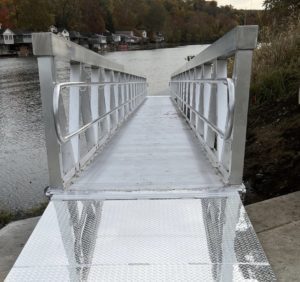
Gangways are raised walkways or connected platforms that allow pedestrians to walk safely from one point to another. Gangways help pedestrians walk from land to water, function as a bridge between sites, provide a stable walkway for pedestrians when boarding and disembarking boats, and connect to floating docks and marinas to create passageways from land to a structure in the water.
Gangways are necessary around high pedestrian-traffic areas around waterfronts, rowing centers, parks, lakes, marinas, rails to trails, and access points, allowing safe entry to waterfronts. BoardSafe Docks offers multiple solutions to their customers with their accessible aluminum-welded gangways, ramps, fixed piers, and pedestrian bridges.
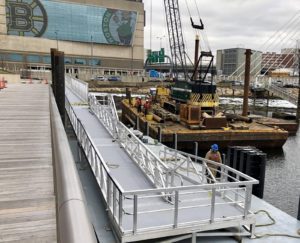
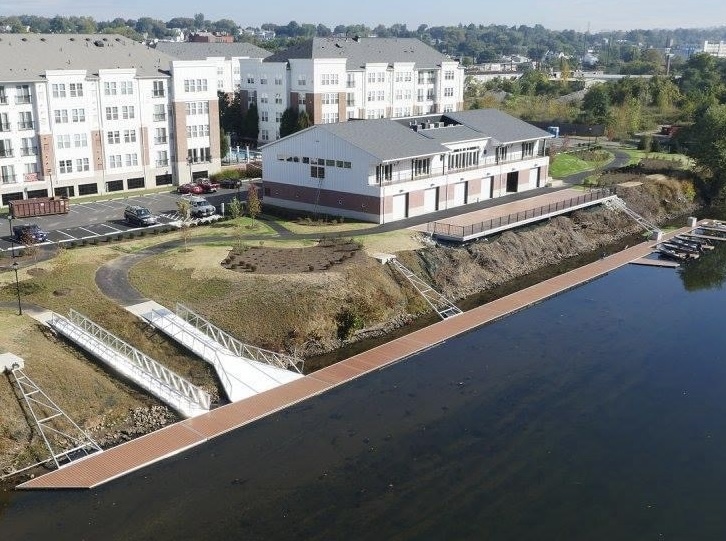
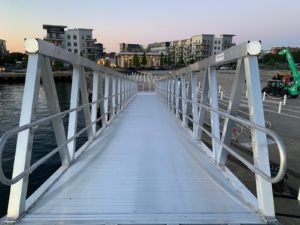
Allentown Waterfront, Allentown, PA Boston Garden, Boston Harbor, MA
BoardSafe aluminum gangways are manufactured to Americans with Disabilities Act (ADA) standards by including a ramp with a 1/12 pitch or less, two full-length handrails, aluminum toe-kick plates preventing sliding off the edge, and special accessibility grab-bars for wheelchair users. BoardSafe’s products are constructed for strength, durability, safety, and accessibility with additional adaptive features.
Although standard-size gangways are stocked for immediate delivery and available for convenience, BoardSafe designs and manufactures gangways to meet custom specifications in sizes from 8′ to 100′ in length. Width varies depending on the project's needs and applications.
Based on architectural and engineering specifications, gangways can be fixed or floating piers that offer seamless transitions to land that ensure full accessibility. ADA-designed gangways increase accessibility for anyone who is disabled, and will allow people using wheelchairs to access locations safely and easily. BoardSafe is a recognized expert and specializes in ADA-compliant designs, as seen in product pictures and videos available at BoardSafeDocks.com.
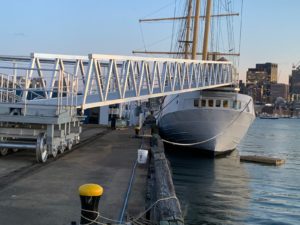
Tall Ship Gangway, Boston, MA
Benefits of a BoardSafe aluminum gangway or fixed pier
Aluminum gangways are much lighter than steel and other materials, making them easier to handle and install.
Aluminum is durable, rust-resistant, and can withstand harsh weather conditions, making aluminum a long-lasting option. It is virtually maintenance-free. Unlike other materials, aluminum requires no painting or other forms of maintenance, saving time and money. Aluminum is corrosion-resistant, making it ideal for use in marine environments, and is recyclable—therefore, an environmentally-friendly option.
Aluminum is a cost-effective option being less expensive than other materials; therefore it’s financially desirable to customers.
Click here to view a video of an 80’ gangway project along the Allentown Waterfront: Allentown Waterfront Floating Dock and Kayak Boat Launch on the Lehigh River
The Allentown Waterfront redevelopment project is an effort to revitalize an undeveloped area along the Lehigh River. Water access along the river is a key feature and will support the success of the mix of retail, commercial, and residential development planned for the location. A custom landing and hub for the top of the gangway was built into the bank with two large support arms providing additional structural integrity to the gangway’s and dock’s connection to the riverbank. The custom floating dock was designed in four sections that allow for movement as the river’s elevation changes throughout the seasons or die to river flooding.
BoardSafe gangways are fabricated with their own proprietary extruded components. Boardsafe’s custom commercial gangways reduce the number of mechanical joins, making the frame components stronger and less likely to loosen over time. All of BoardSafe’s gangways, including the handrails, are manufactured using an aluminum welded design.
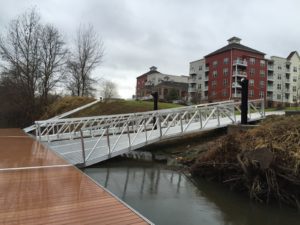
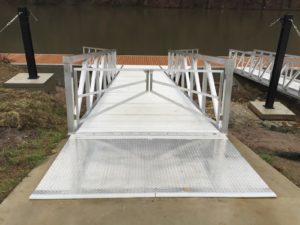
Conshohocken Rowing Center Gangway
Many competitors use bolt-together assemblies that reduce structural integrity and durability. BoardSafe’s railings are constructed with a free-span truss design, with exposed surfaces and welded joints that are smooth and free of sharp or jagged edges. BoardSafe gangways use stainless steel hardware to ensure long-lasting performance. The gangways stay cool to the touch and are built for harsh and high-use environments. Aluminum welds are able to withstand high winds and environmental flooding. The decking materials we offer are slip-resistant, using self-mating extruded aluminum or composite. These choices have proven the optimal choice for year-round access to frequently flooded areas and seasonal streams.
A video example of a 54’ custom gangway can be viewed here: Aluminum Floating Docks and Gangway at Riverside Dock
BoardSafe Docks was contracted to come up with a design for a new floating dock system on the Schuylkill River, across from Pottstown, PA, in North Coventry Township. The site included an existing boat ramp with signs of a previous dock system that had washed away in a flood years ago. The customer asked if BoardSafe could design a new dock system that would stand up to flood conditions. It also had to be ADA-compliant and not project too far out into the river.
BoardSafe’s solution was to evaluate the site conditions and design and manufacture and install a foundation that included a cantilevered deck that projected out over the river. A concrete foundation supports the cantilevered aluminum deck bolted into the foundation. The gangway is connected to the side of the deck and runs parallel to the river bank. Supplemental flotation was placed at the bottom of the gangway to provide adequate buoyancy for its weight and to maintain a freeboard of 16 inches, the same as the floating dock. The gangway is connected to the floating dock via a piano hinge. The hinge allows the dock system to move up and down as the water level fluctuates. The floating dock was made up of two 8’ x 20’ dock sections connected together with a piano hinge. Rubber dock bumpers and adjustable cleats were installed into the dock's custom aluminum extrusions. The components of the dock system include:
- 8’ x 10’ x 4’ concrete foundation supported by a rebar cage and driven steel pilings
- 8’ x 20’ cantilevered deck with aluminum frame and galvanized steel structural support members, composite deck boards
- 5’ x 54’ gangway with an expanded section at the top with non-skid aluminum decking
- 8’ x 40’ floating dock with 16-inch freeboard, manufactured in two sections
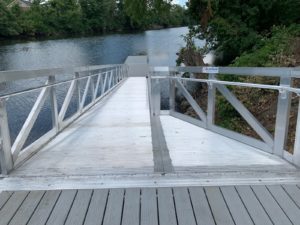
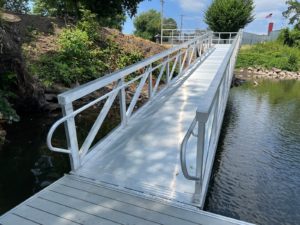
North Coventry Township, PA
Gangway design considerations
Understanding the type of gangway needed for a location can help determine the length and width of the gangway. Design concerns to keep in mind are the environmental conditions of the location and the durability and design life of the project. There is an inherent correlation between cost and the lifespan of an aluminum welded gangway. A gangway constructed of wood may be the least expensive option; however, it may only last a few years due to UV, water, and bug damage.
The following video is a site visit of a BSD aluminum gangway and adaptive kayak launch in Cleveland, OH, approximately one year after its installation. BoardSafe Docks engineered, built, and installed the unique ADA-inspired gangway and accessible launch system to make the waterfront accessible to adaptive paddlers.
East 55th Street Adaptive and Accessible ADA Kayak Launch by BoardSafe Docks
Why docks should be designed for accessibility
Designing docks for accessibility is important for several reasons.
Inclusion Making docks accessible allows individuals with disabilities to participate in water-based activities and access the recreational opportunities the water provides.
Safety An accessible dock is designed to provide a safe and stable environment for people with disabilities to board and disembark from boats. This can include features such as ramps, handrails, and non-slip surfaces.
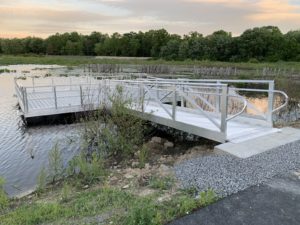
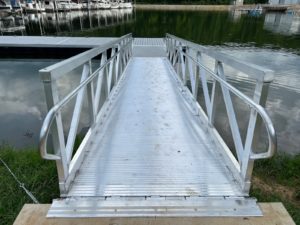
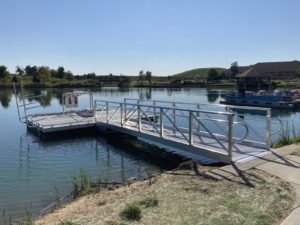
Minsi Lake, Mt. Bethel, PA Pickwick Lake, TN
Compliance with laws In the United States, the Americans with Disabilities Act (ADA) requires new construction and alterations of public accommodations, commercial facilities, and state and local government facilities, to be accessible to people with disabilities.
Cost-effective An accessible dock can be designed to be cost-effective. It can include features that are relatively easy and inexpensive to install, such as a ramp or handrails, and can be incorporated into the design of the dock.
Community benefit An accessible dock can benefit the entire community. It not only improves the recreational opportunities for people with disabilities, it also promotes a more inclusive community and encourages people of all abilities to enjoy the water.
Increase in visitors Making a dock accessible can increase the number of visitors to the area, because people with disabilities and their families and friends may be more likely to visit if the dock is accessible.
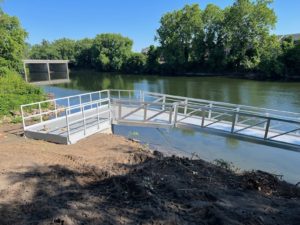
Voice of America Metroparks, OH North Coventry Twp, PA
Statistics from the World Health Organization (WHO), reveal that about 15% of the world's population, or more than 1 billion people, live with some form of disability. Of those, approximately 2–4% have a mobility impairment, which could make it difficult for them to access traditional trails, kayak launches, and other water access points.
Accessible designs benefit a significant portion of the population, including people with mobility impairments, and physical disabilities, older adults, and people with temporary injuries or similar conditions.
Gangways are important access areas for waterfront design and construction because they comply with ADA laws, allow people with disabilities to participate in water-based activities, promote a more inclusive community, increase the number of visitors to the area, offer safe access, and provide cost-effective options for community benefit.
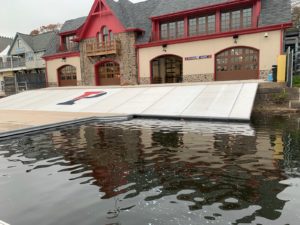
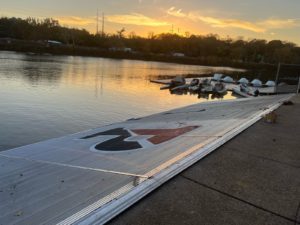
The University of PA Rowing Center The University of PA Rowing Center
BoardSafe Docks is also the expert for many Division I rowing centers and boathouses where specialty gangways are used to get racing sculls into the water safely and efficiently.
What length gangway do I need?
To help determine the gangway needed for your project, here are two articles that will guide you in determining the length of your gangway.
https://boardsafedocks.com/adaptive-launch/what-length-gangway-provides-handicap-access/
https://boardsafedocks.com/adaptive-launch/how-to-calculate-ada-gangway-length/
When your project requires structural integrity, non-polluting materials, corrosion resistance, strength, and safety, a BoardSafe gangway will meet your standards.
Explore your options with a BoardSafe aluminum-welded gangway, ramp, floating dock, kayak launch, fishing pier, or other water access products.
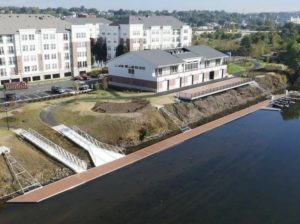
Conshohocken, PA, Rowing Center
BoardSafe Docks is a leading national manufacturer of high-quality aluminum-welded floating docks, gangways, fishing piers, kayak launches, rowing centers, pedestrian bridges, and other accessible water access products. Whatever type of access your project may need, BoardSafe Docks provides a turn-key service, from product design and inception through delivery.
BoardSafe’s sales team is available for questions and consultation and will assist you with finding your optimal waterfront solution. You may learn more about BoardSafe Dock’s projects through their website at BoardSafeDocks.com or by calling 610-899-0286.