


PFBC ACCEPTING APPLICATIONS FOR BOATING FACILITY GRANT PROGRAM
The Pennsylvania Fish and Boat Commission (PFBC) is excited to offer the next round of Boating Facility Grants to help communities capitalize on the surge in new boating activity.
A growing number of communities realize the positive social and economic impacts of having convenient boating access along their local waterways.
The Boating Facility Grant program provides grants for planning, acquisition, development, expansion, and rehabilitation of public boating facilities located on the waters of the Commonwealth. The PFBC encourages townships, boroughs, and municipal and county governments to apply. Nonprofit groups (501c3) including land trusts, conservancies, and watershed associations are also eligible to apply. Private businesses and service clubs are not eligible for direct funding but are encouraged to partner with their local county or municipality.
“Across Pennsylvania, momentum continues to grow around outdoor recreation as a whole, and the enthusiasm we’re seeing for recreational boating is incredible,” said Tim Schaeffer, PFBC Executive Director. “Participation in paddlesports, especially kayaking, has surged, and many communities are eager to accommodate families and individuals by adding or improving safe and convenient public access to the water. Funds awarded through this grant program can help communities develop projects, particularly projects that are accessible for all, to improve existing access areas or develop something new to serve local residents and attract recreational boaters to their communities.”
Applicants can seek grants for site acquisition, development, expansion, prevention of the spread of aquatic invasive species, and rehabilitation of recreational boat access facilities. Eligible construction projects may include, boat ramps, courtesy floats, restrooms, access roads, parking areas, and signs. Funds may also enhance the facility’s ADA compliance or add adaptive elements to the access site. Applicants are encouraged to keep accessibility for all in mind when developing their applications.
Funding requests require a 50% match. For the 2025 round of grants, the PFBC will accept applications from anywhere in the Commonwealth.
The deadline for applications is November 30, 2024.
For more information about the Boating Facility Grant Program and application form, visit the PFBC’s website at fishandboat.com/Transact/Grants/Pages/BoatingFacilityGrantProgram.aspx.
PFBC Accepting Applications for Boating Facility Grant Program
BoardSafe Docks, innovators in the planning, design, manufacture, and installation of adaptive and accessible floating docks and launches, is spreading the word that the PA Fish and Boat Commission is offering grants for improving public boating facilities on our waterways.
Grants have enabled many Pennsylvania parks and other venues to invest in BoardSafe's unique docks and launches, providing recreational opportunities for all community members.
HARRISBURG, Pa. (September 5) – As a growing number of communities realize the positive social and economic impacts of having convenient boating access along their local waterways, the Pennsylvania Fish and Boat Commission (PFBC) is excited to offer the next round of Boating Facility Grants to help communities capitalize on the surge in new boating activity.
The Boating Facility Grant program provides grants for planning, acquisition, development, expansion, and rehabilitation of public boating facilities located on the waters of the Commonwealth.
The PFBC encourages townships, boroughs, and municipal and county governments to apply. Nonprofit groups (501c3) including land trusts, conservancies, and watershed associations are also eligible to apply. Private businesses and service clubs are not eligible for direct funding but are encouraged to partner with their local county or municipality.
“Across Pennsylvania, momentum continues to grow around outdoor recreation as a whole, and the enthusiasm we’re seeing for recreational boating is incredible,” said Tim Schaeffer, PFBC Executive Director. “Participation in paddlesports, especially kayaking, has surged, and many communities are eager to accommodate families and individuals by adding or improving safe and convenient public access to the water. Funds awarded through this grant program can help communities develop projects, particularly projects that are accessible for all, to improve existing access areas or develop something new to serve local residents and attract recreational boaters to their communities.”
Applicants can seek grants for site acquisition, development, expansion, prevention of the spread of aquatic invasive species, and rehabilitation of recreational boat access facilities. Eligible construction projects may include, boat ramps, courtesy floats, restrooms, access roads, parking areas and signs. Funds may also be used to enhance the facility’s ADA compliance or by adding adaptive elements to the access site. Applicants are encouraged to keep accessibility for all in mind when developing their applications.
Funding requests require a 50% match. For the 2025 round of grants, the PFBC will accept applications from anywhere in the Commonwealth.
The deadline for applications is November 30, 2024.
For more information about the Boating Facility Grant Program and application form, visit the PFBC’s website at fishandboat.com/Transact/Grants/Pages/BoatingFacilityGrantProgram.aspx.
BoardSafe prides itself on developing a trusting and respectful relationship with its clients throughout the design and manufacturing process. Their team understands their products’ impact on communities and has witnessed their product designs improve lifestyles for the adaptive and recreation-loving communities they serve. They are proud of the partnerships they develop with their customers and appreciate the opportunity to develop their customers’ visions and turn them into legacies of waterfront inclusivity for generations to come. For more information, contact us at 610-899-0286 or through our website at BoardSafeDocks.com.
10 Considerations When Choosing a Floating Dock Builder
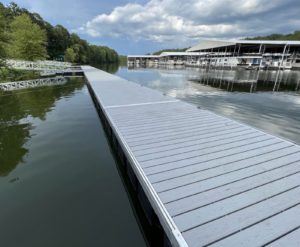
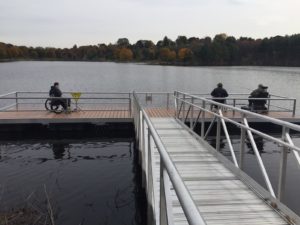
We have listed 10 considerations for prospective buyers to be aware of during the design, engineering, and manufacturing phase of their projects.
If you’ve decided to work with BoardSafe Docks for our industry expertise, you’ve made the right choice. Working with a dock builder you trust will strengthen your professional relationship and translate into a more pleasant building experience.
Following are some key points to learn and understand about the design, engineering, and manufacturing process.
Choose an experienced floating dock builder.
Customers prefer to select a dock builder with prior dock-building experience. Ask how long the dock builder has been doing this type of work. Visit completed dock projects to see what they look like after the installation, as well as jobs they completed five years earlier so you have an idea of their strength, durability, and performance over time. Speak with and review references from prior customers. Since no two waterfronts are ever the same, neither will be floating dock projects. Projects will always vary; therefore, successful prior experience will ensure you’re getting a quality product that lasts. Take the time to research completed projects and reviews before you hire your contractor. Your dock is more than a regular construction project, so don’t waste time with inexperienced or novice builders.
Communicate with your designer-dock builder.
A trusted dock designer will be one you can easily contact and communicate with. Do they respond to your phone calls and emails in a timely manner? Establish in advance your preferred method of communication and the frequency of communication and how payments will be made. Map out a schedule for updates regarding the progress of your project. Dock projects can take time to complete—from designing, engineering, and ordering materials, through fabrication.
Structural integrity of the dock design and materials
You can’t have a quality dock without quality materials! That means asking your floating dock designer about the best type of dock for your environment, its features, and their recommended materials. The kind of dock, its location, and the materials used, will tell you a lot about the quality of their product. If the designer tends to use a certain product or material, you can look up information about the company and decide if you think it’s a good fit. Purchasing a floating dock is a big investment that you want to last for many years to come.
The durability of an aluminum floating dock
Be sure to ask how your dock will stand up against various weather elements. Understand what type of maintenance will be required during the winter months, during changes in tidal conditions, and when there’s flooding or drought. This will reveal the considerations your designer needs to make for your dock regarding the local weather and demands of the waterway. Customers who experience any type of extreme weather, traffic, or tidal conditions, should ensure their designer prepares for it.
Project timeline for the floating dock
When it’s time to really get serious about your project, one of the critical questions you must ask is about your designer’s timeline. Try to zero in on a specific schedule and have some aspect of timeline expectations in your contract.
Site preparation prior to installation
Well before construction even begins, make sure your designer has the plan to protect and prepare your property for the dock’s installation. If trucks and other equipment must be driven through your yard, make sure you know how you want your dock builder to access your property from both land and water. Understand what site work may need to be completed prior to the installation of your floating dock system and who is responsible for that site work. Make sure it is completed prior to the arrival of your dock.
Permits for your water access project
Find out what regulations govern your property prior to starting any waterfront access project. Start with your town building code department and work your way up. Also check for the county, state, and federal regulations that might affect your property. Know who is responsible for obtaining your permits—your landscape architect, the engineer, the dock builder, or the property owner.
Unexpected change orders
There are always unintended changes that may arise during the construction of your project. Ask your designer what the process will be if changes to the design are necessary—especially if they will result in changes in cost. Make it clear that you want to know about changes and any additional costs in advance if necessary.
Consider the end goal early in your floating dock project.
It’s important to consider the entirety of your floating dock project at the start of your project. If you have questions, ask them. If you have your eye set on additional dock accessories, communicate that in advance. Customers who change their design ideas in the middle of the project need to expect additional costs and additional time for completion. These little steps can make a big impact on the timing of construction and your overall satisfaction with your completed boat dock.
Understand the warranty of your floating dock system.
Asking these questions will set you up for an extremely successful relationship with your dock designer. You’re much less likely to face setbacks and disappointments if you set up a good foundation of understanding from the beginning.
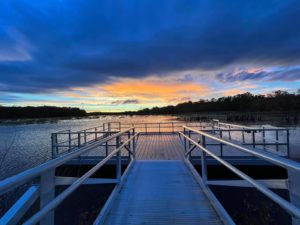
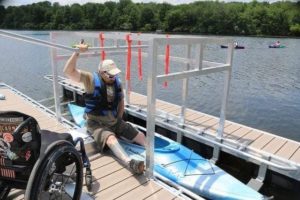
When you find a professional dock builder, ask if they provide annual maintenance packages for your floating dock system, especially if you live in an area where docks need to be removed for the winter months. If they do, it’s a good idea to establish a recurring maintenance schedule.
BoardSafe Docks understands the benefits and impact their floating dock systems offer to communities and park systems. Their inclusive launch is fitted for kayaks, canoes, and SUPS, and gets everyone in the water safely and easily. We know paddlers want close-to-home recreation; safe, easy, and inclusive access to the water; and the ability to connect their families to nature and their local community. BoardSafe’s fishing piers allow their users to enjoy the outdoors safely away from active boat launches and access points. Our floating dock systems for marinas enhance the ability to safely secure vessels in the water, allowing boaters to come onto land for dining and other recreational activities.
To discuss your project and create a water entry site that offers safe and easy access with inclusive and adaptive features, contact us at 610-899-0286 or through our website at BoardSafeDocks.com.
Available Grants for ADA Accessible & Adaptive ADA Kayak Launches
Local nonprofit, state, and federal grants are proliferating to increase outdoor accessibility with adaptive kayak launches and other ADA recreational products.
As many advocates and community groups seek to expand outdoor recreation opportunities and water access for those living with disabilities, or who have mobility challenges, funding and initiatives are becoming available to help secure investments in accessibility. If you are seeking to make your park, lake, river, stream, or other marina location ADA accessible with an adaptive kayak launch or fishing pier, then you may benefit from the following list.
Investing in accessibility can be expensive, but it is worth the time and effort. To help raise money more quickly or help decrease the financial burden on community groups, BoardSafe Docks has created a list of potential grant funding organizations to offset the cost of outdoor accessibility products like an adaptive kayak launch.
Please review the list of organizations and contact them directly to see if your project qualifies. If you know of an organization that could be added to our list, please contact us to submit the information. Together, we can expand the world of outdoor recreation for people of all abilities!
[table id=5/]
How Much Does a BoardSafe Adaptive Kayak Launch Cost?
One of the first questions our customers ask is, “How much does a BoardSafe Adaptive Kayak Launch cost?”
Let me explain some of our general pricing guidelines and the different components of our launch that directly affect pricing. The purchase of an adaptive kayak launch is much like the purchase of a vehicle or even a home — With so many options available, price ranges can vary depending on the options you select. Like a car, you’ll want to select the options that will make your excursions safe, comfortable, and easily accessible.
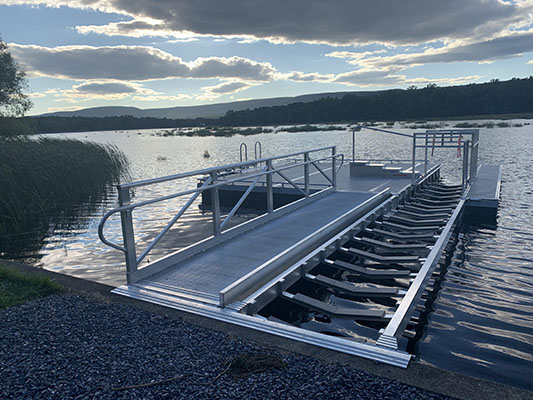
BoardSafe Docks manufactures a number of standard-size kayak launches, gangways, chutes, and floating docks. These components can be arranged in countless configurations to meet the site conditions and needs of our customers.
Click here to view the different kayak launch layouts that will affect your pricing.
There are 20 different configurations that BoardSafe Docks has put together to meet customers' unique needs and to ensure usability for adaptive paddlers. Our goal is to make sure our launch system provides the necessary features that accommodate the widest range of user abilities. We’ve evaluated hundreds of launch sites and have learned what’s needed to enable our customers to safely and easily access their vessels and get out onto the water.
BoardSafe’s sales team members are available to evaluate your waterfront and make recommendations about the launch system that will work best for your application and your intended users. After your site has been evaluated, our sales professionals will guide you on the layout that will be the best option for your users and your access point. They will also assist you with budgetary numbers for your site’s design.
Can I save money by purchasing a BoardSafe Kayak Launch system now and adding the adaptive kit when additional funds become available?
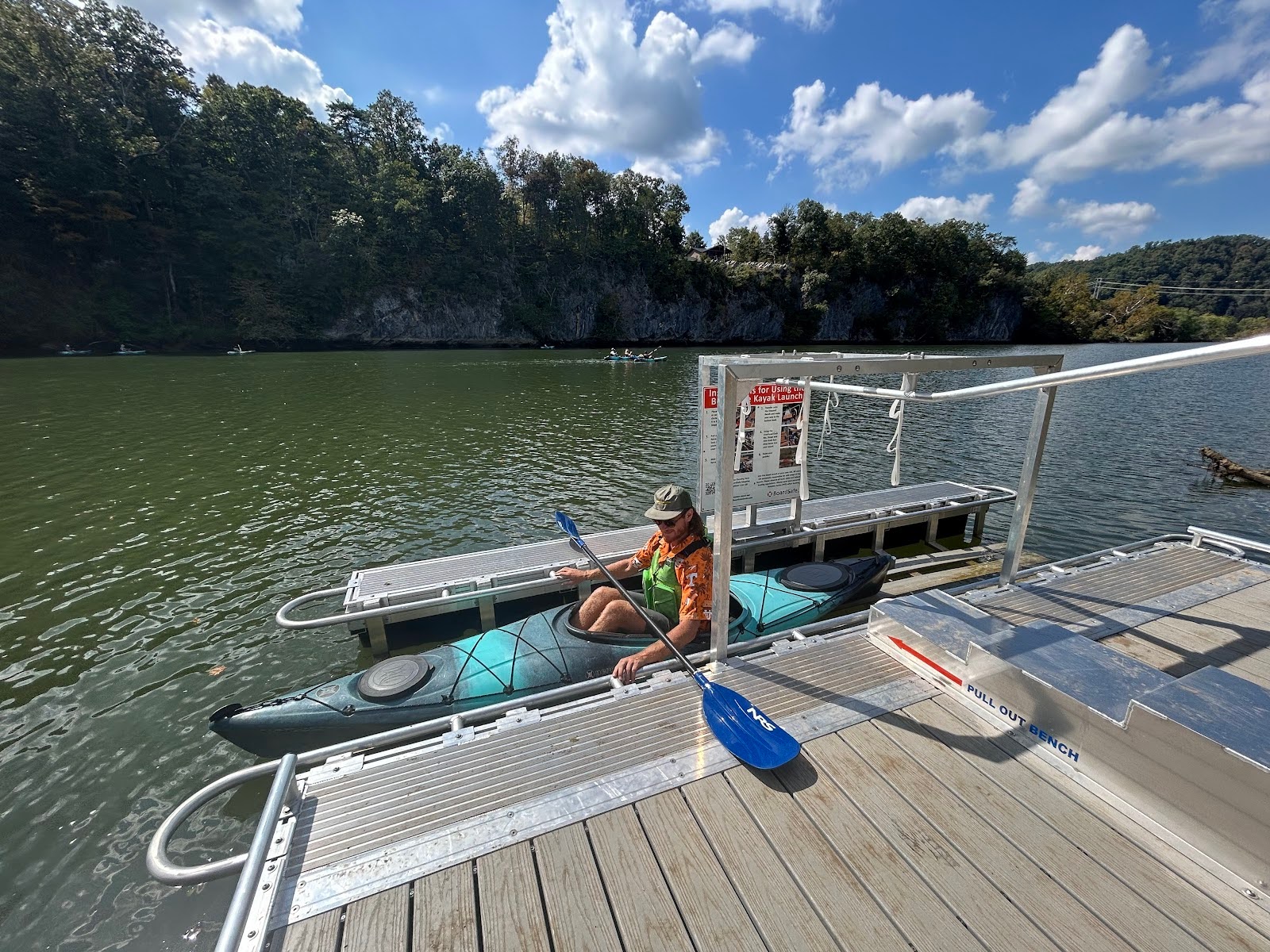
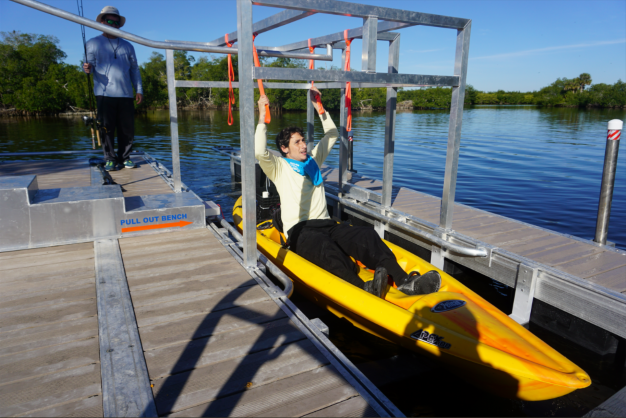
The BoardSafe Adaptive Kayak Launch has features that can be purchased separately or together. These features include the gangway and accompanying kayak chute, floating dock, adaptive kit (step-down bench, overhead roll cage with grab bars and straps, and signage), saddle launch or Clip-a-Launch. Each of these components can be personalized to your launch site with the features you find most important for the safety and accessibility of your identified users. The launch can be designed for the components in the adaptive kit to be added at a later time.
To keep the initial cost down, the kayak launch can be purchased with or without the Adaptive Boarding Kit (bench with pullout seat, overhead grab bar with hand straps, and instructional signage).
The length of the gangway and accompanying kayak chute is another feature that will affect pricing. Depending on the location and placement of the floating dock, the gangway and chute will be designed in varying lengths. The floating dock structure of an adaptive kayak launch needs a minimum water level of 18 inches in order for the encapsulated floats to remain floating in the water so the gangway, chute, and floating docks are not sitting in the mud.
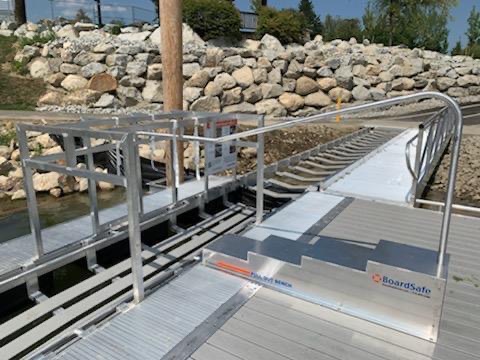
This is one of the reasons that BoardSafe Docks offers multiple solutions and layouts. Their design capabilities will assist you with choosing the best configuration.
How quality and longevity affect the cost of a BoardSafe Kayak Launch system
BoardSafe launches are manufactured using aluminum welded frames, composite deck lumber, encapsulated flotation, and proprietary extrusions that make their system durable and able to withstand the test of time. Our launches are also designed to be used with canoes and stand-up paddleboards, making their versatility very desirable for many user groups.
The approximate price range of these configurations is between $30,000 and $55,000, depending on the size and options you select.
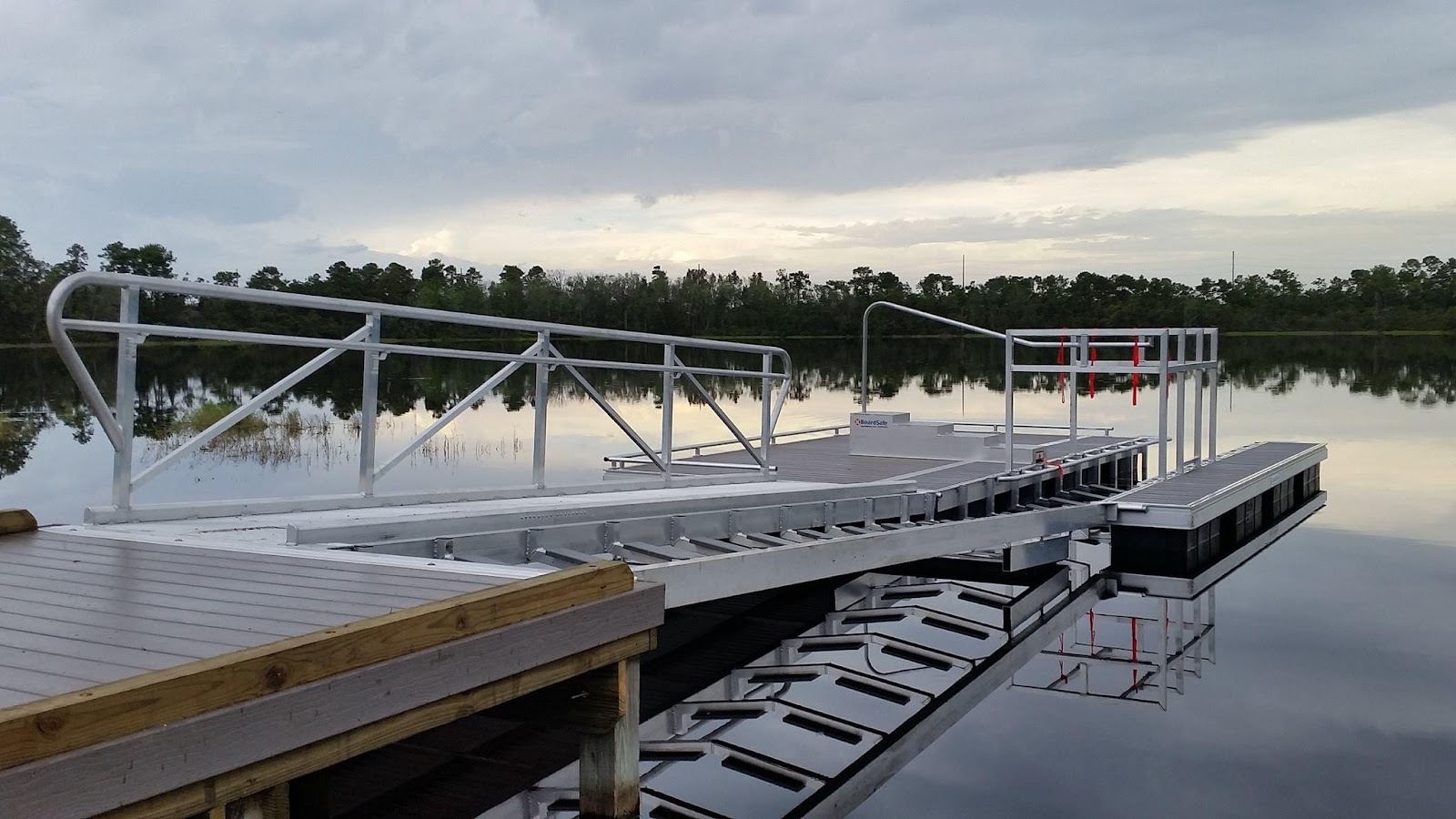
BoardSafe understands that you want your kayak launch to be around for a long time — longer than you might keep your car, and possibly as long as you plan to live in your home. Picking the right kayak launch with the right options and configuration the first time is critical to ensure maximum enjoyment with minimum maintenance. Because of this, most of our customers end up selecting the launch that will make them happiest in the long run.
Unfortunately, when customers only focus on the price of the kayak launch and are solely focused on finding the cheapest launch, they also sacrifice quality, warranty, low maintenance, and aesthetics. This can inevitably lead to regret — especially considering that, unlike a vehicle, a kayak launch cannot be traded in when someone is dissatisfied and disenchanted with their product or performance.
BoardSafe Docks is a trusted expert in the location, selection, site work, design, engineering, manufacturing, and installation of floating docks, fishing piers, gangways, pedestrian bridges, rowing centers, marinas, and the BoardSafe Adaptive Kayak Launch.
Our adaptive launch provides a truly accessible experience for the adaptive paddler as well as all able-bodied paddlers. To discuss your project, and for assistance with finding your optimal waterfront solution, please call 610-899-0286 or visit us at BoardSafeDocks.com.
How Much Does an Adaptive Accessible Kayak Launch Cost?
Across the nation, many people — from park rangers to city engineers — are seeking to improve access to their local community’s water and marine features. This is an extension and outgrowth of the Americans with Disabilities Act (ADA), with the objective to provide access for all abilities to all amenities. Access to nature for the disabled has been long overlooked, but now parks, towns, and clubs are clamoring for ADA-accessible picnic tables, bathrooms, and walking trails, as well as adaptive kayak launches.
With any new product, one of the first questions asked is, “How much does it cost?” The appropriate answer is almost always, “Well, that depends!” So, how much does an adaptive or accessible kayak launch cost? The answer is inevitably found within the range of quality, features, and durability. This can mean a few hundred bucks for an accessory to bolt onto an existing wood dock or tens of thousands of dollars for an elaborate commercial-grade adaptive floating kayak launch and dock system.
System vs. Accessory
A quick Google search finds accessibility accessories to attach to existing docks. The less expensive the item, the less utility it offers to those with a disability. Hanging a large hook from an algae-encrusted wooden dock to stabilize a kayak is not helpful to individuals who are unstable on their feet. It may be useful to hold the boat for Grandma or a daredevil teen, but it is not suitable for one with mobility challenges. As the price for those bolt-on accessories increases, so do the engineering and thought put into the design of the part to ensure safe and easy transition in and out of vessels.
An accessory’s usefulness is contingent upon the quality and durability of the existing dock to which it is attached. For example, a BoardSafe Clip-a-Launch can be bolted onto the aluminum frame of an existing rigid or floating dock, and costs a few thousand dollars. Depending on the range of abilities of the users, a Clip-a-Launch alone may not suffice to assist paddlers in and out of boats. A person’s needs may require additional bars, straps, a transition bench, and other adaptive features to enable the paddler to easily enter and exit their craft. These features can be added to an existing dock, and are also sold as a package or full adaptive kayak launch system.
A fully-accessible or adaptive launch system is not an accessory that can be attached to an existing dock. The best option is, depending upon the need, a floating dock, gangway, and other accessories that facilitate water access.
Adaptive Kayak Launch System Features
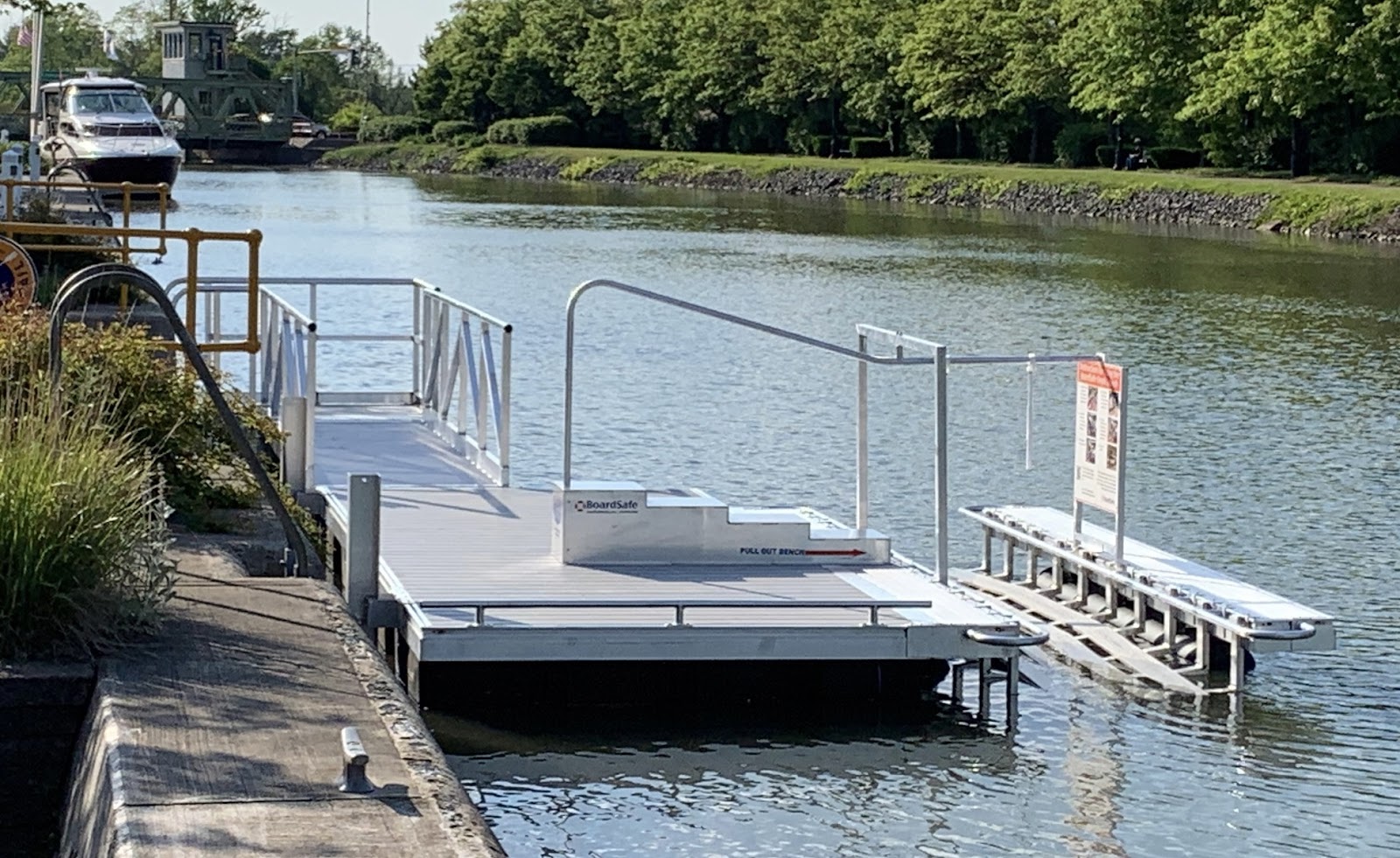
The gangway must offer an adaptive paddler a way of moving the kayak from the land to the launch area and vice versa. The gangway should have a maximum pitch of 1/12 (meeting ADA slope requirements and features) and a parallel boat chute where the vessel is placed in alignment with the kayak launch.
The chute and launch area should be large enough to accommodate kayaks with outriggers. However, it shouldn’t be too wide or it will create too great a distance between the boarding bench and the cockpit of the vessel.
Ample space on a floating dock As the paddler rolls up to the bench to begin the transition from the chair into the cockpit, sufficient space is required to maneuver the wheelchair, especially if there is more than one adaptive paddler leaving their chairs on deck. The floating dock should also have a toe kick around the perimeter as an added safety feature. This prohibits a wheelchair from accidentally rolling off the dock into the water.
A tiered bench allows the user to easily transfer from the wheelchair. The top step of the bench must be equal to the height of a wheelchair in order for the user to transition from their wheelchair over to the bench. The steps should be minimal in height (approx. 3”) to allow the paddler a small shift from step to lower step.
The bench must be equipped with a pull-out seat that slides out over the kayak and directly above the vessel’s cockpit. This allows the adaptive paddler to slide down into the vessel with a limited drop and shimmy himself or herself into their kayak.
The roll cage must provide support for an overhead grab bar as well as optional hand straps. Adaptive paddlers have varied upper-body strengths and varied preferences as they enter and exit their vessel. Some paddlers prefer the grab bar while others prefer the hand straps. There should be no obstructions on either side of the step-down bench, allowing the paddler to choose the side they prefer and are most comfortable using to navigate down the bench.
The pull bars on either side of the launch must be at the right elevation and distance from the paddler, making it comfortable and easy for a disabled paddler to pull himself or herself down the chute and into the water.
Stabilization saddles and launch area Too often, the launch area is sloped and includes rollers. When a kayak, canoe, or SUP, is placed into the launch, gravity will dictate the action of the vessel. If a kayak is not level in the chute, it will roll into the water and will not remain securely in place for the disabled paddler to board or disembark from. Remember, the design needs to accommodate the return of paddlers as well, and rollers can actually make this condition worse because they prevent the vessel from sitting securely and remaining in place. The width of the launch area is also a factor — if it is too wide, it makes it more difficult for a paddler to make their way from the step-down bench in order to transfer into their vessel.
Quality and Durability
With most products, value is inevitably determined through quality products enduring the test of time. Most entry-level accessible kayak launches consist of molded plastic floating docks and accessories with some metal features. While they may not be as aesthetically pleasing or able to survive severe storms, they are an affordable way to test the waters (so to speak), launch a program, and engage new paddlers without a large investment. These launches require regular maintenance and have a short product life. For organizations that desire a high-quality adaptive kayak launch and have the budget to match, a BoardSafe kayak launch system should be considered.
BoardSafe’s entire system has been engineered for paddler performance and product durability. This includes commercial-grade aluminum, stainless steel, weather-resistant and slip-proof composite decking, encapsulated floats, and many other design features that facilitate safe transfer in and out of the water. These systems last for many years and are the preferred products of clients who don’t want to remove the docks in the winter or who have fluctuating water levels or who are susceptible to heavy storms.
Accessible vs. Adaptive
Although often used interchangeably, the terms “accessible” and “adaptive” are distinct and need to be properly understood. In the traditional sense, “accessible” denotes something that is easy to get to, where barriers such as steps have been removed. It can also include features stipulated by ADA guidelines, like a 1:12 gentle pitch, specific height handrails, and alternative handrails. Accessible launches are great for able-bodied kayakers, beginners, children, seniors, and people with minor limitations like joint issues, arthritis, and developmental delays. An accessible launch may even work for a small number of paddlers with moderate disabilities. However, for adaptive paddlers with greater mobility challenges, an accessible launch alone does not meet their full range of needs, and will not get them into the water safely or easily.
An “adaptive” launch is an enhanced accessible launch. Adaptive kayak launches are engineered and designed with features that accommodate paddlers of all abilities. The adaptive kayak launch designed by BoardSafe Docks was created based on the input of physical and occupational therapists and adaptive paddlers. Adaptive kayak launches are feature-rich to empower all users to overcome any mobility challenges.
Value
Many kayak launch buyers determine the value of a kayak launch relative to its ability to assist a number of paddlers over a period of time. Most people are aware that a product that outlasts a similarly-priced product offers greater value. In a similar way, but often overlooked, a product that accommodates a greater number of users will offer more benefit to more people, and therefore be more valuable. Feature-rich adaptive launches could help three or four times the number of users than a standard accessible launch. Each potential buyer needs to calculate this cost of ownership and return on investment. Many buyers go beyond the basic quantifiable measures of determining a kayak launch’s value, because helping those who live with the most severe handicaps is priceless. Some inferior accessible launches keep many with mobility issues from even considering their use, but allow an organization to check off the “ADA” box. On the other hand, those who desire to empower all users — especially those who typically do not enjoy life’s simple pleasure of roaming access — do not equate an adaptive launch’s value to the ROI because helping those in our communities with the greatest needs is, as they say, priceless.
To discuss your project and evaluate BoardSafe’s adaptive kayak launch options, contact us on our website or call 610-899-0286.

BoardSafe Is a Member of PA COSTARS' Purchasing Program
BoardSafe is a participant in the Pennsylvania COSTARS Cooperative Purchasing Program. COSTARS is the Commonwealth of Pennsylvania's cooperative purchasing program that serves as a conduit through which registered and eligible local public procurement units and state-affiliated entities are able to leverage contracts established to cost-effectively and efficiently identify suppliers with whom to do business. This streamlines the purchasing process for both sides.
The COSTARS Program's goal is to provide members with contracts that are competitively priced while delivering increased opportunities for our supplier and member partners.
Membership in COSTAR facilitates the purchase of supplies, services, and construction by entities that spend public funds, such as a council of governments or an area government, or an organization that receives public grant funds.
COSTARS suppliers, such as BoardSafe, must demonstrate high standards of responsibility and responsiveness. Many purchasers use a shortlist of preferred suppliers that they know they can depend on to deliver the goods in a timely manner and at competitive prices. Amazing customer service plus competitive pricing will go a long way to winning a member’s project!
Government agencies large and small, up and down the East Coast, have found BoardSafe to be a reliable supplier of the finest aluminum floating docks, gangways, adaptive kayak launches, and other marine recreation products. We have lived up to their COSTARS standards and reputation.
Other clients, from private citizens to boating and kayak clubs to public schools and universities, have relied on the trusted BoardSafe name.
For more information, contact us at 610-899-0286 or continue to browse our website, especially our Projects page.
Grants Make Outdoor Recreation More Accessible
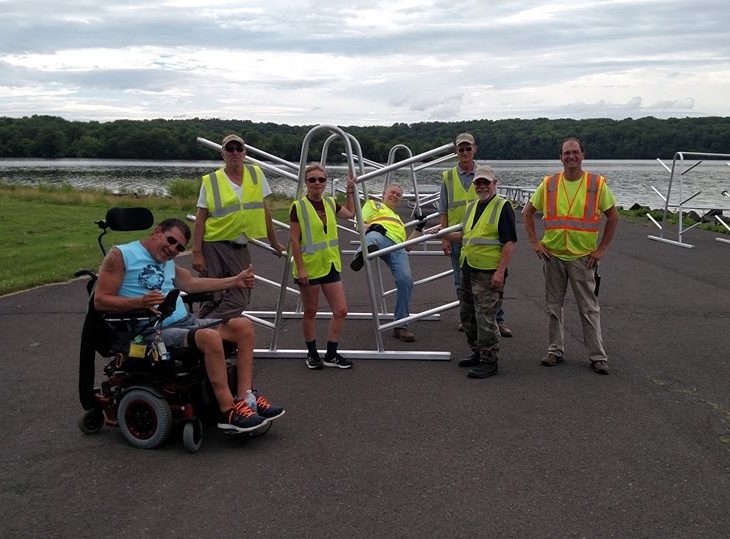
Adaptive and wheelchair sports have been growing dramatically over the last few years, especially with the influx of an estimated 10,000 veterans and active service members now participating in adaptive sports. The interest in the Paralympic Games has also led to sports fitness facilities built especially for wheelchair and adaptive athletes. Many state and local governments and park services are revisiting their recreational facilities and offering funding, grants, and other incentives, to plan, develop, and implement programs to open access to handicapped individuals who want to enjoy the same sports and recreational opportunities as others.
One example is the city of Reading, Pennsylvania. The Pennsylvania Department of Conservation and Natural Resources is working on a multimillion-dollar recreation plan to help cities improve their outdoor all-accessible facilities for adaptive athletes. You can read about it here.
PDCNR Secretary Cindy Adams Dunn says, "They're cooped up at home. Perhaps they're doing their learning from home. Perhaps they're working from home. People are confined in tight spaces," Dunn said. "One thing that was deemed essential from the beginning was time outdoors."
BoardSafe is grateful to be a part of so many plans to help our handicapped citizens enjoy a fuller life.
Applications Open for Community Organizations to Apply for Millions in Adaptive Sports Grants
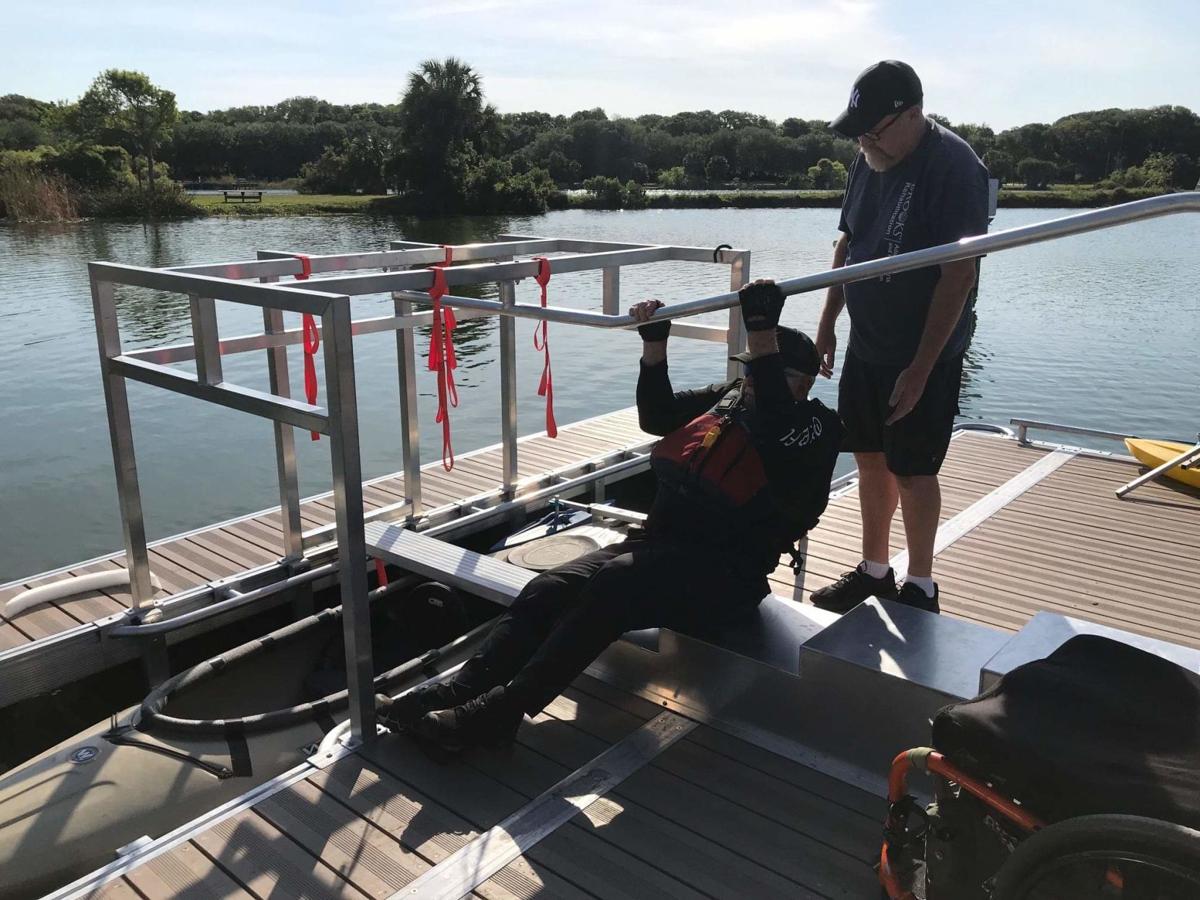
The U.S. Department of Veterans Affairs (VA) is accepting applications through March 17, 2020, for up to $15 million in grants for civic groups providing adaptive sports and therapeutic recreational opportunities to Veterans and members of the armed forces with disabilities.
BoardSafe has the experience, trust, and expertise to design, deliver, and install ADA-compliant adaptive water products for every need. Click here to read about our exclusive features.
Application instructions and eligibility information for these grants — that will help qualified organizations plan, develop, manage, and implement these programs — are available at VA Adaptive Sports Grant Program.
“Built on VA clinical expertise and operations, with essential support from community partners, the adaptive sports grant program allows VA to extend its level of care beyond the clinical setting,” said VA Secretary Robert Wilkie. “We are pleased to offer grant funds to community organizations as it means there will be more Veterans engaging in the challenge of sports and more Veterans who are exposed to new skills for healthier living.”
In 2019, the VA awarded $14.9 million in adaptive sports grants to 126 organizations, estimated to serve more than 11,000 veterans and service members from every state, the District of Columbia, and Puerto Rico. Of the total awarded, $1.5 million is being used to assist organizations that offer equine-assisted therapy to support mental health.
All applications must be submitted to www.grants.gov by 8 p.m. EST, March 17, 2020. The VA will announce awards based on a competitive selection in fall 2020.
BoardSafe Manages All Shipping Details

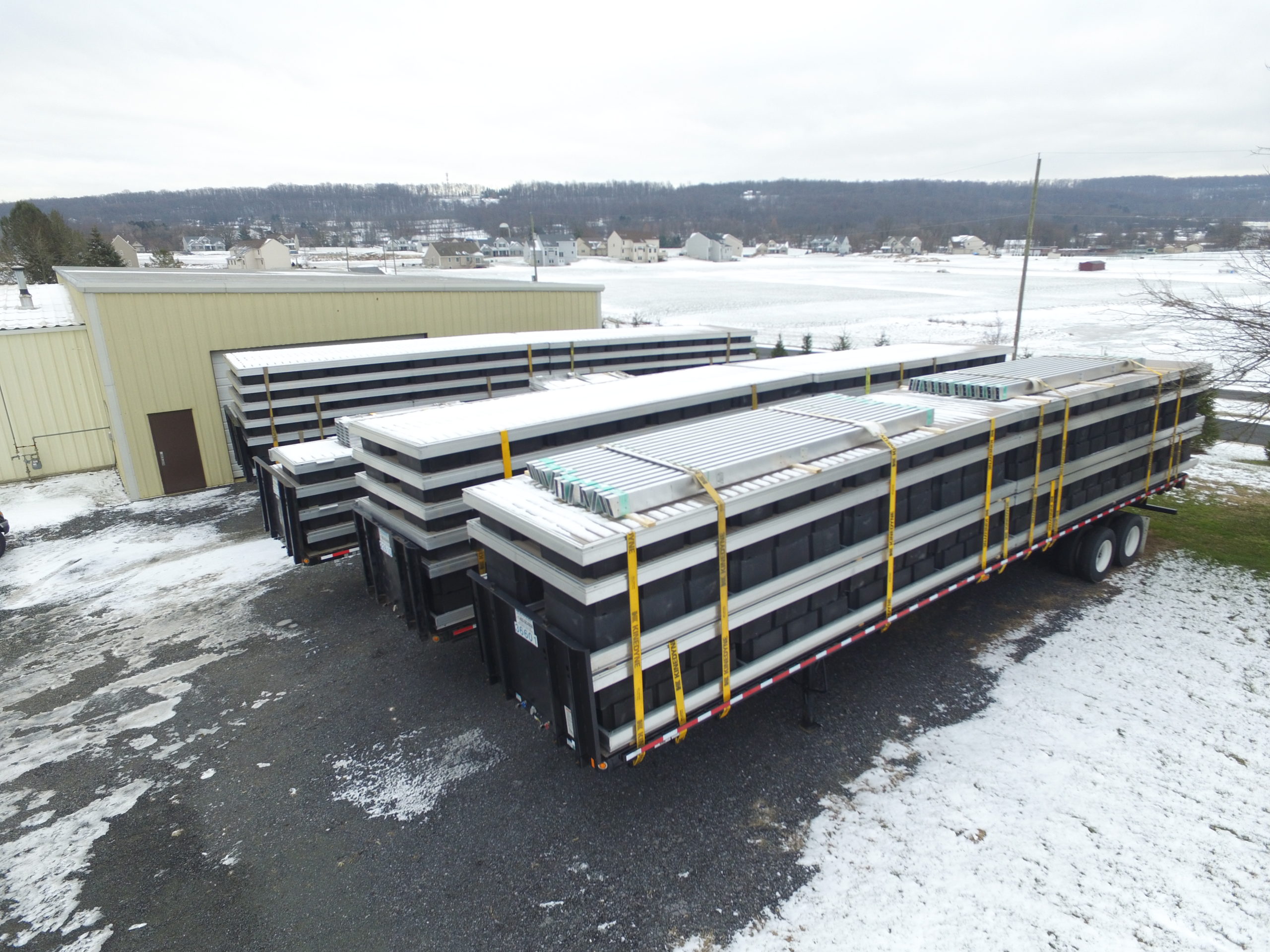
As you can imagine, shipping tons of materials to any site, near or far, can be complicated. With BoardSafe, clients don't need to worry — we take care of all the shipping details.
Just one example is our large rowing center project in Austin, Texas. The main dock will be 15,000 square feet and will house two 3,000-square-foot boathouses. These boathouses will store rowing equipment and gear right on the dock. A total of 5 trucks will carry the materials from our manufacturing center to the site in Austin, Texas.