

BoardSafe News at the Mariners' Museum, Newport News, VA
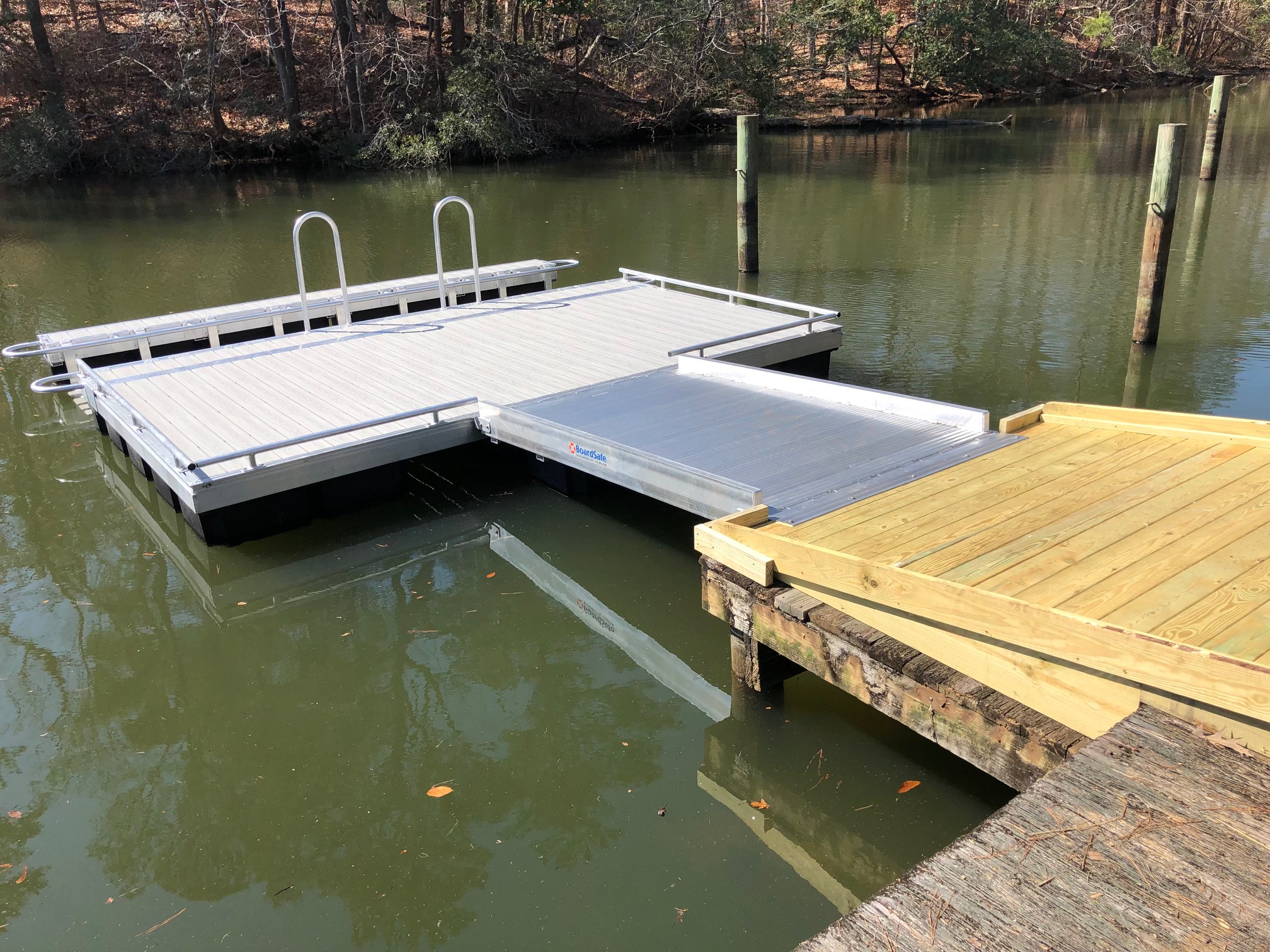
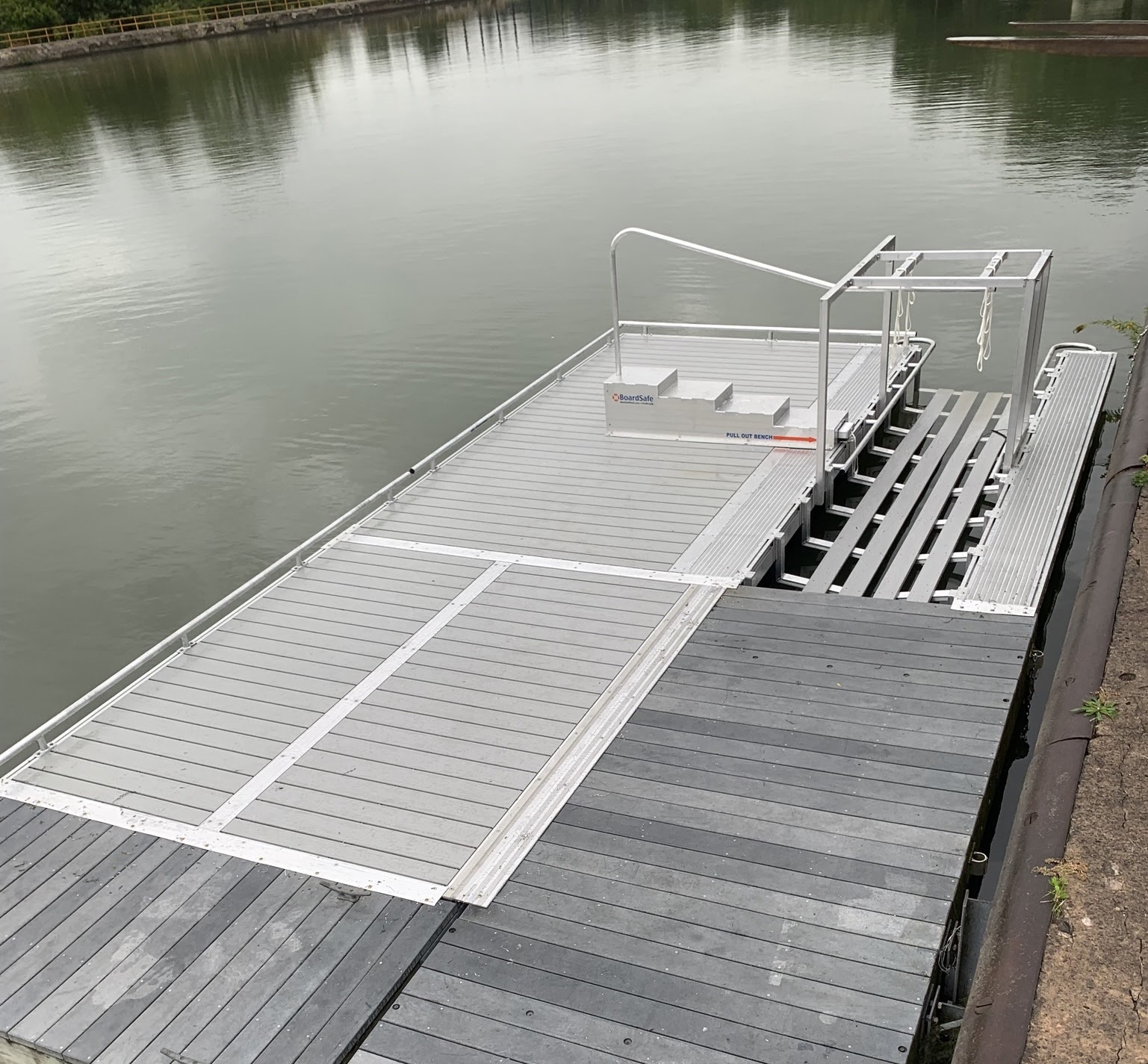
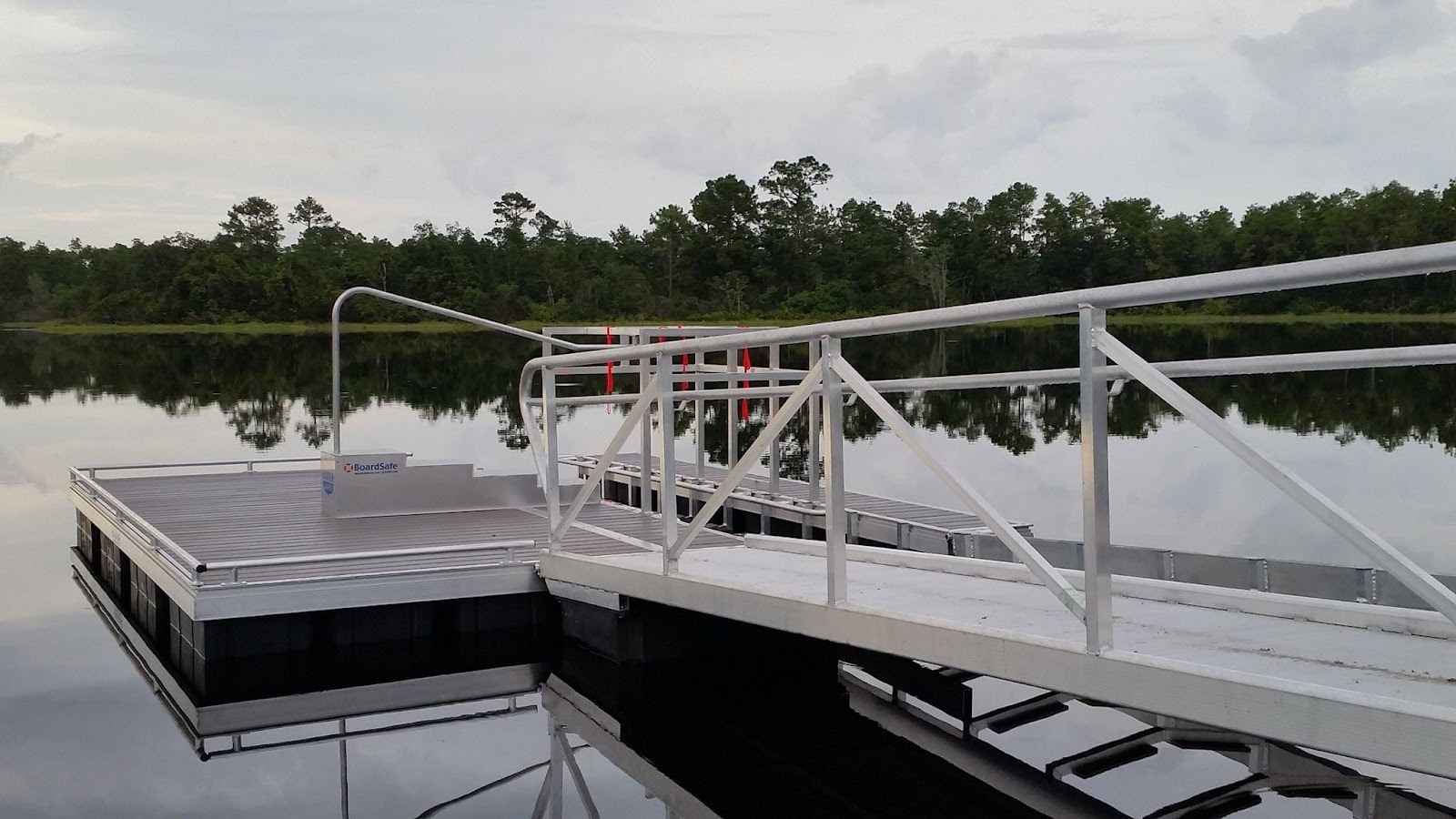
In early March of 2022. the following project was installed at the Mariners’ Museum in Newport News, VA. The client had a fixed pier with steps that lead to a floating dock. The floating dock was removed and a new pressure-treated ramp was installed by the customer on top of the pier, which then provided ADA-compliant egress to the dock. We then added an 8-foot-by-5-foot gangway, 8’ x 16’ floating dock, and Clip-a-Launch 16D (without an adaptive boarding kit). The cost of this project was approximately $27,000.00 (manufacturing only).
Are "Accessible" Kayak Launches All Truly "Adaptive"?
The radiant sun presided over the springtime rejuvenation and the songbirds cheered the eager kayakers as they slipped into their boats. It was harmonious: camaraderie on the Erie Canal and oneness with nature — at least for all but one paddler in the group.
Of the kayakers, Ken Ryno was the only adaptive paddler. A dirt bike accident at the age of 18 shattered his lower vertebrae, as well as his ability to enjoy the outdoors — or at least he thought. Medically classified as a C5-C6 Incomplete Quadriplegic, Ken pieced his life back together into a beautiful mosaic of perseverance and grit, living life to his fullest potential.
Ken is paralyzed from the chest down, but maintains the use of his upper body and arm strength. After hundreds of hours of rehab, in addition to dedication in the gym, Ken is an avid fisherman, wheelchair basketball player, and hunter. Ken is an inspiration to all who know him, but unfortunately, what most restricts him is not his own physical limitations, but rather a lack of accommodations available to him. In many cases, simple adjustments — like an additional handle on a product or increased open space around another — are the difference between participation and exclusion.
So, this is how he found himself on a spring day in Upstate New York: frustrated, embarrassed, and lamenting the lack of a few additional adaptive features — ironically, on the accessible kayak launch that stood between him and his favorite hobby.
In his love for kayaking, Ken is not alone. The nonprofit Outdoor Foundation tracks participation levels for outdoor activities and reported that paddlesports like kayaking, canoeing, and stand-up paddleboarding, have propelled forward over the past decade.

Not surprisingly, the COVID pandemic drove many people outside, seeking to distance themselves from others and commune with nature. This has allowed Americans to re-discover the great outdoors, the benefits of physical and mental health, and also feel the joy provided by reconnecting with nature.
While this is common knowledge, not all segments of society pursue paddlesports for a multitude of reasons. In an attempt to lower the barriers of participation, many organizations, like the American Canoe Association and ASLA (American Society of Landscape Architects), have created committees devoted to Diversity, Equity, and Inclusion. It is no wonder that many adaptive paddlers like Ken describe the freedom of leaving their wheelchair and transitioning into a kayak as “liberating.”
Specifically for those with disabilities, paddlesports offer a unique experience to holistically enrich individual lives in ways that other activities cannot. “For many, paddling is a new sport and frontier for people to enjoy, to encourage one another, and have fun,” says Joe Morini, president of Team River Runner (TRR), a national nonprofit whose purpose is to “provide all veterans and their families an opportunity to find health, healing, community purpose, and new challenges through adventure and adaptive paddle sports.” Since its inception in 2004, TRR’s growth to 75 chapters and tens of thousands of paddlers is evidence of paddling’s appeal.
Clinicians have also been drawn to paddling. Occupational Therapist Alice Krauss, Manager of the Adaptive Sports and Recreation of Brooks Rehabilitation in Jacksonville, a health network of 50 outpatient rehabilitation centers and a 160-bed inpatient rehabilitation unit, recognized a gap in the health care system. She wanted to create meaningful activities that promote better health, integrating mind, body, and spirit. She observed that insurers allowed patients less time in rehab services and that discharged patients were ill-prepared to maintain their gains. Patients found themselves socially isolated and with declining activity levels.
“We looked into sports and recreation programming to attract patients to activities, build social connections, and provide a sustainable community to empower participants.” Brooks’s Adaptive Sports Program was born in 2007, and the program has continued to grow over the last 15 years with the adaptive paddling sessions “selling out” each month.
“What I most love about kayaking is that when we are out on the water, we are all on the same level, looking eye-to-eye. I don’t need to look up at my friends, nor do they look down on me,” says Ken, speaking in both literal and figurative terms. While there has been a steady increase in ADA accessibility at public parks and recreational facilities, the number of ADA access points needs to be increased.
Equally and arguably more important than the quantity of access points — and the central thesis of this article — is the quality of each installation. “Many times, even if a location is deemed ‘handicapped accessible,’ many who live with physical disabilities like myself still cannot use it,” explained Ken, in reference to a variety of public spaces from restaurants and hotels to retail stores.
Ironically, most accessible products and applications designed for those with handicaps are created by able-bodied people. Despite these good intentions, if gaps in equity, inclusion, and diversity are to be bridged, then the best solutions should come from those who experience the challenges.
“Accessible” and “Adaptive” are not synonymous
Although mistakenly used interchangeably, the terms “accessible” and “adaptive” are distinct and need to be properly understood. In the traditional sense, “accessible” denotes something that is easy to get to, where barriers such as steps have been removed. It can also include features stipulated by ADA guidelines, like a 1:12 gentle pitch, specific height handrails, and alternative handrails.
Accessible launches are great for able-bodied kayakers, beginners, children, seniors, and people with minor limitations like joint issues, arthritis, and developmental delays. An accessible launch may even work for a small number of paddlers with moderate disabilities. However, for adaptive paddlers like Ken, members of Team River Runner chapters, and disabled veteran and wounded warrior groups, an accessible launch alone does not meet their full range of needs, and will not get them into the water safely or easily.
An “adaptive” launch, in turn, is an enhanced accessible launch. Adaptive kayak launches are engineered and designed with features to accommodate paddlers of all abilities, whom Ken Ryno would characterize as “differently-abled” paddlers. The adaptive kayak launch designed by BoardSafe Docks was created based on the input of Ken and several of his paddling peers.
Lead designer of the adaptive kayak launch was BoardSafe president Scott Tihansky, who was astonished by the group’s feedback. “As able-bodied people, we overlook numerous and seemingly trivial aspects of getting in and out of a boat and fail to understand how they may pose challenges to adaptive paddlers. Hearing the group’s feedback was eye-opening, and we are able to solve the issues with design changes.”
Based on the group’s feedback, an adaptive kayak launch that will serve the widest range of paddlers should include the following features:
In order to access the adaptive launch, an egress that allows for wheelchair travel must exist from the parking lot to the kayak launch site.
The gangway must offer an adaptive paddler a way of moving the kayak from the land to the launch area and vice versa. The gangway should have a maximum pitch of 1/12 (meeting ADA slope requirements and features) and a parallel boat chute where the vessel is placed in alignment with the kayak launch.
The chute and launch area should be large enough to accommodate kayaks with outriggers. However, it shouldn’t be too wide or it will create too great a distance between the boarding bench and the cockpit of the vessel. If a launch is too wide, it will decrease the stability needed for a disabled paddler to get into their vessel.
Ample space on a floating dock. As the paddler rolls up to the bench to begin the transition from the chair into the cockpit, sufficient space is required to maneuver the wheelchair, especially if there are more than one adaptive paddler leaving their chairs on the deck. The floating dock should also have a toe kick around the perimeter as an added safety feature. This prohibits a wheelchair from accidentally rolling off the dock into the water.
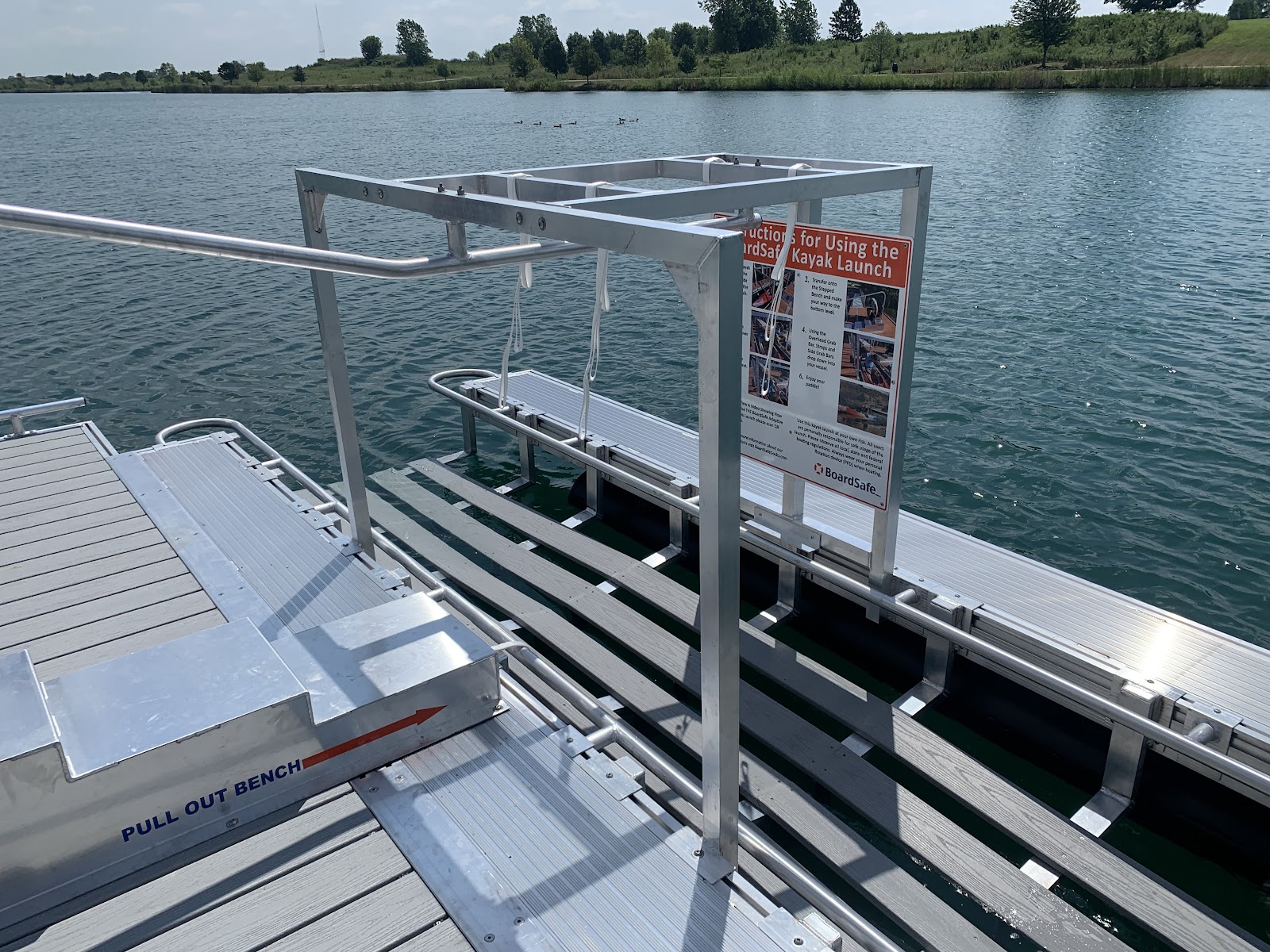
A tiered bench to allow the user to easily transfer from the wheelchair. The top step of the bench must be equal to the height of a wheelchair in order for the user to transition from their wheelchair over to the bench. The steps should be minimal in height (approx. 3”) to allow the paddler a small shift from step to lower step.
The bench must be equipped with a pull-out seat that slides out over the kayak and directly above the vessel’s cockpit. This allows the adaptive paddler to slide down into the vessel with a limited drop and shimmy himself or herself into their kayak.
The roll cage must provide support for an overhead grab bar as well as optional hand straps. Adaptive paddlers have varied upper-body strength and varied preferences as they enter and exit their vessel. Some paddlers prefer the grab bar while others prefer the hand straps. There should be no obstructions on either side of the step-down bench, allowing the paddler to choose the side they prefer and are most comfortable using to navigate down the bench.
The pull bars on either side of the launch must be at the right elevation and distance from the paddler, making it comfortable and easy for a disabled paddler to pull himself or herself down the chute and into the water.
Stabilization saddles and launch area. Too often, the launch area is sloped and includes rollers. When a kayak, canoe, or SUP, is placed into the launch, gravity will dictate the action of the vessel. If a kayak is not level in the chute, it will roll into the water and will not remain securely in place for the disabled paddler to board or disembark from. Remember, the design needs to accommodate the return of paddlers as well, and rollers can actually make this condition worse because they prevent the vessel from sitting securely and remaining in place. The width of the launch area is also a factor, if it is too wide it makes it more difficult for a paddler to make their way from the step-down bench in order to transfer into their vessel.
Often, kayak launches are touted as “ADA launches” or “ADA compliant,” but current ADA guidelines do not apply to marina applications like kayak launches. What is correct is that kayak launches have design features that are borrowed from ADA guidelines as they apply in terrestrial applications. This makes the launches friendlier to use, but it reveals a lack of standardization, opening the door for the subjective interpretation of a kayak launch to be adaptive or accessible.
Regardless, it is agreed that adaptive paddlers should be given every opportunity, and feature to safely and easily enjoy paddlesports. “We’ve seen what has been touted as an ‘ADA accessible’ dock and it is the furthest thing from it -- what a joke,” says Kimery Duda, Founder and Director of The Expedition School in Austin, TX.
The Expedition School seeks to give students and adults outdoor experiences that transform their lives. Currently, Kimery is designing a world-class adaptive dock and launch system for their location. Her approach and advice to others seeking to build accommodating facilities is, “It is vital to consult with all disabled communities, including amputees, wheelchair users, the blind, those with cognitive impairments, quadriplegics — all those in the disability community and their families because all have different challenges and needs to address.”
So, how did Ken end up paddling with his group on that particular day? Because the accessible launch lacked four of the above-identified features, he found it easier to bypass the bench and chute and crawl from his wheelchair across the dock and into his kayak with the assistance of two people. (It should be noted that Ken typically can get from his van and into the water in less than 10 minutes, by himself, at the adaptive kayak launch close to his home.)
Fortunately, Ken’s passion for paddling was stronger than the humiliation he felt. Additionally, he was there to participate in an adaptive paddling workshop for local, state, and federal officials, in addition to other champions for adaptive paddling. Ken’s humiliation paled in comparison to the embarrassment felt by the committee who selected that accessible launch to elevate adaptive paddlers — but in fact witnessed the unintentional degradation of a paddler.
While it is encouraging to see so many leaders across many industries in the private and public sectors strive to create a more inclusive society, it is paramount that the adaptive products selected and employed benefit the greatest number of users possible. Landscape architects play an important and responsible role in shaping the future of the country’s outdoor spaces, inclusive lifestyles, and quality of life, in order to improve the greatest number of lives possible — and not just check off an “ADA Accessible” box.
Continue here to read more about BoardSafe's exclusive adaptive products.
New Truly Adaptive Launch at Medina on the Erie Canal
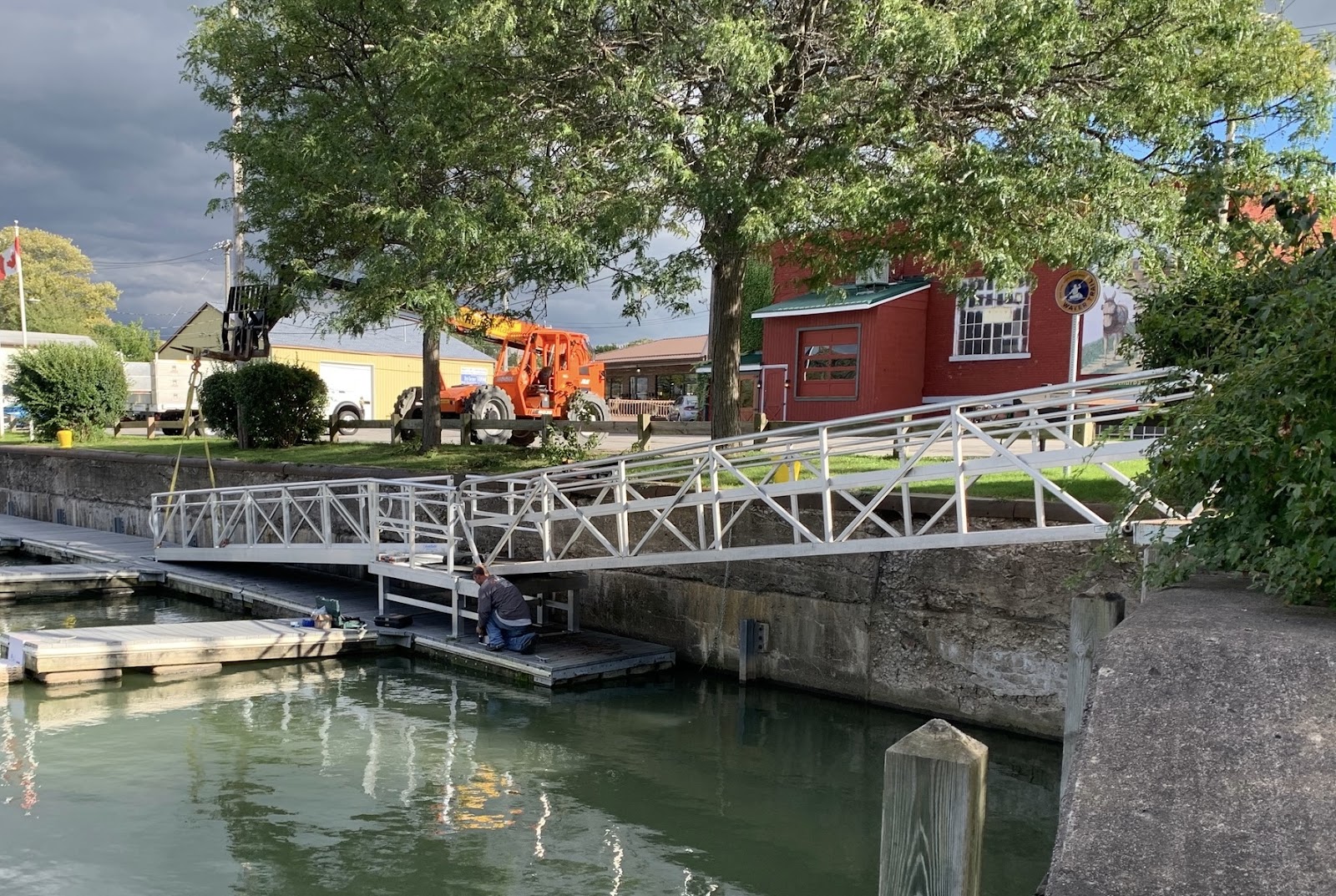
The first challenge identified by BoardSafe Docks was that the existing gangway didn't conform to ADA guidelines and was greater than a 1/12 slope. To correct this issue, a landing was constructed for the existing gangway to rest on and a second gangway added to connect from that platform to the floating dock.
This concept was a cost savings for Mayor Mike Sidari in the Village of Medina because BoardSafe recognized they were able to use their existing gangway and not replace it with a more costly gangway. A replacement gangway would have been nearly 70-feet long.
The adaptive kayak launch in Medina was designed to attach to the customer’s existing floating marina. The marina’s freeboard was 16 inches, and the same height as a standard BoardSafe Dock. BoardSafe was able to size the docks and configure the launch to fit onto the downriver side of their dock system.
The components of this project included a customized landing platform for their existing gangway, a new 30-foot aluminum welded gangway, two 5' x 10' floating docks, one 8' x 20' floating dock, and one Clip-a-Launch 20S with a single side entry.
The cost of this project was approximately $65,000.
The BoardSafe Adaptive Kayak Launch appeals to adaptive paddlers and will help the village of Medina continue to grow as a tourist destination because of its accessibility to the water, downtown historic district, and painted murals project located behind their historic downtown buildings.
Read more about BoardSafe's exclusive adaptive products here.
Fairport on the Erie Canal Welcomes Adaptive Paddlers
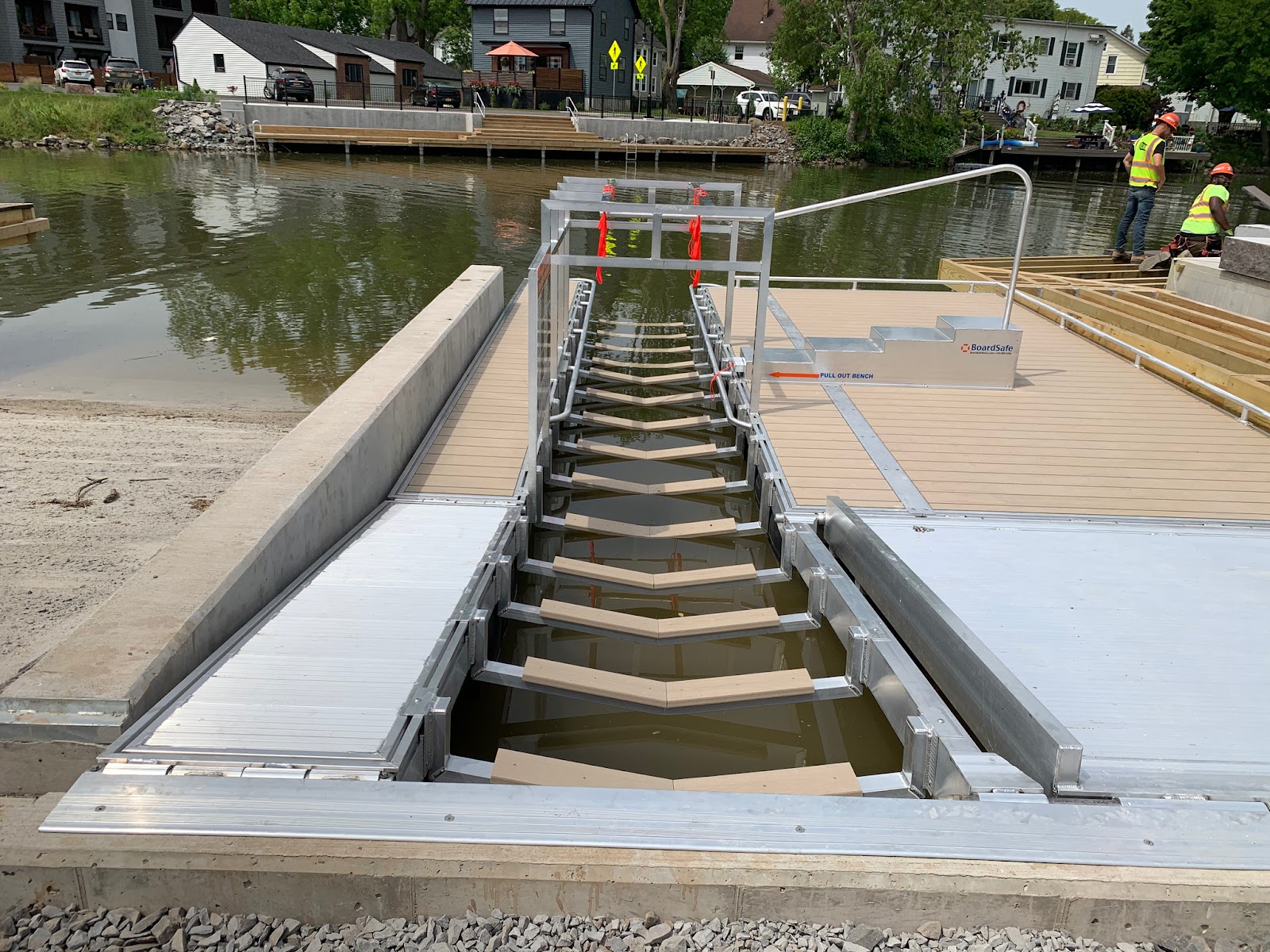
The Village of Fairport is proudly equipped with a custom BoardSafe Adaptive Kayak Launch, part of a complete waterfront redesign at its Erie Canal’s entry point. GPI, the design engineer on the project, sought out BoardSafe Docks for their assistance in developing a design solution that would fit the adaptive launch into a designated space that rests next to their newly-designed boat ramp.
The launch system was designed with a concrete trench at the top of the launch that allowed for the installation of the bulkhead angle and related hinge pin. This space allowed the pin to be removed for an easy installation.
The customized scope of this project included an 8-foot-wide gangway that fit into the designated launch space. The chute was also designed to be 8 feet. The launch included an 8-foot by 20-foot floating dock and Clip-A-Launch 20S (designed for entry from one end). The cost of this project was $50,000 and was installed at the location of the Erie Boat Company, Inc., operated by Peter Abele.
The Erie Canal Boat Company offers kayak rentals and excursions on the Erie Canal and also has associated walking and bike trails along the canal. Their accessible boat company offers kayak, canoe, paddle board, pontoon, and bicycle rentals to people of all abilities.
The Erie Canal Boat Company is a recognized supporter of, and partner with, Rochester Accessible Adventures and the Adaptive Paddling And Cycling Centers (APACC) in the Upstate New York Regions. Together they host accessible paddle days, offer training, equipment, and inclusive programming to transform the Erie Canalway.
Anita O’Brien, Executive Director of RAA, has a mission to ensure that people with disabilities who live or travel in the region have access to equipment and have the ability to enter the water as safely and easily as they deserve. She wants everyone to experience the greatness of the Erie Canalway alongside their family and friends. Anita O’Brien is currently working with BoardSafe to get more of their adaptive launches installed along the canal.
The BoardSafe Adaptive Kayak Launch supported the Erie Canal Boat Company in their mission and has helped make Fairport an inclusive destination for paddlers of all abilities. Tourism is on the rise in Fairport, which is becoming recognized as an inclusive destination. Read more about BoardSafe's exclusive adaptive products here.
Take a video tour of the Fairport accessible kayak launch below.
Brockport's Paddling on the Erie Canal Is Truly Inclusive
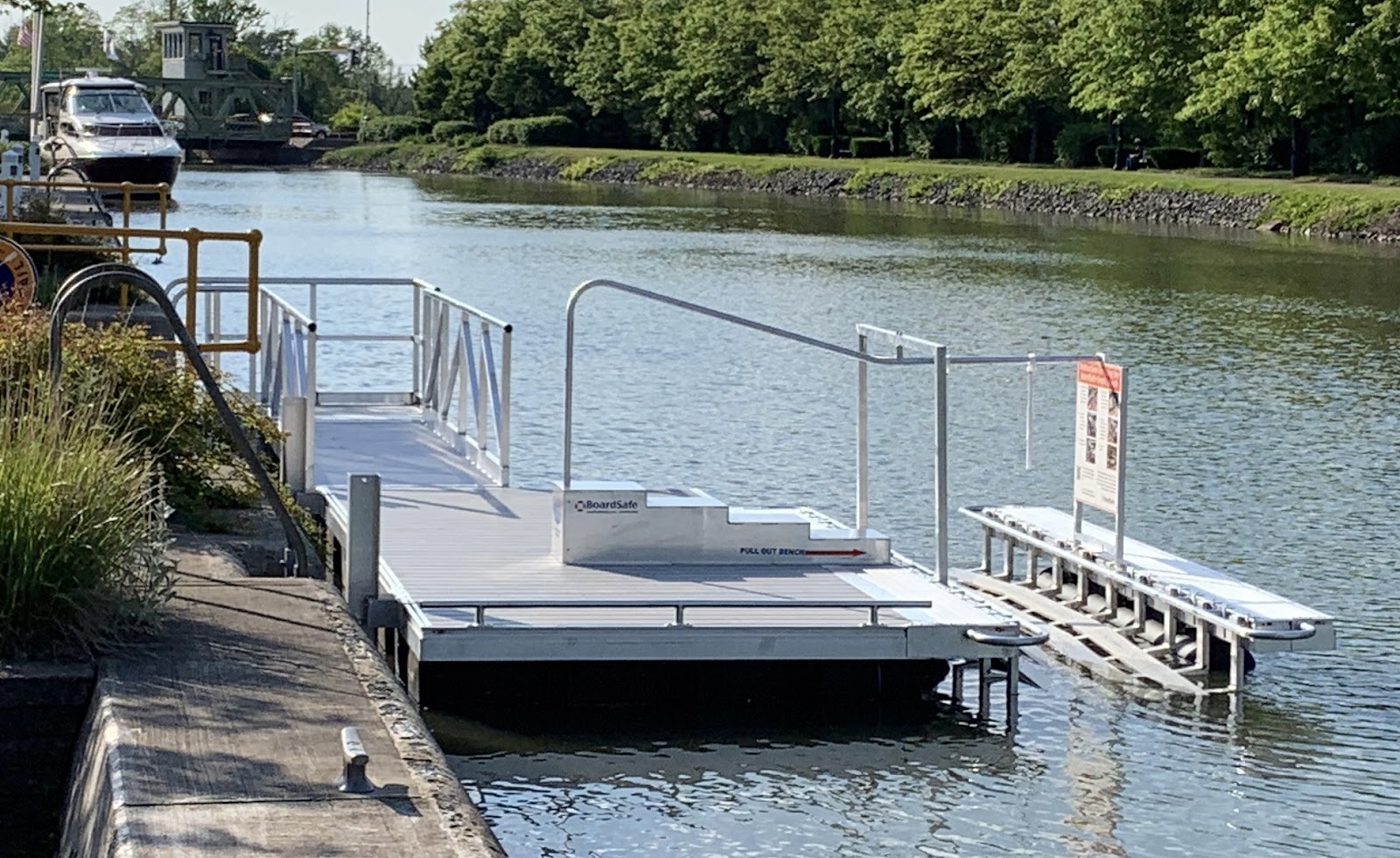
The Village of Brockport installed its BoardSafe Adaptive Kayak Launch in June 2021 to accommodate truly inclusive paddling. The adaptive system is located in downtown Brockport along the Erie Canal. One of the challenges for this project was a nearly 20-foot-high concrete wall along the entire area, meaning the gangway for this project needed to be engineered from the walkway along the wall and down to the dock.
There has been a tremendous increase in kayaking, canoeing, and paddle boarding over the last several years. COVID has added to paddlesports’ popularity. Visitor research completed for the Erie Canalway National Corridor in 2017 reported that 42% of visitors would like to canoe or kayak on the canal. You can see the presentation below:
Erie_Canalway-Visitor_Research.pdf
In the years since that research study has been completed, it’s very likely the percentage of visitors interested in paddling the canal has increased. However, most small towns have not improved their canal access points or made provisions to include the disabled community. Launches that have not been improved and launches that have been built in accordance with minimum ADA standards still exclude a large group of adaptive paddlers. Adaptive paddlers require a launch with specific adaptive features. Adaptive athletes find great joy in getting into their vessel and out onto the water with their family and friends.
Read more about BoardSafe's exclusive adaptive products here.
Since the canal is considered a "navigable waterway,” the Erie Canal Corporation stipulated the entire dock system could only project a minimal distance into the canal. BoardSafe Docks identified a design solution that included a cantilevered walkway with support arms attached to the concrete wall. The walkway provided the solution as well as the necessary attachment point for the gangway that ran parallel to the concrete wall and attached to the floating dock. The adaptive launch was attached to the opposite end, allowing for safer and easier access for persons in wheelchairs.
A second challenge at this site was keeping the dock system in place. BoardSafe analyzed the options and recommended that two vertical I-Beam pilings be bolted to the concrete wall and piling guides be attached to the floating dock. This solution allowed the dock system to move up and down as the water level fluctuated, keeping the dock in the same position in relation to the concrete wall.
This custom project included a 5' x 6' landing, a 4' x 16' gangway, one 8' x 20’ floating dock, one Clip-a-Launch 16Dual that allows entry from both sides, and two custom I-Beam pilings and piling guides.
The total cost of this project was about $45,000.
Brockport is on the National Register of Historic Places and is known for its Victorian downtown district. The College at Brockport, State University of NY, is also located here and is recognized for offering the first Adaptive Physical Education Program in the country. It’s fitting that the Village of Brockport understands the need for equity and inclusion in providing an accessible waterfront and saw value in the BoardSafe Adaptive kayak launch with specific adaptive features, ensuring that paddlers of all abilities can experience the joys of paddling the Erie Canal.
Read a local article about the installation here.
BoardSafe Docks Improves Accessibility for Adaptive Paddling Along the Erie Canal
Hospitality and heritage bring hundreds of thousands of tourists to the Erie Canal each summer. They come from near and they come from far, attracted to the region by different activities: biking, paddling, camping, hiking, shopping, sight-seeing, or simply to refresh and resolve to do absolutely nothing. The tourists are as diverse as the region itself. This includes a diverse range of personal mobility — some hindered by age and arthritis, others living with significant disabilities. As a tourist, there is nothing worse than having your group — whether family or friends — fragmented because one member in the group is unable to access a particular location. Everyone in the tourism industry knows the importance of being hospitable, and this includes accommodating those with disabilities.
As the Erie Canal Heritage Corridor strives to better accommodate all visitors, many local leaders have recognized the popularity of paddling and the need to provide safe and convenient access in and out of the water. The recent addition of three adaptive kayak launches has improved accessibility for the adaptive paddling community and all visitors hoping to paddle the historic canal.
BoardSafe Docks is the manufacturer of the adaptive kayak launch, an industry leader in customized marine access products. BoardSafe Docks’ inclusive design allows for persons in wheelchairs to safely transition into their kayak and out on the water. It also ensures that groups of family and friends paddle together.
The launch system has been engineered with specific adaptive features that have improved the paddling experience for the widest range of users. The launch can also be used with canoes and stand-up paddleboards (SUPs), making it a versatile option for towns, communities, and park systems looking for a truly inclusive launch.
Read "Who can use the BoardSafe Adaptive Kayak Launch?"
The Story of the Erie Canal
The Erie Canal is one of the greatest civil engineering feats in our nation’s history. Nestled along the Erie Canal are 234 cities, towns, and villages that touch New York’s 524 miles of navigable waterways. The identities of its communities are all tied to their canal heritage. Historically, the Erie Canal created an economic structure by connecting its small canal towns, opening a water route to the midwest, and allowing for cheaper transportation of goods. The canal provided new opportunities for work and life for Americans living along the canal corridor. The waterway created a social connectedness between villages and served as the information highway for that era. The canal also became instrumental for social reform.
Today, the Erie Canal corridor is a national heritage landmark and a national treasure for each village because of its help in shaping American history. History and tourism are the crown jewels of each canal town. In-water activities offered along the canal corridor — specifically, paddlesports like kayaking, canoeing, and paddle boarding — offer a positive contribution to each town’s economy.
Tourism and paddling on the Erie Canal
There has been a tremendous increase in kayaking, canoeing, and paddle boarding over the last several years. COVID has added to paddlesports’ popularity. Visitor research completed for the Erie Canalway National Corridor in 2017 reported that 42% of visitors would like to canoe or kayak on the canal.
Erie_Canalway-Visitor_Research.pdf
In the years since that research study has been completed, it’s very likely the percentage of visitors interested in paddling the canal has increased. However, most small towns have not improved their canal access points or made provisions to include the disabled community. Launches that have not been improved and launches that have been built in accordance with minimum ADA standards still exclude a large group of adaptive paddlers. Adaptive paddlers require a launch with specific adaptive features. Adaptive athletes find great joy in getting into their vessel and out onto the water with their family and friends.
Providing accessibility for all abilities
Why paddle the Erie Canal?
Kayaking and other paddle sports are great options for visiting tourists who want to experience life on the water in the small canal towns. Fishing, relaxation, fun, and family, were the answers most often given when kayakers were asked about what draws them to the water. Kayaking allows for those who love the water to get out onto the water for less money than the cost of boating.
"We kind of just like going at our own pace, it's peaceful, and you can take kayaks into places you can't take other boats," said a paddler who used the Fairport Village Launch operated by the Erie Boat Company.
Benefits of a BoardSafe Adaptive Kayak Launch
The Village of Fairport is proudly equipped with a custom BoardSafe Adaptive Kayak Launch, part of a complete waterfront redesign at its Erie Canal’s entry point. GPI, the design engineer on the project, sought out BoardSafe Docks for their assistance in developing a design solution that would fit the adaptive launch into a designated space that rests next to their newly-designed boat ramp.

The launch system was designed with a concrete trench at the top of the launch that allowed for the installation of the bulkhead angle and related hinge pin. This space allowed the pin to be removed for an easy installation.
The customized scope of this project included an 8-foot-wide gangway that fit into the designated launch space. The chute was also designed to be 8 feet. The launch included an 8-foot by 20-foot floating dock and Clip-A-Launch 20S (designed for entry from one end). The cost of this project was $50,000 and was installed at the location of the Erie Boat Company, Inc., operated by Peter Abele.
The Erie Canal Boat Company offers kayak rentals and excursions on the Erie Canal and also has associated walking and bike trails along the canal. Their accessible boat company offers kayak, canoe, paddle board, pontoon, and bicycle rentals to people of all abilities.
The Erie Canal Boat Company is a recognized supporter of, and partner with, Rochester Accessible Adventures and the Adaptive Paddling And Cycling Centers (APACC) in the Upstate New York Regions. Together they host accessible paddle days, offer training, equipment, and inclusive programming to transform the Erie Canalway. Anita O’Brien, Executive Director of RAA, has a mission to ensure that people with disabilities who live or travel in the region have access to equipment and have the ability to enter the water as safely and easily as they deserve. She wants everyone to experience the greatness of the Erie Canalway alongside their family and friends. Anita O’Brien is currently working with BoardSafe to get more of their adaptive launches installed along the canal.
The BoardSafe Adaptive Kayak Launch supported the Erie Canal Boat Company in their mission and has helped make Fairport an inclusive destination for paddlers of all abilities. Tourism is on the rise in Fairport, which is becoming recognized as an inclusive destination.
The Village of Brockport installed their BoardSafe Adaptive Kayak Launch in June 2021. The adaptive system is located in downtown Brockport along the Erie Canal. One of the challenges for this project was a nearly 20-foot-high concrete wall along the entire area, meaning the gangway for this project needed to be engineered from the walkway along the wall and down to the dock.

Since the canal is considered a "navigable waterway,” the Erie Canal Corporation stipulated the entire dock system could only project a minimal distance into the canal. BoardSafe Docks identified a design solution that included a cantilevered walkway with support arms attached to the concrete wall. The walkway provided the solution as well as the necessary attachment point for the gangway that ran parallel to the concrete wall and attached to the floating dock. The adaptive launch was attached to the opposite end, allowing for safer and easier access for persons in wheelchairs.
A second challenge at this site was keeping the dock system in place. BoardSafe analyzed the options and recommended that two vertical I-Beam pilings be bolted to the concrete wall and piling guides be attached to the floating dock. This solution allowed the dock system to move up and down as the water level fluctuated, keeping the dock in the same position in relation to the concrete wall.
This custom project included a 5' x 6' landing, a 4' x 16' gangway, one 8' x 20’ floating dock, one Clip-a-Launch 16Dual that allows entry from both sides, and two custom I-Beam pilings and piling guides.
The total cost of this project was about $45,000.
Brockport is on the National Register of Historic Places and is known for its Victorian downtown district. The College at Brockport, State University of NY, is also located here and is recognized for offering the first Adaptive Physical Education Program in the country. It’s fitting that the Village of Brockport understands the need for equity and inclusion in providing an accessible waterfront and saw value in the BoardSafe Adaptive kayak launch with specific adaptive features, ensuring that paddlers of all abilities can experience the joys of paddling the Erie Canal.
The Village of Medina installed a customized BoardSafe Adaptive Kayak Launch, Floating Docks, Gangway, and Landing, completed in September 2021.
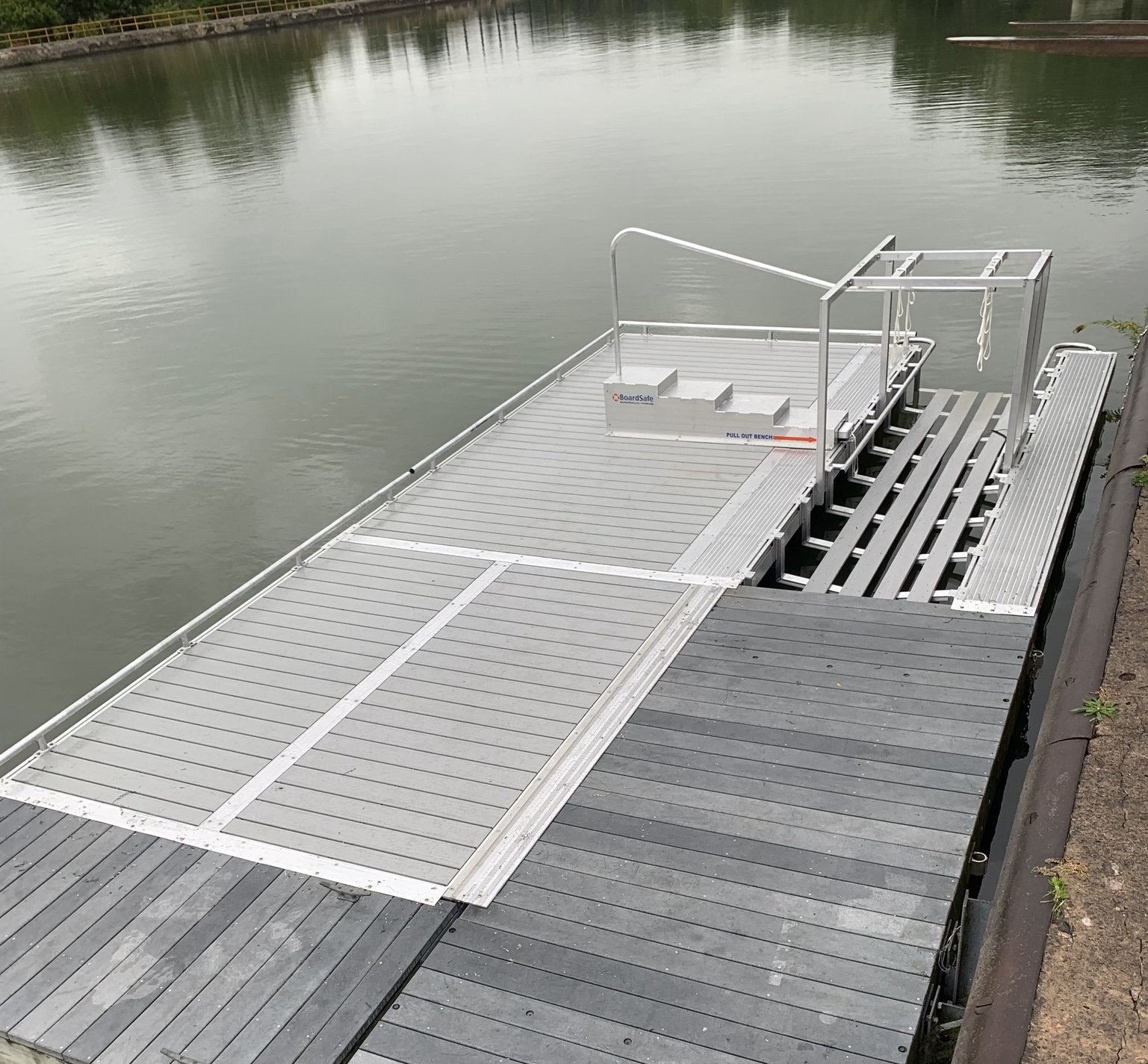
The first challenge identified by BoardSafe Docks was that the existing gangway didn't conform to ADA guidelines and was greater than a 1/12 slope. To correct this issue, a landing was constructed for the existing gangway to rest on and a second gangway added to connect from that platform to the floating dock. This concept was a cost savings for Mayor Mike Sidari in the Village of Medina because BoardSafe recognized they were able to use their existing gangway and not replace it with a more costly gangway. A replacement gangway would have been nearly 70-feet long.
The adaptive kayak launch in Medina was designed to attach to the customer’s existing floating marina. The marina’s freeboard was 16 inches, and the same height of a standard BoardSafe Dock. BoardSafe was able to size the docks and configure the launch to fit onto the downriver side of their dock system.
The components of this project included a customized landing platform for their existing gangway, a new 30-foot aluminum welded gangway, two 5' x 10' floating docks, one 8' x 20' floating dock, and one Clip-a-Launch 20S with a single side entry.
The cost of this project was approximately $65,000.
The BoardSafe Adaptive Kayak Launch appeals to adaptive paddlers and will help the village of Medina continue to grow as a tourist destination because of its accessibility to the water, downtown historic district, and painted murals project located behind their historic downtown buildings.
Although the needs and challenges of these three villages are all very unique and different, BoardSafe Docks was able to evaluate their needs and identify a solution to create an accessible launch system that includes specific features that will work for an adaptive paddler.
Build one and they will come
In addition to helping Erie Canal communities boost tourism and revenue, More Features = More Paddlers. Adaptive launches serve a wide range of paddling groups, making it safer and easier to enter and exit the vessel and the water. Adaptive launches are all about inclusion and human rights. Launches with specialized features increase social connection for adaptive paddlers and offer physical activity to contribute to the best medical outcomes. The Erie Canal has a great history for improving the lives of Americans who lived and worked on the canal and contributed to social reform. Today, the canal and villages have the ability to continue this work and ensure their launches are available to and accessible for everyone.
BoardSafe Docks is the industry leader in adaptive kayak launches and fishing piers, gangways and pedestrian bridges, rowing centers, and marinas. They specialize in design consultation, engineering, and manufacturing, and will work with you to ensure your project is accessible to the widest range of users and that necessary specific adaptive features are not overlooked.
You may learn more about BoardSafe Dock’s projects through our website at BoardSafeDocks.com or by calling 610-899-0286.

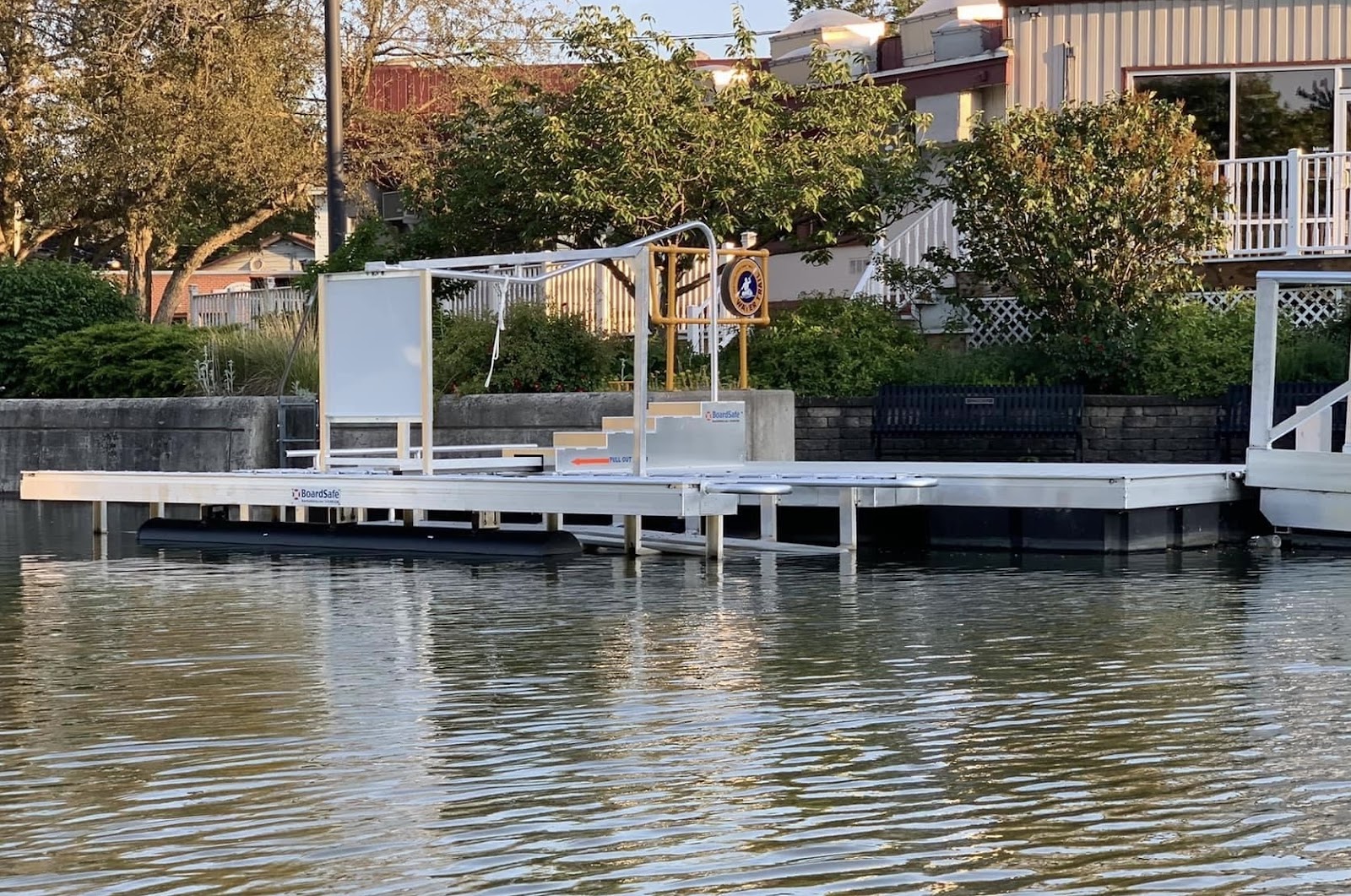
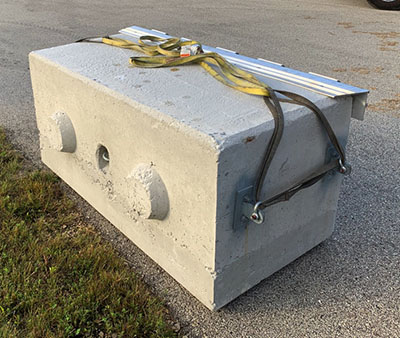
Launch-in-a-Box — Mount the Adaptive Kayak Launch Yourself
Landscape architects, recreation and parks managers, and other professionals who support adaptive paddling and accessibility in their communities, are working on plans to provide safe, universal water access in towns, cities, and parks across the nation.
They are responding to demands for adaptive kayak launches, also known as accessible kayak launches. These are sometimes mischaracterized as "ADA launches" (The Americans with Disabilities Act does not have guidelines for piers, gangways, floating docks, and similar marine applications). These kayak and boat launches have numerous features to assist adaptive paddlers to get in and out of the water. These special features include an aluminum gangway, tiered bench, roll cage, handrails, launch, underwater saddles, and other special features.
Adaptive kayak launches provide universal access for a wide range of people, including those living with very limiting disabilities and those who have minor mobility challenges.
BoardSafe designs, engineers, manufacturers, and installs all of their products, but some clients choose to perform the installation on their own — Specifically, organizations that have staff and experienced construction crews able to install the launches on their own. We have provided a video (below) that explains the process of mounting an angle onto the concrete bulkhead.
This metal angle is the connector between the gangway and boat slide and the fixed structure (the cement) on land, that secures the adaptive launch.
BoardSafe sells an adaptive launch kit called "Launch-in-a-Box," with all the features of a commercial adaptive kayak launch, including an aluminum gangway, tiered bench, roll cage, handrails, launch, underwater saddles, and other special features. Launch-in-a-Box is a turnkey package for clients who can assemble and install the launch on their own. Included in Launch-in-a-Box is a rectangular cement block that is buried and secured on land, then buried, to provide the anchoring for the adaptive boat launch.
The following video explains the process of mounting an angle onto the concrete bulkhead.
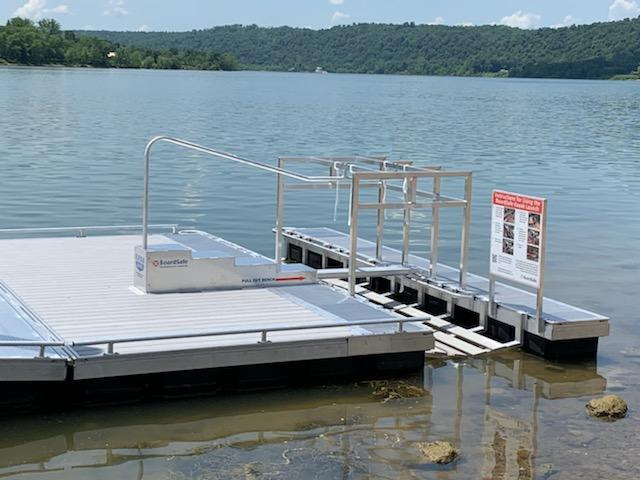
8 Questions To Consider When Identifying the Best Location for an Adaptive Kayak Launch
Your community has decided that it needs to be more welcoming and accessible to those living with disabilities. You volunteered to research options for an adaptive kayak launch. You understand how important it is for those with mobility issues to enter and exit their kayaks safely — as well as the need to sustain a lifetime of physical activity and social connections. Now is the time to make this dream a reality.
BoardSafe also understands this and we want to educate parks, towns, and other communities about providing paddling opportunities for the greatest number of paddlers possible, and empower them to accomplish this goal. An adaptive kayak launch is a big investment — not only in financial terms, but more importantly, in its direct impact on the life of individuals and the collective community.
You must consider the following eight questions when identifying the best location for the launch because this specialty system will be a long-term investment for your community. By answering these questions, you’ll ultimately improve the kayaking experience for all of your paddlers.
When deciding on the best location for your Adaptive Kayak Launch, you’ll need to answer these eight questions about your site:
- What is the vertical drop from the anchorage point to the top of the water? This is important because it will help determine the length of your gangway and chute.
- Is there ADA access to the site from the parking lot? You’ll want to ensure the infrastructure is in place that will allow paddlers in wheelchairs to get from their vehicles to the launch site.
- Is the water depth adequate for the system? A minimum of 18 inches of water is the recommended depth to allow the launch to float.
- Is the area prone to any flooding? If so, you’ll want to make sure your bulkhead is protected and your gangway is attached with a strong connection to the bulkhead and engineered to withstand a stronger load.
- Are droughts a possibility and could the dock system possibly be sitting in mud? If there are drought conditions in your area, you’ll want to increase the length of your gangway to ensure the dock remains in the water.
- Are there any zoning regulations that identify where you can or cannot install the Adaptive Kayak Launch system? Permits are based on local zoning requirements and also should be investigated early in the design process.
- Does your preferred location experience any tidal changes? Any tidal change will determine the length of your gangway as well as the length of your chute. Specific details about the length of your gangway can be found here.
- Should the kayak launch be attached to a fixed pier or concrete bulkhead? Whatever method of attachment is recommended, the width of your pier or bulkhead will need to accommodate a piano hinge mounting angle. For a gangway and chute combination, the hinge will be 10 feet, and for a gangway alone, it would be 5 feet. If the launch is being installed on a river or a place that has swift moving tidal waters, support cables or pipe pilings may need to be added.
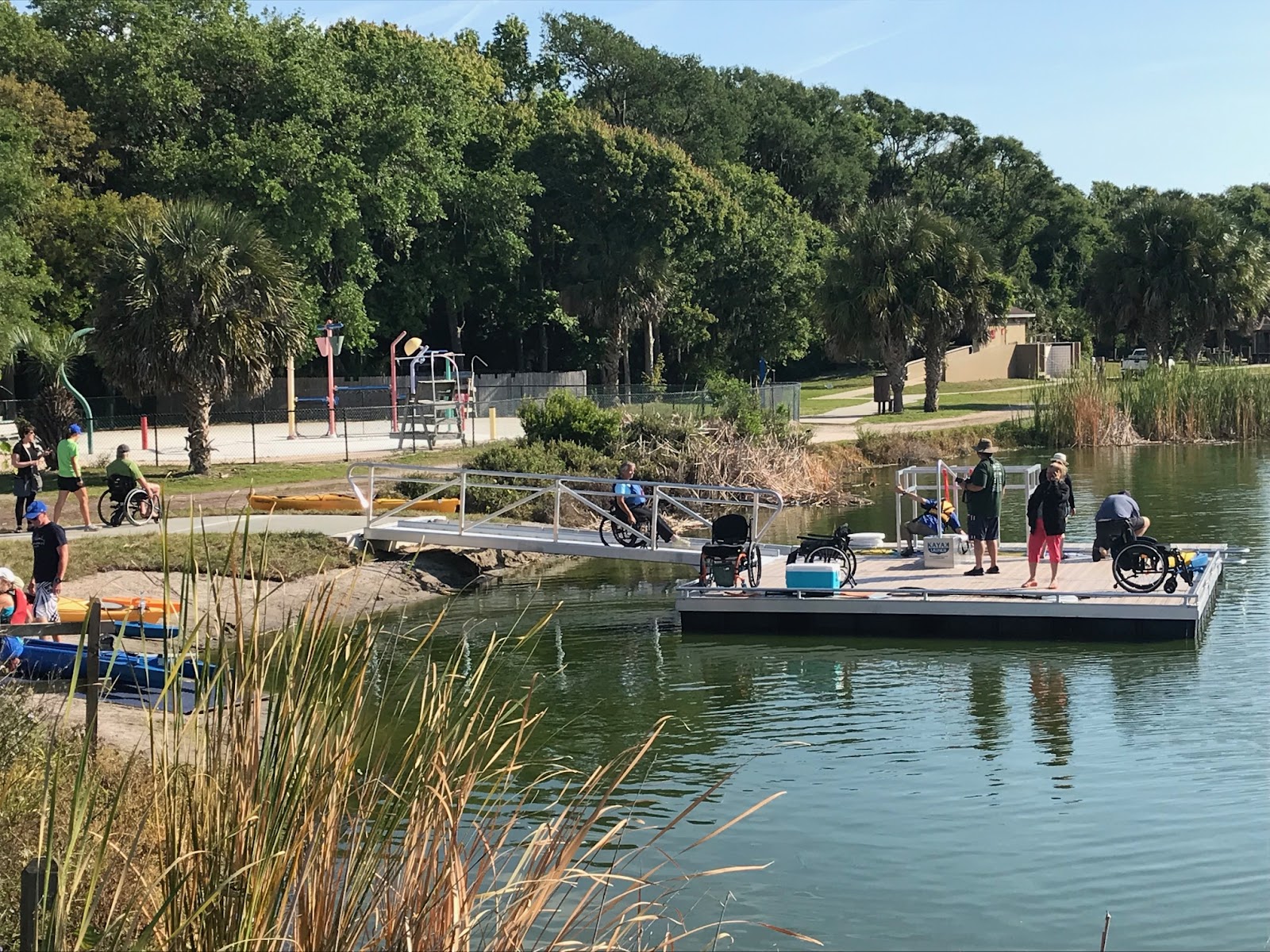
Taking the time to conduct the proper due diligence during site assessment and ensuring accessibility will increase the durability and performance of the Adaptive Kayak Launch. Another consideration is the environmental factors: understanding the impact on the natural habitat, surrounding fauna, and animal life during the installation and long-term use of the launch.
Of equal importance to matching the adaptive launch to an ideal location is matching the kayak launch’s features to the range of mobility of the users. Paddlers who are older, arthritic, or suffer from poor balance, can benefit from an Accessible Kayak Launch that offers basic features that help the paddler transition into the vessel. For users with more severe cognitive impairments or those in wheelchairs or with limited mobility, an Adaptive Kayak Launch is best for the job. An adaptive launch is replete with ADA features that include handrails, gentle sloping gangways, low thresholds, boat slide, multi-tiered transition bench, hand straps, a pullout seat, underwater boat stabilizers, and numerous locations for hand grips.
The amount of features available on the kayak launch directly correlates with the number of users who can enjoy the launch. As a recent adaptive paddling instructor recently shared, “A kayak launch that is promoted as ‘ADA’ or ‘accessible,’ but only serves the highest-functioning individuals in the disability community, communicates to the disabled community a disconnect between paying lip service and a true desire to empower a paddler with handicaps. Decision-makers must do their homework and talk to various individuals with various disabilities to best serve this segment of society.”
Moreover, many communities are seeing an opportunity to increase the number of out-of-town visitors and the quality of life for residents. Many areas, including states, counties, and cities, recognize the value of the bodies of water in their communities. Whether it is to draw tourists, promote resident quality of life, or protect nature, waterfront areas are always the most popular real estate, whether for spreading out a picnic blanket or for building a hotel. Providing safe and easy access to help the community enjoy the water is key.
Where can an Adaptive Kayak Launch be installed?
You’ll find that adaptive launches can be installed almost anywhere.
BoardSafe Docks has installed launches on:
- lakes
- rivers
- streams
- ponds
- tidal waters
- bayous
We can install anywhere your heart takes you paddling!
BoardSafe Docks is the trusted designer, engineer, and manufacturer of aluminum floating docks, as well as the premier designer and manufacturer of rowing centers for top national rowing teams. Their sales team is always available for questions, consultation, and to assist you in finding your optimal waterfront solution. You may learn more about BoardSafe Dock’s projects through their website at BoardSafeDocks.com or by calling 610-899-0286.
You Need to Know This Before Purchasing an Adaptive Kayak Launch
It’s admirable when a community or organization recognizes the need to install an accessible kayak launch with adaptive features. However, there are many questions that need to be answered before the project can move forward. Funds for these types of projects are often hard to come by, so it’s critical to make sure your launch system meets the needs of everyone in your community who wishes to use it.
Kayaking has increased in popularity over the last several years, especially since the onset of COVID. Kayaking allows paddlers to enjoy the great outdoors and be together in a group while maintaining social and safe distancing. Adaptive athletes desire to be on the water with their able-bodied friends and family members. Kayaking has proved beneficial for an adaptive athlete’s physical and mental wellbeing and makes them feel included. It offers a sense of freedom they may not experience on land or in their wheelchair. The same challenges that exist for them on land also exist for them when trying to get into their kayak and out onto the water. A BoardSafe Adaptive Kayak Launch with specific adaptive features offers park systems and communities the opportunity to shape the future of outdoor spaces, lifestyles, and quality of life for an adaptive paddler — and not just check off an “ADA Accessible” box.
A kayak launch is a big investment in your town, your lake, and your park system. This investment in your community should be inclusive of ALL paddlers. Over the years, the feedback we’ve received from adaptive paddlers is that there's nothing more disheartening than to travel to a site that promotes its facilities as “accessible,” yet is only accessible for some of the users and not inclusive of everyone who wishes to use the launch system.
While it’s encouraging to see so many leaders across many industries in the private and public sectors strive to create a more inclusive society, it’s paramount that the accessible products they select benefit the greatest number of users possible.
BoardSafe Docks is here for our customers and available to address the many different aspects of your project. We excel in finding solutions for your water entry challenges.
To ensure your launch system is truly accessible, we’ll work with you to design the specific adaptive features necessary for your launch. Our launches are not one-size-fits-all (which limits who can truly access the launch) but customized to fit your waterway.
BoardSafe’s Adaptive Kayak Launch Custom Features
- BoardSafe Docks will guide you with the length of your gangway to ensure it’s ADA compliant and no greater than a 1/12 pitch.
- We’ll help you decide if a kayak chute is necessary.
- The adaptive features of our adaptive kayak launch that are necessary for an adaptive paddler to enter and exit their vessel and the water are:
- gangway, chute and saddle launch that are customized to fit your point of entry into the water
- a protective toe kick that prohibits the wheelchair from accidentally sliding into the water
- a tiered boarding bench with pullout seat
- roll cage with overhead grab bar and optional hand straps
- pull bars located on both sides of the kayak saddle
- Construction using one or multiple floating dock sections
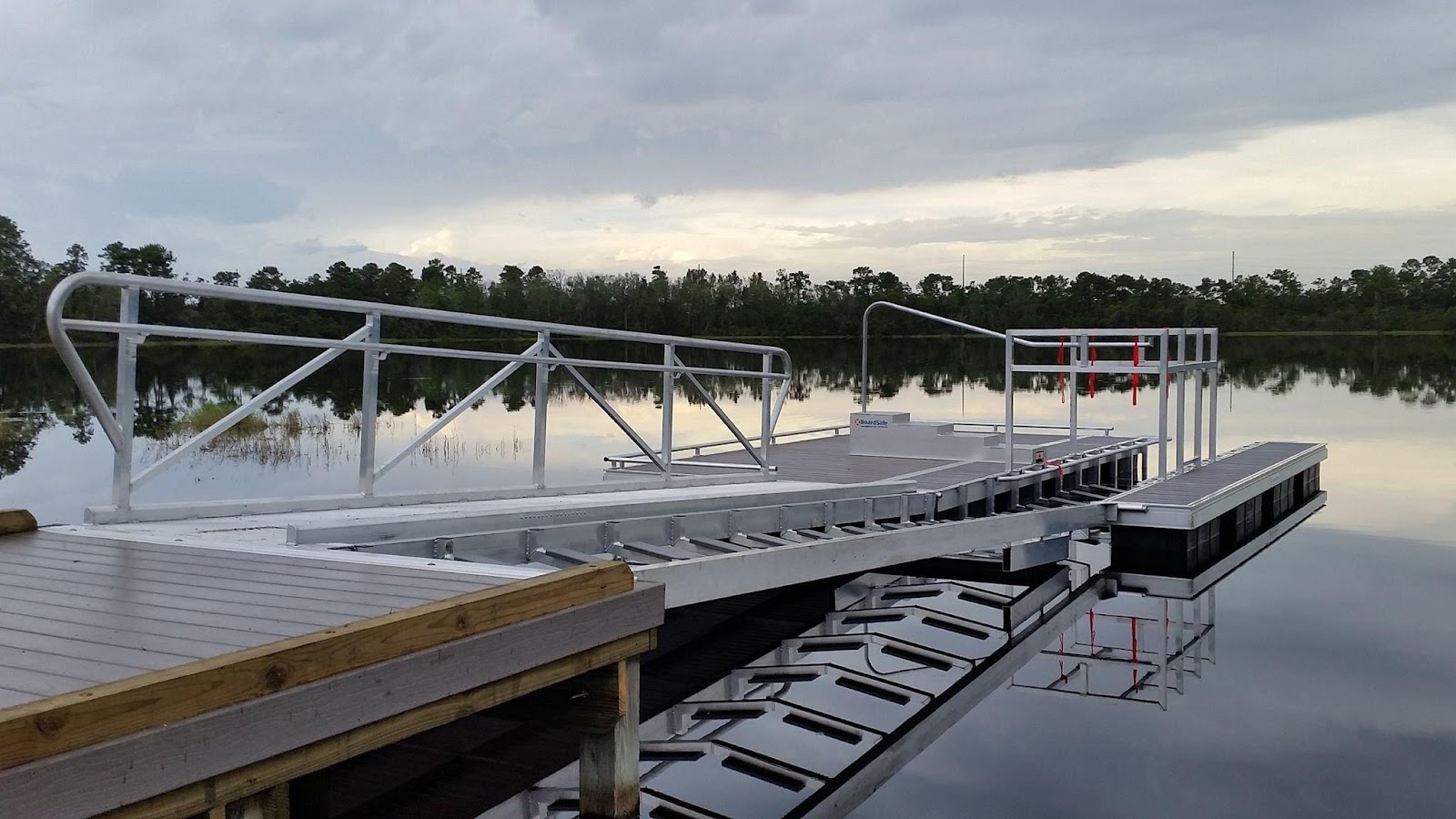
- BoardSafeDocks will assist you to find the best location for your adaptive kayak launch, whether it's on a lake, river, or waterway affected by tidal fluctuations and changing weather conditions.
- BoardSafe Docks can also evaluate an existing mounting location, such as a wooden pier or concrete foundation, and provide guidance if there’s no current infrastructure in place.
Over the years, BoardSafe has developed expertise in building adaptive kayak launches because it seeks the input of adaptive paddlers. From Day One, BoardSafe has engaged a focus group of spinal cord rehabilitation members, a local nonprofit for independent living, amputee groups, and other outdoor adaptive athletes. BoardSafe includes ideas and feedback from other adaptive paddler groups in order to improve the kayak launch product to meet all needs in the disability community. BoardSafe recommends that all prospects and clients desiring to offer an adaptive kayak launch in their community engage with local adaptive recreation groups and solicit their input to create the most equitable application for all.
Everyone should be aware that obtaining permits and approvals is usually necessary prior to installing a BoardSafe Adaptive Kayak Launch. These may involve local, state, and federal (ACOE- Army Corps of Engineers) agencies.
BoardSafe Docks is the trusted designer, engineer, and manufacturer of aluminum floating docks, as well as the premier designer and manufacturer of rowing centers for top national rowing teams. Their sales team is always available for questions, consultation, and to assist you in finding your optimal waterfront solution.
Learn more about our projects at our website, BoardSafeDocks.com, or by calling us at 610-899-0286.
BoardSafe Understands the Difference Between Adaptive and Accessible
Adaptive vs. Accessible Kayak Launches
The popularity of kayaking and other paddle sports has increased over the last several years.
Adaptive athletes hold the same desire to be on the water with their able-bodied friends and family members. However, accessibility challenges continue to exist for those with physical disabilities when trying to get into their kayak and out onto the water. Kayaking has proved to be beneficial to the adaptive athlete’s physical and mental wellbeing, allowing them to feel included and offering a sense of freedom they may not experience on land and in their wheelchairs. Shouldn’t we all do more to ensure the kayak launch being considered is going to serve those with the greatest need for accommodations?
BoardSafe Docks designs, engineers, and manufactures floating dock systems and holds a longstanding presence in assisting customers to access their waterfront both safely and easily. Understanding the difference between an accessible launch system and an adaptive launch system comes up frequently in discussions when assisting customers with identifying a kayak launch that will provide the greatest amount of accessibility for paddlers with the greatest need for assistance.
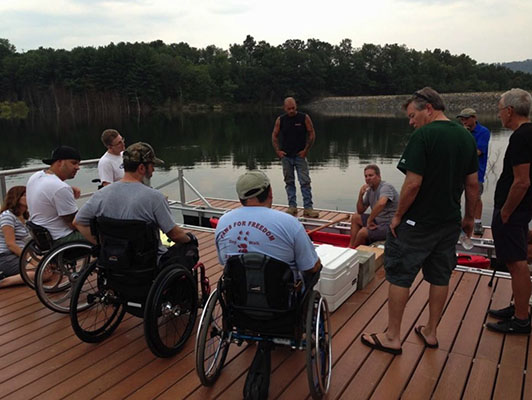
In 2015, the Lehigh Valley Chapter of Team River Runner, an adaptive paddling group, and the Kempton Lion’s Club, sought out BoardSafe Docks for their dock-building expertise. Specifically, they were interested in an adaptive kayak launch that would work for paddlers in wheelchairs. Team River Runner is a national organization with over 75 chapters in 34 states. Their mission is to provide all veterans and their families an opportunity to find health, healing, community purpose, and new challenges, through adventure and adaptive paddle sports. As Team River Runner’s local chapter membership grew, so did the varied needs of their adaptive paddlers. A partnership was formed with BoardSafe Docks and they worked with the adaptive paddlers to identify specific adaptive features that would work to get them in and out of their vessel and onto the water for a safer and more successful paddling experience.
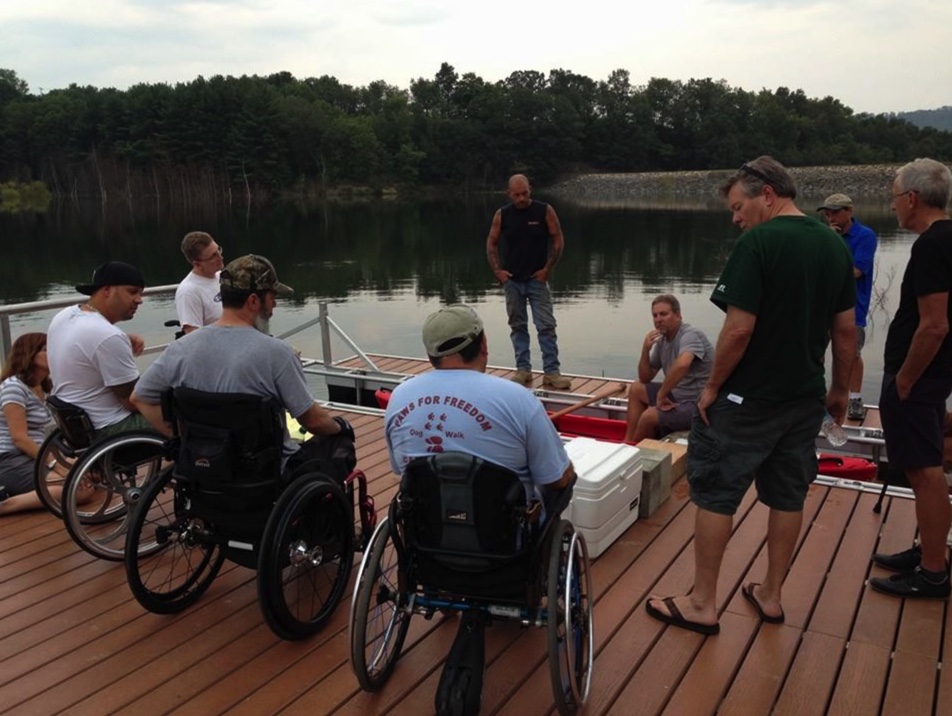
Team BoardSafe and Team River Runner collaborating on the first adaptive kayak launch
More often than not, the adaptive paddlers reported that they couldn’t get into the water to kayak, even when the launch was described as "accessible." Together, they identified the problems that existed with accessible launches they had tried but had not worked. Too often, launches that were described as accessible only worked for the able-bodied paddler. They talked about what was missing and identified solutions that would help them gain access to the water safely and independently. BoardSafe’s team has been fortunate to work side by side with Team River Runner’s adaptive paddlers to identify features that truly work and identify features that have kept them excluded.
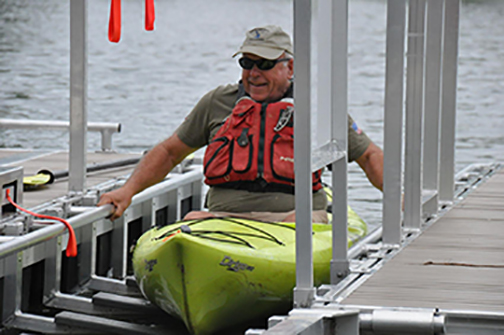
Ken Ryno, an adaptive paddler with Team River Runner’s Lehigh Valley Chapter, is classified as a C5-C6 Incomplete Quadriplegic. Ken is paralyzed from the chest down and has use of only his upper body and arm strength. Over the years, Ken has become a very active chapter leader and has taken on the role of spokesperson for BoardSafe Docks. Ken’s mission is to help educate communities about specific adaptive features that should be considered when designing an adaptive dock system.
A kayak launch is a big investment, whether it’s in your town, lake, or park system. The investment you’re building and buying should be inclusive of ALL paddlers. Adaptive paddlers have expressed their dismay in traveling to sites that promote themselves as accessible when, in reality, they’re only accessible for some of the users and not inclusive of all.
Accessible launches get paddlers to the water. Accessible launches are found to be great for able-bodied kayakers, beginners, and seniors, and people with minor limitations like joint issues, arthritis, and developmental delays. Accessible launches may even work for a small number of paddlers with moderate disabilities. However, for adaptive paddlers like Ken Ryno, Team River Runner chapters, disabled veteran groups, and wounded warrior groups, an accessible launch alone does not meet their needs or get them into the water safely and easily.
When considering an adaptive launch, input from local adaptive paddling groups should always be considered. What types of disabilities is the launch going to serve? Adaptive paddlers are able to identify launch features that will work for them and also identify features that will create additional challenges. As we continue to educate ourselves about the needs of the adaptive paddling community, we have the responsibility to ensure that future kayak launches will be usable by the disabled paddler, or as Ken Ryno refers to himself and those like him, the “differently-abled” paddler.
Here is a video of Ken Ryno using an adaptive kayak launch independently.
To help you better understand the specific adaptive features that allow Ken to access the water independently, they are illustrated below:
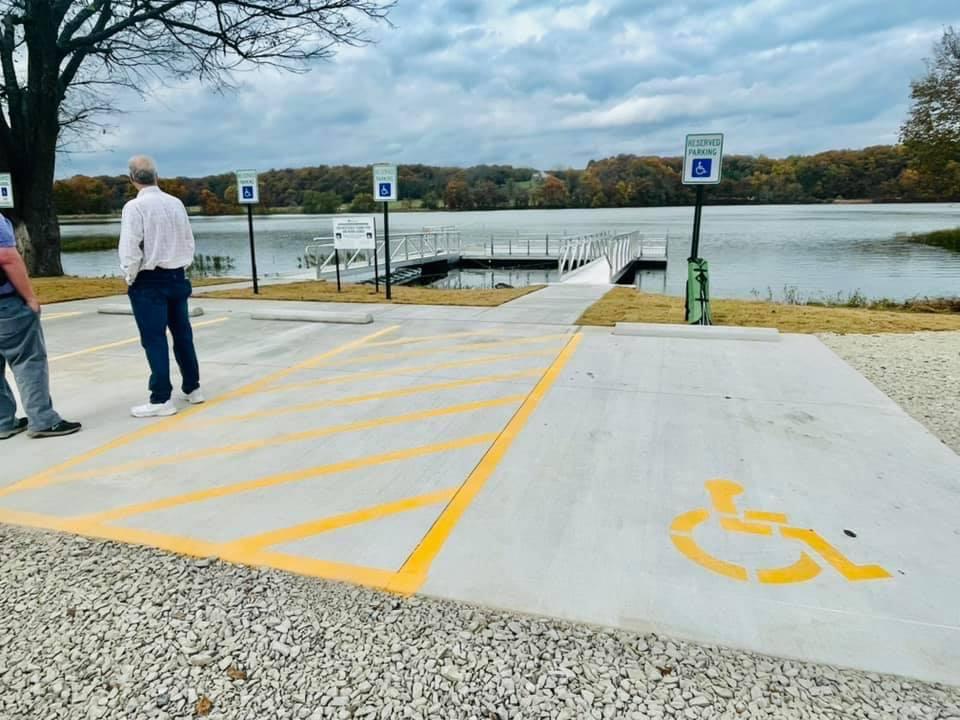
A means of egress must exist that allows for wheelchair travel from the parking lot to the kayak launch site.
The gangway offers an adaptive paddler a way of moving their kayak from the land to the launch area and vice versa. The gangway should have nothing greater than a 1/12 pitch (meeting ADA slope requirements and features) and a chute where the vessel is placed in alignment with the gangway and launch saddle.
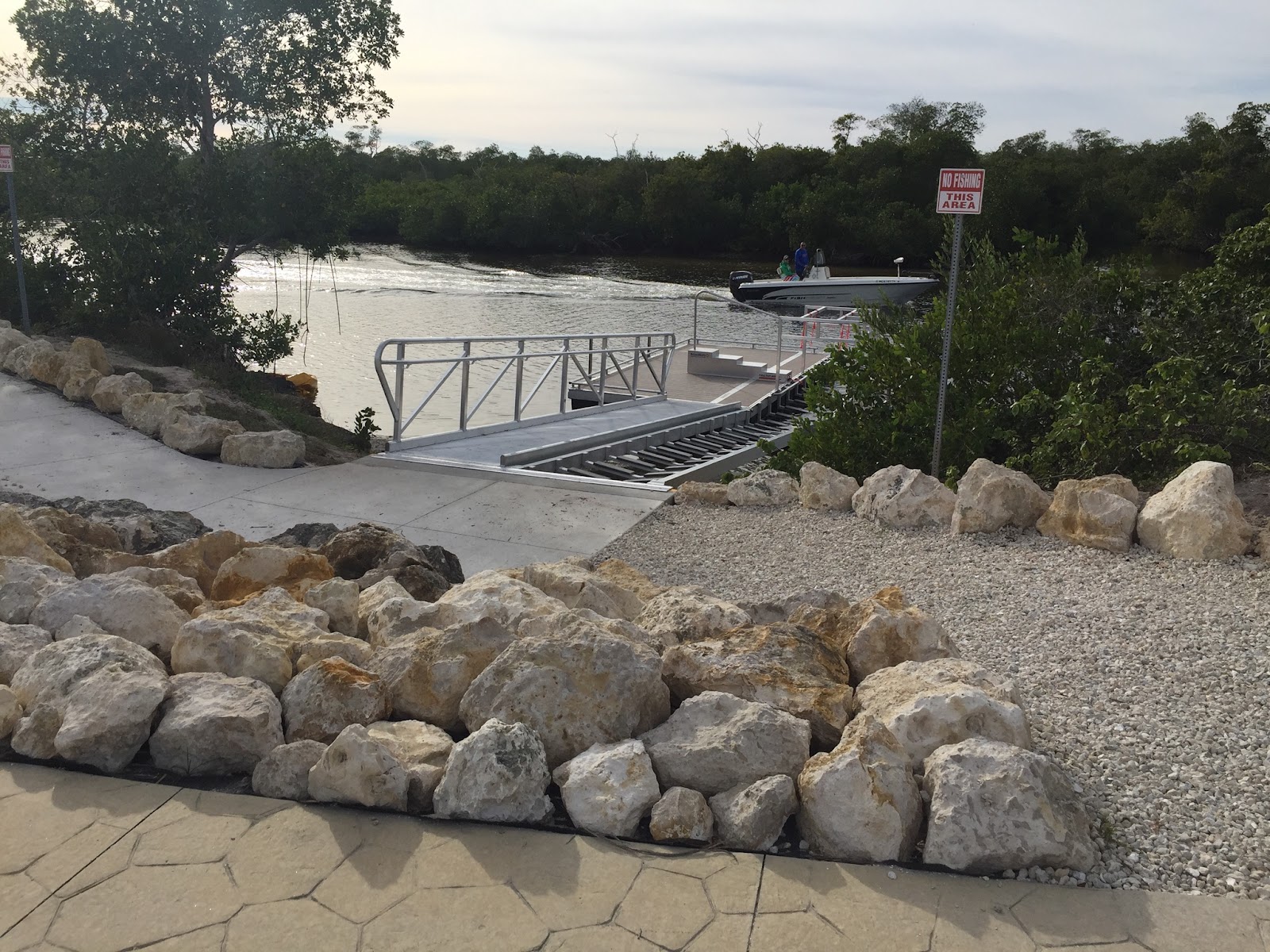
The chute and launch saddle should be large enough to accommodate kayaks with outriggers. However, they shouldn’t be too wide or they will create too large a distance between the boarding bench and the cockpit of the vessel. If the saddle is too wide, it will decrease the stability needed for a disabled paddler to get into and out of their vessel.
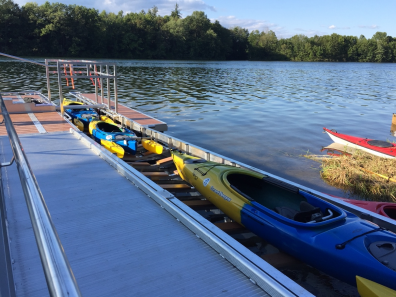
A toe kick is an added safety feature around the perimeter of the floating dock. This will prohibit a wheelchair from accidentally rolling off the dock into the water.
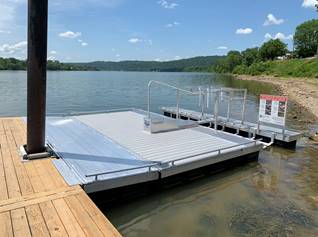
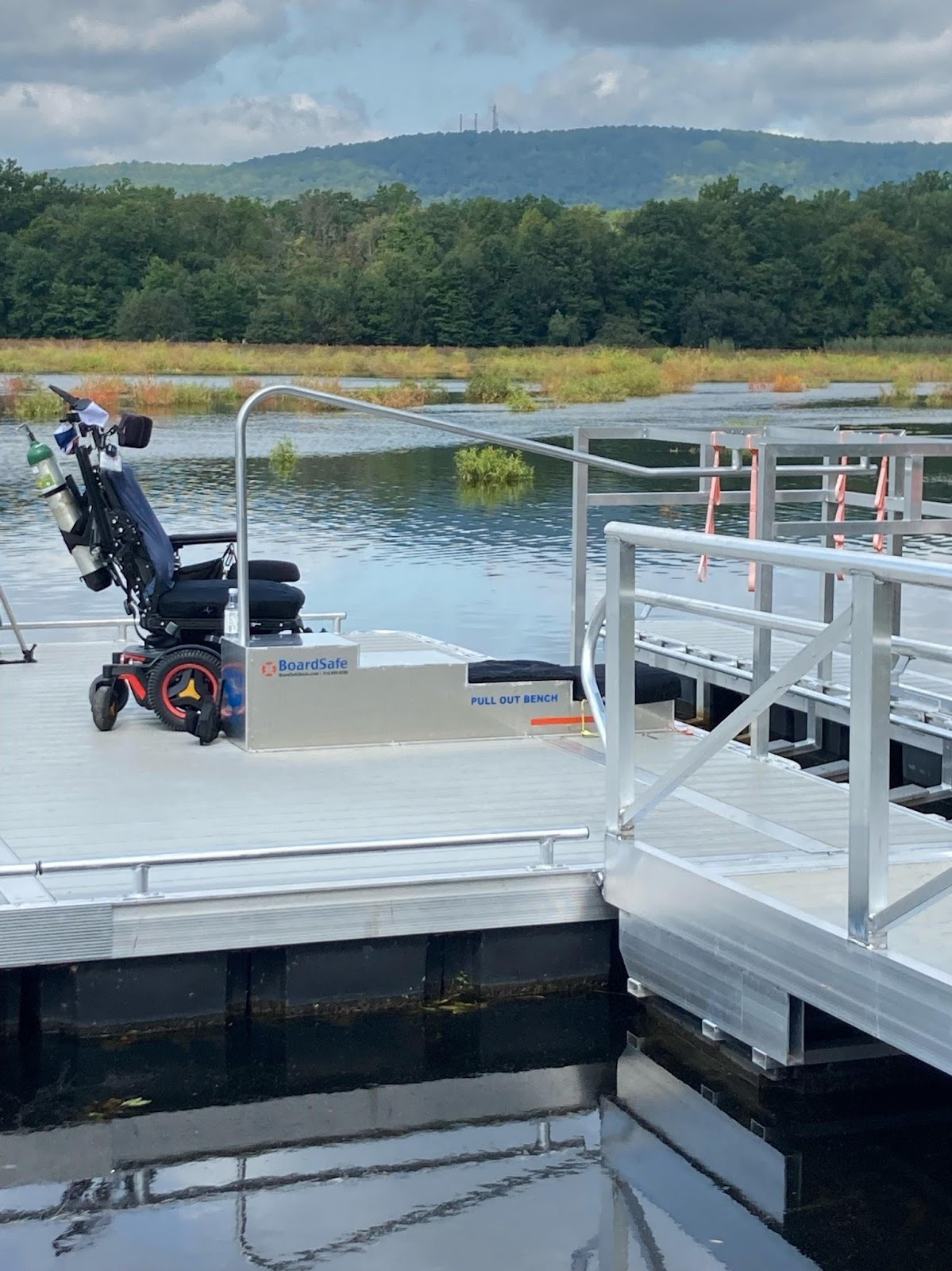
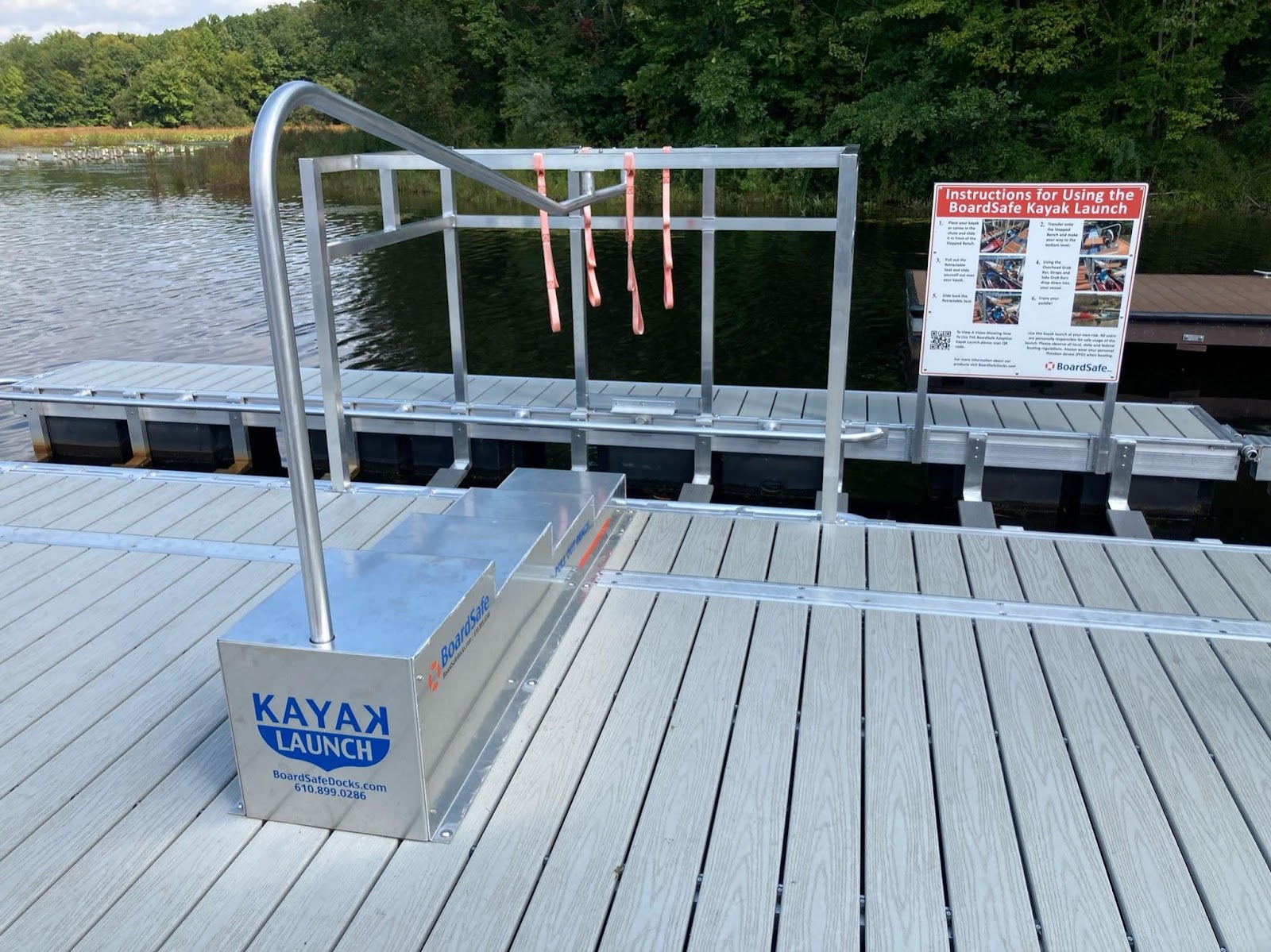
A tiered boarding bench allows the user to easily transfer from the wheelchair. The top step of the bench must be equal to the height of a wheelchair in order for the user to transition from the wheelchair to the top of the bench. The steps should be minimal in height (approx. 3”) to allow the paddler a small shift from step to lower step.
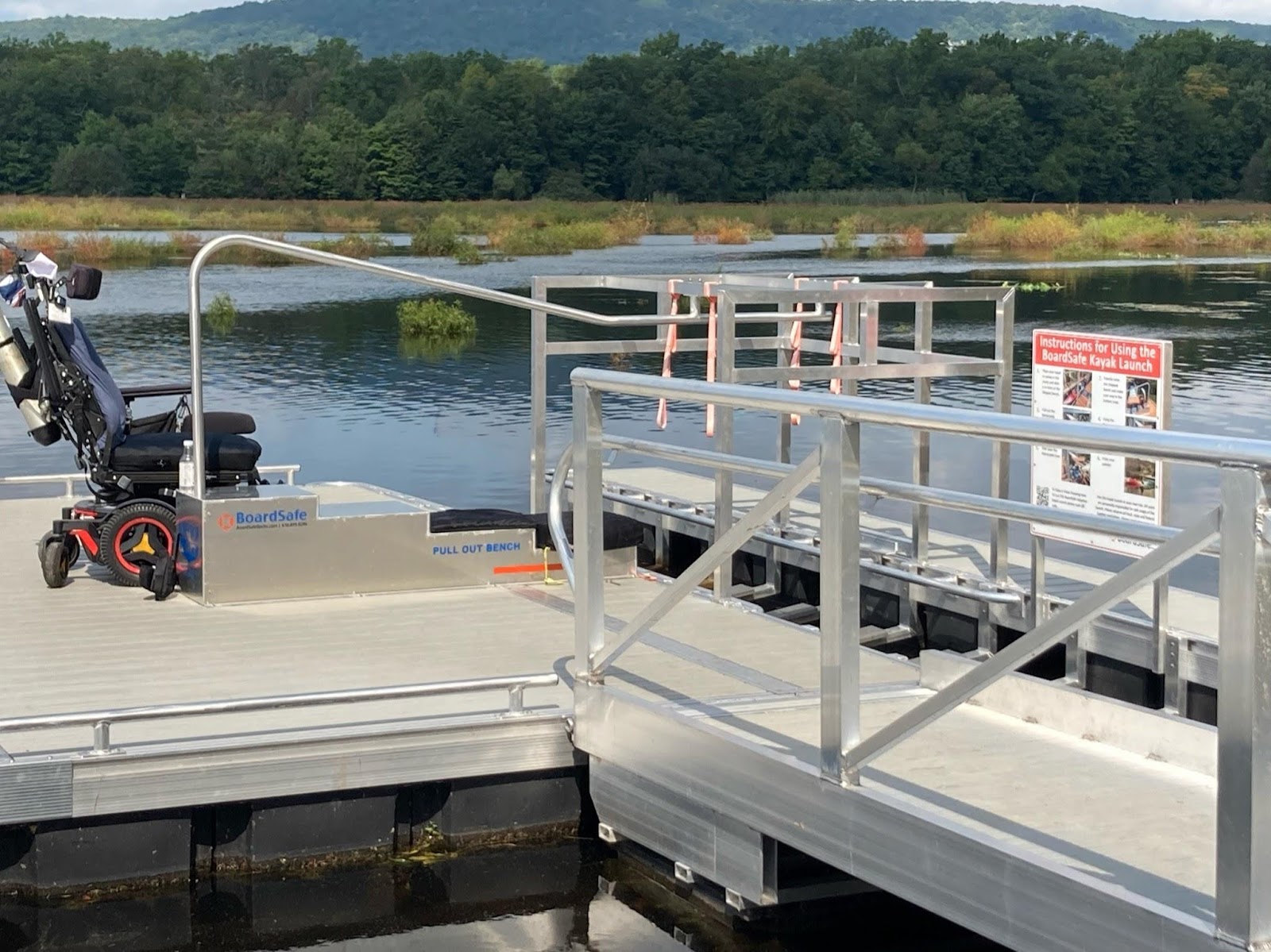
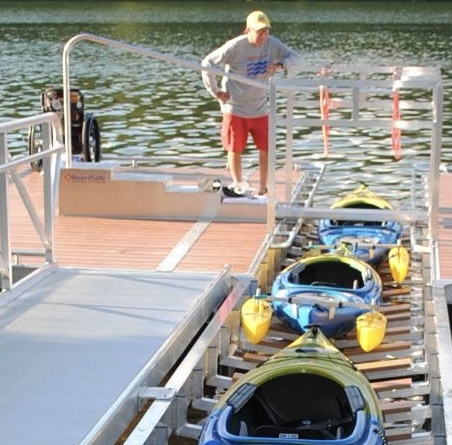
The bench should be equipped with a pull-out seat that slides out over the kayak and directly above the vessel’s cockpit. This will allow the adaptive paddler to slide down into the vessel with a safe but limited drop, and shimmy himself or herself into their kayak.
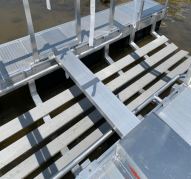
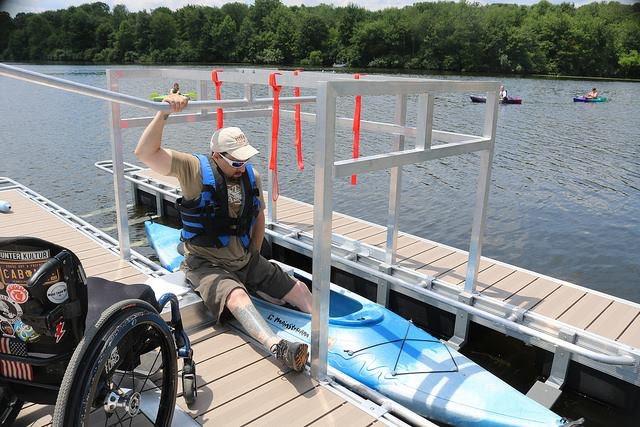
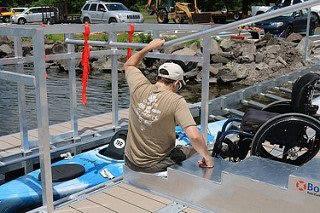
The roll cage provides support with an overhead grab bar as well as optional hand straps. Adaptive paddlers have varied upper-body strength and varied preferences as they enter and exit their vessels. Some paddlers prefer the grab bar while others prefer the hand straps. Notice that there are no obstructions along either side of the step-down bench, allowing the paddler to choose the side they prefer and are most comfortable with as they navigate themselves down the bench.
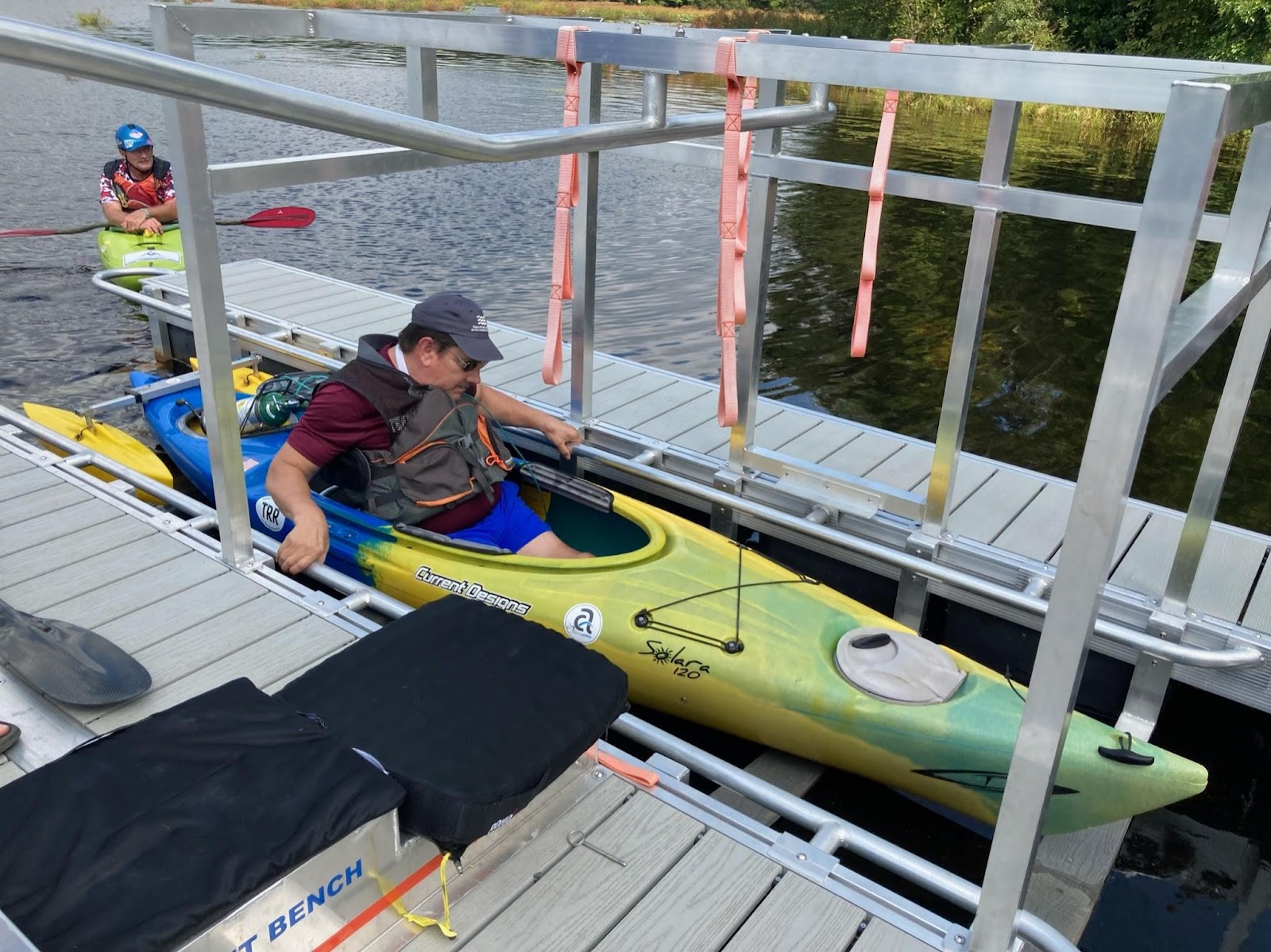
The pull bars on either side of the launch are at an elevation and distance from the paddlers that are comfortable and easy to use, allowing the paddler to pull himself or herself down the chute and into the water.
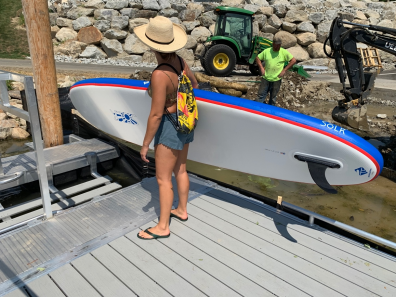
This particular kayak launch not only contains all the adaptive features necessary for an adaptive paddler — this chute is designed and equipped to accept a single, center rudder that allows users to launch a standard Stand-Up Paddle Board (SUP).
The most commonly-overlooked adaptive features
Kayak Chute
Too often, we see accessible launches that force the disabled paddler to drag their kayak behind them down the gangway. This is a challenge for those with mobility issues.
Kayak Launch Area
Too often, we find the launch area is sloped and includes rollers. When a kayak, canoe, or SUP is placed into the launch, gravity will dictate. If a kayak is not level in the chute, it will roll into the water and will not remain securely in place for the disabled paddler to board or disembark from their vessel. Rollers can actually make this condition worse because they prevent the vessel from sitting securely and remaining in place.
The launch area is too wide — in some cases, nearly 6-feet wide. This is nearly 2-feet wider than what is needed. The wider loading area makes it more difficult for a paddler to make their way from the step-down bench in order to transfer into their vessel.
Pull-Out Bench
The length of the step-down areas is too narrow, not wide enough to comfortably sit on.
There is no pull-out seat, meaning there is no way to get from the bottom of the step-down bench to the vessel. The drop is often too great of a distance for a disabled person to lower themselves safely into the kayak.
Overhead Grab Bar
The bar is not centered over the middle of the bench and is more of a handrail design that limits the user to boarding the bench from only one side.
There are no hand straps over the cockpit area to provide lifting assistance for the adaptive paddler.
Toe Kick
There must be a safety toe kick around the perimeter of the floating dock as a safety feature for all wheelchairs on the dock. This will prohibit a wheelchair from accidentally rolling off the dock into the water.
There are no published guidelines for adaptive kayak launches, only various products manufactured by a handful of dock companies that make the claim that their product provides the required adaptive features. Everyone wants to believe their system will work for the able-bodied and differently-abled paddlers, but there are often shortcomings due to a lack of standards.
At BoardSafe Docks, we have developed ongoing relationships with Team River Runner chapters, disabled veterans groups, and rehabilitation centers, and are always seeking feedback and reflections on the usability of the BoardSafe Adaptive Kayak launch and our adaptive fishing pier.
By definition, "accessible" can be defined as "physically within reach; however, it’s the specific additional adaptive features that will make a kayak launch system usable for disabled paddlers. The adaptive features are what allow them to get in and out of their vessel independently and safely.
Many accessible launch systems may look good to us visually and can be aesthetically pleasing; however, too often their features haven’t been developed to the extent necessary to truly work for the adaptive paddler.
Working with adaptive paddling groups has been a continuing educational experience for the team at BoardSafe Docks. Understanding the difference between an accessible launch and an adaptive launch is imperative for everyone considering an adaptive launch system. An accessible launch is not synonymous with an adaptive launch. BoardSafe Docks continues to work within the adaptive community of paddlers to ensure their launch remains the premier adaptive kayak launch. Their mission remains to continue to provide the best, safest, and most accessible launch for paddlers using their docks.
Watch the video below to see how the Lion’s Club, Team River Runner, and BoardSafe Docks partnered for a successful adaptive kayak launch that now benefits their whole paddling community!