
What Length Gangway Provides Handicap Access for an ADA Floating Dock, Fishing Pier, or Adaptive Kayak Launch?
Many states, cities, and other government and nonprofit entities, are promoting safe water accessibility products for adaptive athletes and individuals living with a handicap. These include a range of products, like adaptive and accessible kayak launches, ADA fishing piers and floating docks, aluminum floating rowing docks, and more. As this new industry grows in popularity, there is much uncertainty about how to design and engineer products that truly accommodate all ages and abilities. BoardSafe has become the trusted expert to engineer, design, and manufacture accessibility products for those who are serious about ADA access for their community.
We often get asked, “What length gangway do I need for my dock project?” There are many site conditions that need to be considered before this question can be answered.
One of the most important considerations is the vertical dimension from the top of the floating dock to the connection point on land. The connection point may be a concrete foundation or fixed wood pier. It is important that this dimension be determined when the water is deemed at its lowest recorded daily average. This water elevation is referred to as “mean low water” (MLW).
The slope requirement for the gangway is also an important consideration. You will need to find out what regulations you are required to follow, such as those regarding the Americans with Disabilities Act (ADA). If your project is for commercial or public use, this is something that needs to be considered. If so, you will most likely need a gangway that provides either a 1/12 (8.3%) or 1/20 (5.0%) slope. Again, this needs to be clarified by your local permitting authority. If your project is a residential application, there may be no slope requirements you need to follow. We have, however, determined that a slope of 2.75/12, or 22.9%, is the maximum slope that is comfortable to walk up or down.
Another consideration is water depth. We manufacture our gangways with flotation added to the bottom of the gangway. The reason we do this is to ensure the weight of the gangway does not put an additional point load on the dock. Quite simply, we don’t want to sink the dock because of the gangway’s weight. As a rule of thumb, we require a minimum water depth of 18 inches at the end of the gangway. This dimension may be larger for longer, more heavy gangways.
To help you determine what length gangway you will need, we’ve developed a drawing showing key dimensions and definitions. Gangway length will be based on your specific site dimensions and dock freeboard (the dimension from the top of the water to the top of the dock — please reference sketch below).
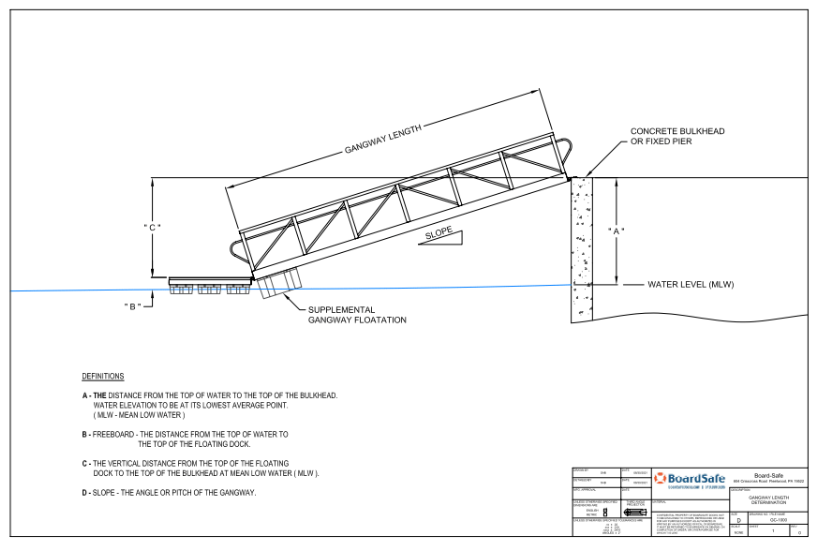
It is important to understand that BoardSafe Docks manufactures its gangways to be attached to our floating docks, not to sit on top of them.
For assistance in designing, engineering, and ordering an aluminum gangway for your project, please complete the contact form or call us at 610-899-0286.
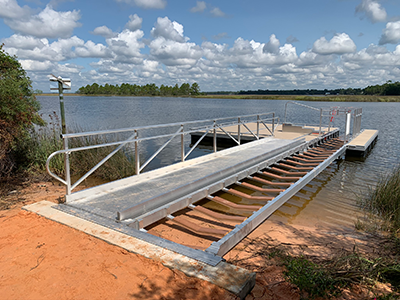
How to Calculate ADA Gangway Length to Provide Handicap Access for an ADA Floating Dock, Fishing Pier, or Adaptive Kayak Launch
Boating, paddling, and kayaking, have exploded in popularity as people of all ages and abilities seek new and exciting outdoor activities. Many community groups and government officials have taken notice of this trend and seek to open safe water access for all abilities — young and old, able-bodied and adaptive athletes. Some of the most popular accessibility products include adaptive kayak launches and accessible fishing piers that include many features that are considered Americans with Disabilities Act (ADA)-compliant. Included in this compliance is the slope of the gangway when the user moves from land, across the threshold, and onto the gangway that has a modest slope or pitch leading to the floating dock, pier, or boat launch. The slope requirement for the gangway is an important consideration.
The first step to compliance is to find out what regulations you may be required to follow, such as the Americans with Disabilities Act (ADA). If your project is for commercial or public use, this is something that needs to be considered. If so, you will most likely need a gangway that provides either a 1/12 (8.3%) or 1/20 (5.0%) slope. Again, this needs to be clarified by your local permitting authority. If your project is a residential application, there may be no slope requirements you need to follow. We have, however, determined that a slope of 2.75/12, or 22.9%, is the maximum slope that is comfortable to walk up or down. Even if your floating dock project is not subject to ADA requirements, following these requirements and features will ensure that the maximum number of users can safely use the dock or launch.
The second consideration regarding the gangway dimensions after the slope is identified is to calculate the length of the aluminum gangway. Understanding all site conditions is imperative, including the vertical dimension from the top of the floating dock to the connection point on land. The connection point may be a concrete foundation or fixed wood pier. It is important that this dimension be determined when the water is deemed at its lowest recorded daily average. This water elevation is referred to as “mean low water” (MLW).
Another consideration is water depth. BoardSafe manufactures our gangways with flotation added to the bottom of the gangway. The reason we do this is to ensure the weight of the gangway does not put an additional point load on the dock. Quite simply, we don’t want to sink the dock because of the gangway’s weight. As a rule of thumb, we require a minimum water depth of 18 inches at the end of the gangway. This dimension may be larger for longer, more heavy gangways.
Refer to the charts below to estimate the gangway length based on two factors: Dimension “C” and the slope required for your project.
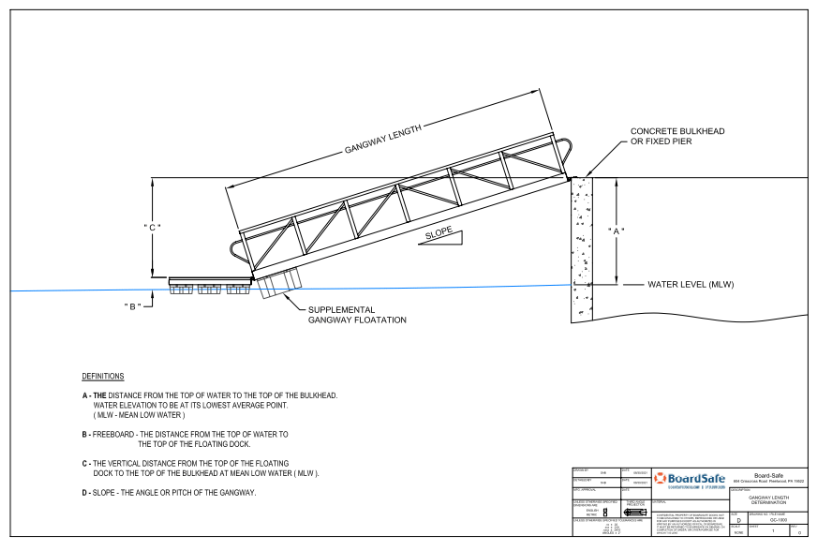
Typical Gangway Layout
Please note: Dimension “C” is determined by subtracting your dock’s freeboard (dimension “B”) from your overall height (dimension “A”) as shown on the layout below.
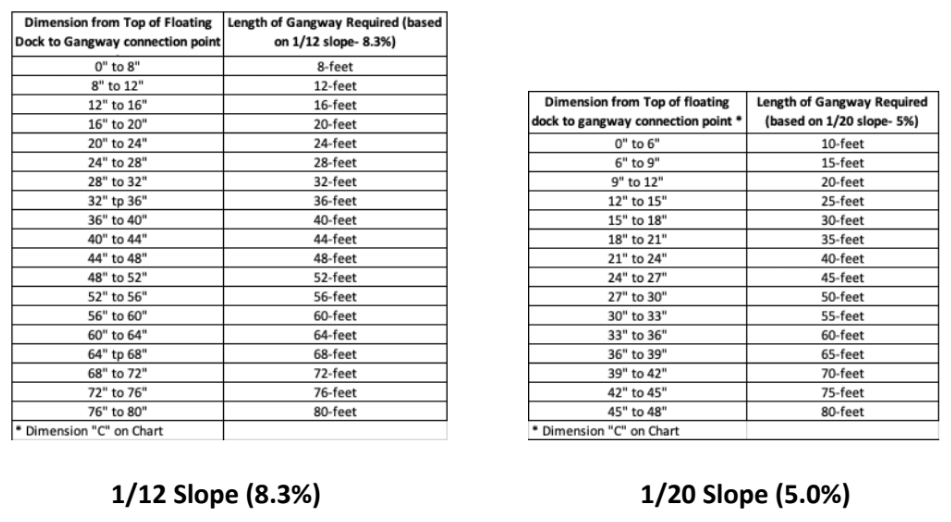
It is important to understand that BoardSafe Docks manufactures its gangways to be attached to our floating docks, not to sit on top of them. If your gangway sits on top of your floating dock, the slope and length may be different from what is shown on our charts above.
To help you determine what length gangway you will need, we’ve developed a drawing showing key dimensions and definitions, as well as charts showing gangway lengths based on your specific site dimensions and dock freeboard (the dimension from the top of the water to the top of the dock — please reference sketch below).
Please do not hesitate to contact BoardSafe Docks if you need assistance sizing the gangway for your project. Use the contact form or call our office at 610-899-0286.
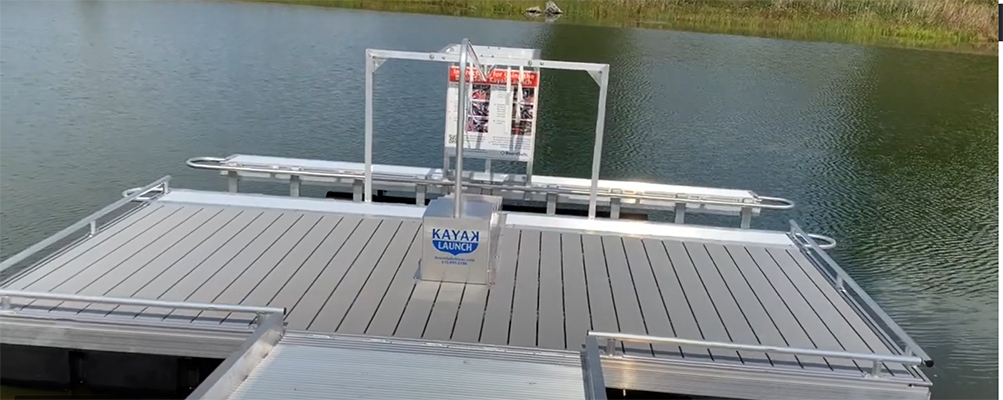
BoardSafe's Launch-in-a-Box Makes Adaptive Kayak Launch Installation Easier
BoardSafe's custom-designed and installed adaptive kayak launches make it easier for the adaptive athlete to enter and exit a kayak and enjoy the freedom of this popular water sport.
Now, BoardSafe has pioneered a concept that makes the installation process easier for the user and the user's community: Launch-in-a-Box.
One of the essential elements of any installation is the concrete foundation that provides the anchoring for the gangway / floating dock system. In a typical foundation installation, the ground must be excavated, a concrete form installed, and then poured. A few days later, the forms are stripped and then backfilled. This process can take days to complete and cost between four and five thousand dollars.
With BoardSafe’s innovative Launch-in-a-Box, the foundation arrives at your job site along with the entire dock system. All you have to do is excavate, set the precast foundation, and backfill. This process can take less than an hour to complete. There is no need for the customer to install a conventional foundation, and in most applications, the bulkhead mounting angle comes attached to the precast foundation, another time-saving benefit. This foundation option can cost as little as $2,500, a savings of up to 50% over conventional construction methods.
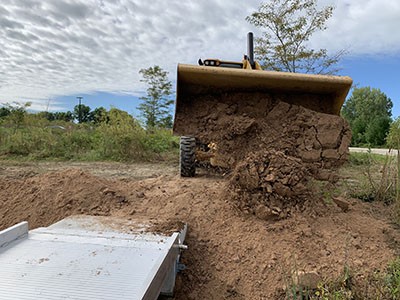
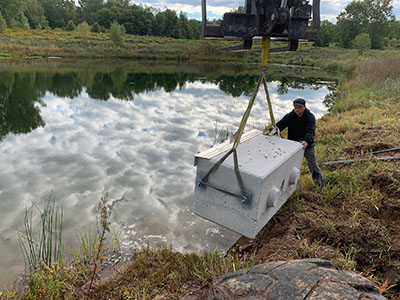
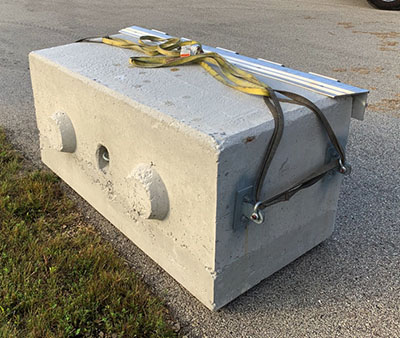
The following video of an adaptive installation in Oneida, Wisconsin, displays the ADA features of the Launch-in-a-Box. You will see the bulkhead mounting kit attached to the concrete, the gangway with toe kick, the 8' x 16' floating dock with toe kick, kayak launch, boarding bench, pull-out seat, roll cage with overhead grab bar (unique to BoardSafe), hand straps, and instruction sign with QR code that accesses an instructional video.
A few questions to consider
What size precast foundation do I need? The size of your concrete foundation will be determined by a number of factors: the length of the gangway, the size of the floating dock, and the geographical area of the installation. These are the most important factors that need to be evaluated before a recommendation can be made. To ensure that you are supplied with the correct-size precast foundation, we recommend that you contact our sales engineers for a free evaluation of your site conditions, as well as the dock system. In some areas, the recommended size of the foundation may need to be verified by a structural engineer, as well as local permitting agencies.
What if the bulkhead mounting kit isn’t installed on the foundation before arriving at my job site? In some cases, the foundation system may arrive in multiple sections, meaning the bulkhead angle will have to be attached by you in the field after the foundation block(s) is set. To help you better understand the installation process of the angle kit, we’ve developed an installation video detailing the entire process. Please note: All of the hardware shown in the video is included as part of the kit. You will, however, have to provide all of the tools referenced.
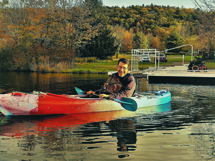
BoardSafe Spokesman and Accessible Sports Advocate Ken Ryno Keeps Chugging Along
At the age of 17, Ken Ryno had a motorcycle accident that changed his life. It did not ruin his life, but changed it for the benefit of others.
Ken was told he would never walk again. For 23 years, this was true, but it did not stop him from trying. Long story short, Ken is now a spokesman for BoardSafe Docks, touting the benefits of our ADA-accessible launches, docks, and piers.
Read Ken's remarkable story here: tnonline.com/20210612/warmest-regards-little-engine-that-could-still-chugging/.
Links to our ADA-accessible products:
Adaptive Products
Accessible Kayak Launch
Adaptive Fishing Piers
Clip-a-Launch
Instructions for Using the BoardSafe Kayak Launch
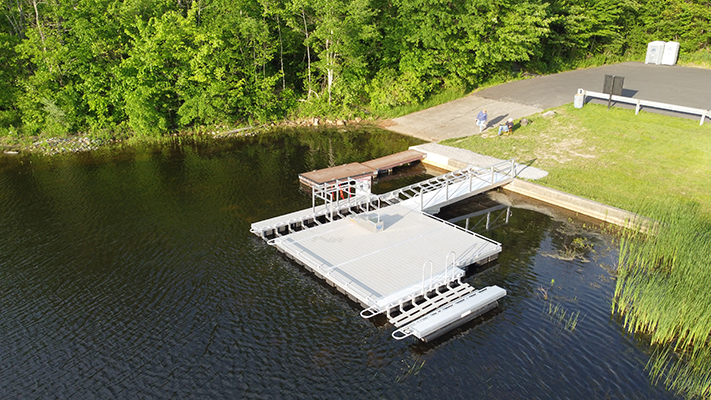
Minsi Lake Wilderness Area, PA, Proud of Their New ADA-Accessible Kayak Launch
Minsi Lake Wilderness Area is a 311-acre park, with hiking trails, picnic areas, woodlands, wetlands, and a 117-acre lake for public fishing and boating. Northampton County Parks & Recreation manages the parkland around the lake. Facilities include two paved boat launches, two parking lots, two picnic areas, and two trails. The park recently reopened after replacing, renovating, and rebuilding decades-old park amenities and infrastructure; building new recreation and park facilities; and making Minsi Lake an accessible recreation area for everyone throughout the region — opening up access to all of their community members, regardless of their physical abilities.
Of course, part of that renovation included three of BoardSafe’s innovative products. There is an ADA-accessible launch, as well as 2 ADA-accessible, 6' x 25' fishing piers. One pier is accessed by a 5' x 20' gangway, and the other by a 5' x 40' gangway.
This installation was featured on WFMZ, an Allentown, PA, news station, in this article and video.
Here are some pictures of the installation, followed by 2 recent videos:
[smartslider3 slider="5"]
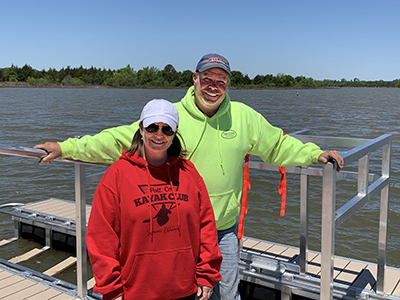
ADA-Accessible Kayak Launch for Shawnee, OK, Kayak Club
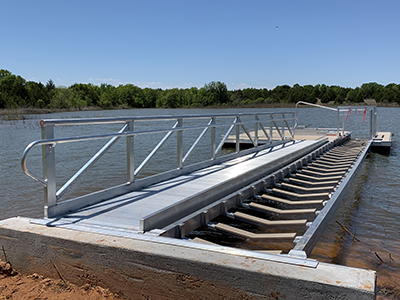

BoardSafe supplied the Pott County Kayak Club of Shawnee, Oklahoma, with an ADA-accessible kayak launch at Shawnee Twin Lakes. BoardSafe worked alongside the kayak club and a local contractor to have the kayak launch installed in late April, 2021. The 12ft x 20ft launch featured a 20ft-long access gangway direct-feed kayak chute to improve accessibility for adaptive paddlers. Our team at BoardSafe is thrilled to have assisted the Pott County Kayak Club and local community with supplying the adaptive kayak launch as one of their initial projects to build an ADA-compliant community park on the shores of Shawnee Twin Lakes.
Adaptive Features That Make a Kayak Launch ADA-Accessible
“Just because a product is marketed as ‘accessible’ doesn’t mean that we can actually use it" — Michael White, avid outdoorsman and paddler who lived with spina bifida.
BoardSafe’s uniquely-accessible kayak launches maximize the number of users in a community who can use the launch by making them truly inclusive for those with moderate to severe physical challenges.
Direct quotation made prior to becoming a BoardSafe client (See below for client testimonials.) "Not only are the transfers of some with mobility impairments questionably safe but also the moving of the kayaks in/out of the water. I was not comfortable with the consistent level of safety that we are able to provide for our volunteers, all staff and, of course, our participants.” — Alice Krauss, M.Ed., OTR/L, Manager, Adaptive Sports and Recreation, Brooks Rehabilitation
BoardSafe Docks understands the needs and concerns of adaptive athletes, so we have worked with them to engineer ADA-accessible kayak launches that incorporate our unique aluminum materials and floating mechanisms.
Here are some of the features that make BoardSafe docks the perfect choice for paddlers.
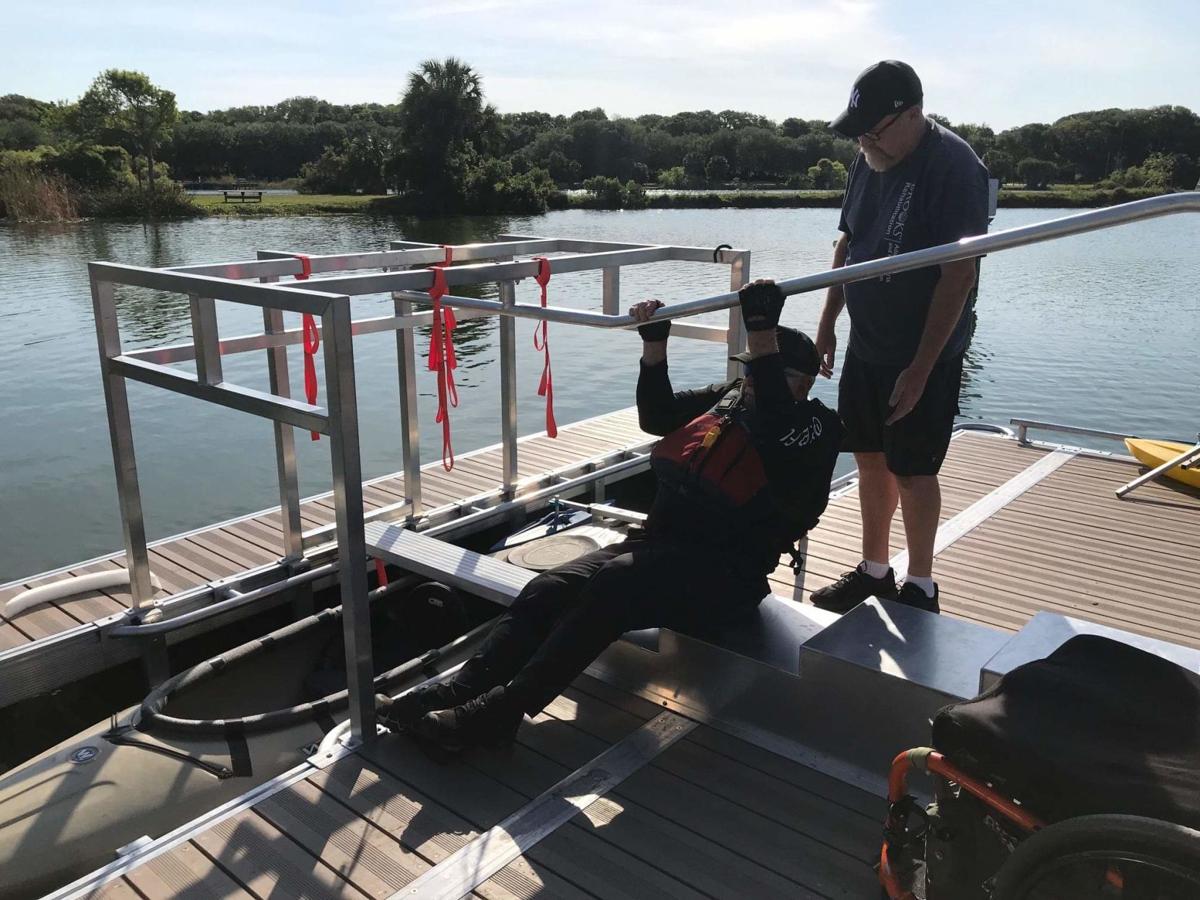
- ADA-compliant features include a uniform 1:12-slope aluminum gangway that is adjacent to the composite-decking boat slide. This design allows individuals to ease their kayak down the slide while they travel along the gangway.
- The floating dock and gangway have a 36″ continuous handrail along the perimeter, consistent with ADA requirements.
- Aluminum floating docks with boat access are engineered for maximum flotation stabilization considering the size, number, and placement of plastic-encapsulated floats. The marine conditions and water movement (tidal waters, rivers, lake ice, etc.) are also considered.
- On the floating dock, there is a loading bench that is 16″ high. Our group of adaptive kayakers determined this to be the ideal height to allow them to transfer over from a wheelchair. On the loading bench, there are four levels with 4" rises. The athlete can use the handrail that runs the length of the bench to guide himself or herself along the bench to the boat. On the last transition, there is a pullout seat that extends out and across the top of the boat. The users can simply slide across the pullout seat, locate themselves directly across the kayak seat, and guide themselves into the boat.
- Surrounding the kayak is the roll cage. It is a frame of handrails and hand straps offering the individual numerous gripping options for lowering into the boat.
- Supporting the boat in the water is a partially-submerged bracket system to stabilize the kayak.
- Our kayak launches are stand-up paddleboard (SUP) compatible, allowing the adaptive athlete to participate in the rapidly-growing SUP sport.
Client Testimonials
"We have been VERY impressed by BoardSafe, and they have developed a system which we feel is superior to the EZ Dock system." — Leon Mertz, Lake Loramie Improvement Association
"BoardSafe has all the features to provide the most access to the greatest number of users." — George White, Wetland Biologist, Team River Runner Chapter Coordinator
"After a Category 3 hurricane flooded our area we found that all the kayak launches were ripped away, except for the BoardSafe launch. It didn’t move an inch." — Chris Camp, Principal Engineer, City of Cape Coral, FL
"The construction and installation of our new ramp and dock were flawless … we are the envy of our neighbors on Boathouse Row in Philadelphia." — Michael Ragan, Pennsylvania Barge Club
This installation was highlighted on the following real estate presentation:
For more information about the BoardSafe Docks family of adaptive products, click here.
Boston's New Floating Restaurant Uses BoardSafe Gangways
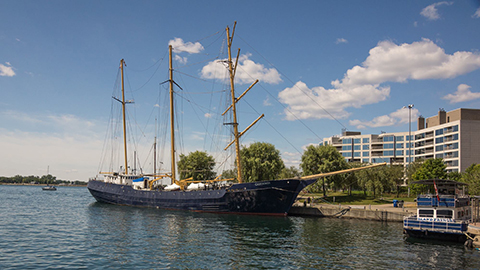
Boston Harbor is probably best-known for the Boston Tea Party. Since then, many restaurants have opened along the harbor, but BoardSafe is proud to be part of a new venture — a restaurant floating in the harbor.
Charlie Larner is outfitting the 245-foot tall ship, Caledonia, to seat 300 people on its main deck. The fare will be typical sea fare, including mostly raw fish, lobster rolls, and fresh bivalves. Cocktails will be poured at a massive bar covered by awnings made from sails.
BoardSafe is engineering and installing the gangway that will provide safe, stable access for the crowds of diners. Because Sailor's Oyster Bar will be afloat in harbor waters that are prone to large fluctuations, tidal ebbs and flows from 9 – 12 feet had to be taken into consideration during the design process. BoardSafe's decades of made-in-the-USA experience and commitment to using only the highest-grade aluminum suit such a project perfectly. We take into consideration site variables, ecology, and other considerations.
In this case, an existing, unused set of railroad tracks sparked the idea for the perfect way to manage gangway movement for the safety of the customers. The gangway can travel and pivot safely to facilitate access to this unique restaurant, displaying BoardSafe’s ability to “go with the flow.”
The new floating restaurant will be surrounded by luxury yachts and be a part of a renewed harbor venue. The BoardSafe gangway will fit right in, giving safe, reliable access to this new venture.
[metaslider id="6596"]
Here are some photos of the installation in progress.
[metaslider id="6685"]
Here are some new photos of this unique installation!
[metaslider id="6898"]
BoardSafe Is a Member of PA COSTARS' Purchasing Program
BoardSafe is a participant in the Pennsylvania COSTARS Cooperative Purchasing Program. COSTARS is the Commonwealth of Pennsylvania's cooperative purchasing program that serves as a conduit through which registered and eligible local public procurement units and state-affiliated entities are able to leverage contracts established to cost-effectively and efficiently identify suppliers with whom to do business. This streamlines the purchasing process for both sides.
The COSTARS Program's goal is to provide members with contracts that are competitively priced while delivering increased opportunities for our supplier and member partners.
Membership in COSTAR facilitates the purchase of supplies, services, and construction by entities that spend public funds, such as a council of governments or an area government, or an organization that receives public grant funds.
COSTARS suppliers, such as BoardSafe, must demonstrate high standards of responsibility and responsiveness. Many purchasers use a shortlist of preferred suppliers that they know they can depend on to deliver the goods in a timely manner and at competitive prices. Amazing customer service plus competitive pricing will go a long way to winning a member’s project!
Government agencies large and small, up and down the East Coast, have found BoardSafe to be a reliable supplier of the finest aluminum floating docks, gangways, adaptive kayak launches, and other marine recreation products. We have lived up to their COSTARS standards and reputation.
Other clients, from private citizens to boating and kayak clubs to public schools and universities, have relied on the trusted BoardSafe name.
For more information, contact us at 610-899-0286 or continue to browse our website, especially our Projects page.