


Rowing Center Aluminum Floating Dock Survives Flood
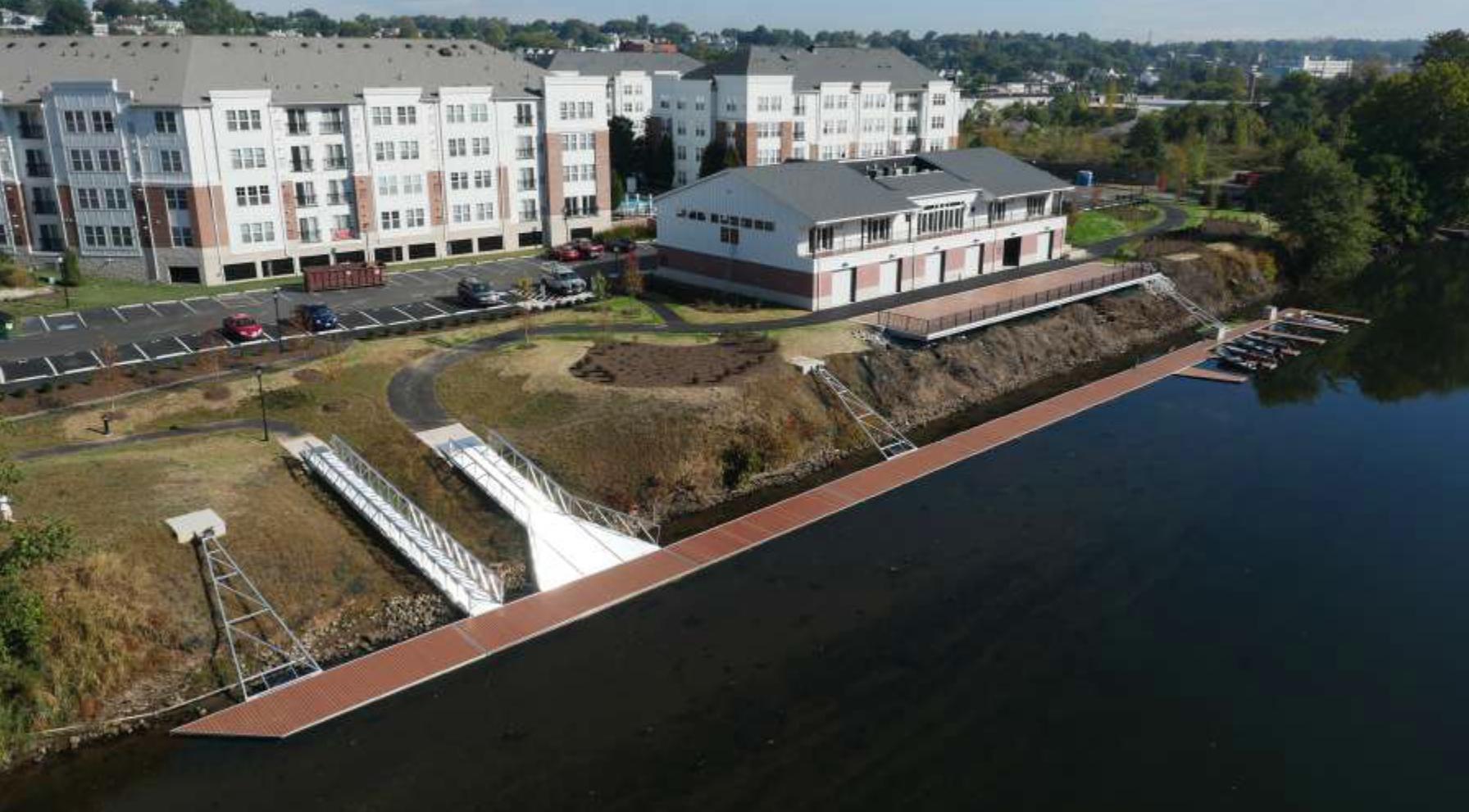
The Conshohocken Rowing Center, located north of Philadelphia on the Schuylkill River, was challenged by a rainstorm that caused the river to rise 20 feet, reaching the top of the embankment. Despite the flooding, the aluminum floating docks, gangways, and rowing center, remained intact. This is yet another testimony to BoardSafe's engineering and construction skills. Watch this on-the-spot video:
BoardSafe Provides Docks and Gangways for Philly's Boathouse Row
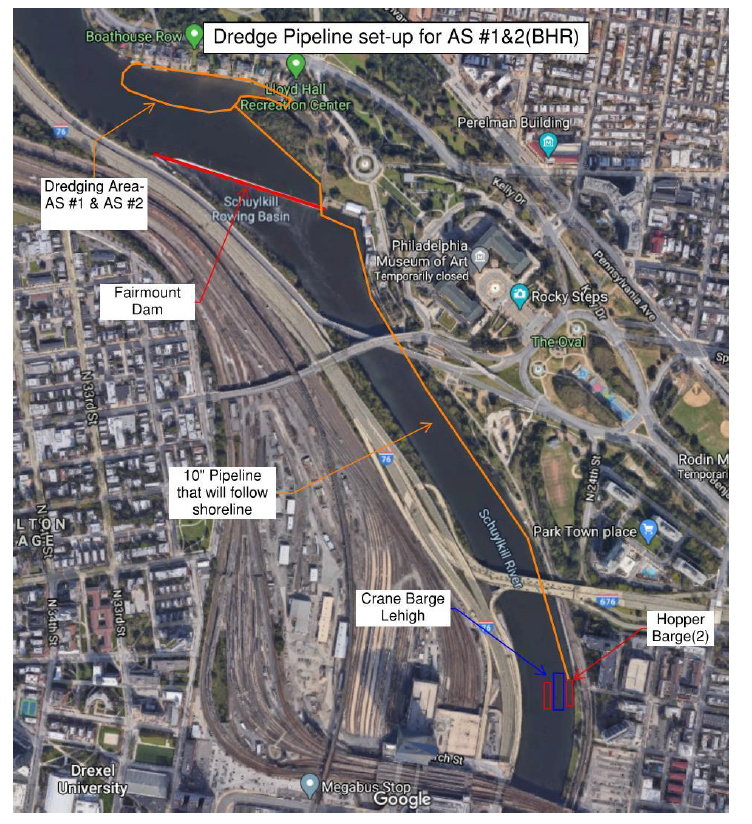
In May of 2020, Philadelphia city officials announced that the Schuylkill River would be dredged for the first time in over twenty years. Now, a team that includes a Penn Design professor is researching strategies to keep the river clear for decades to come.
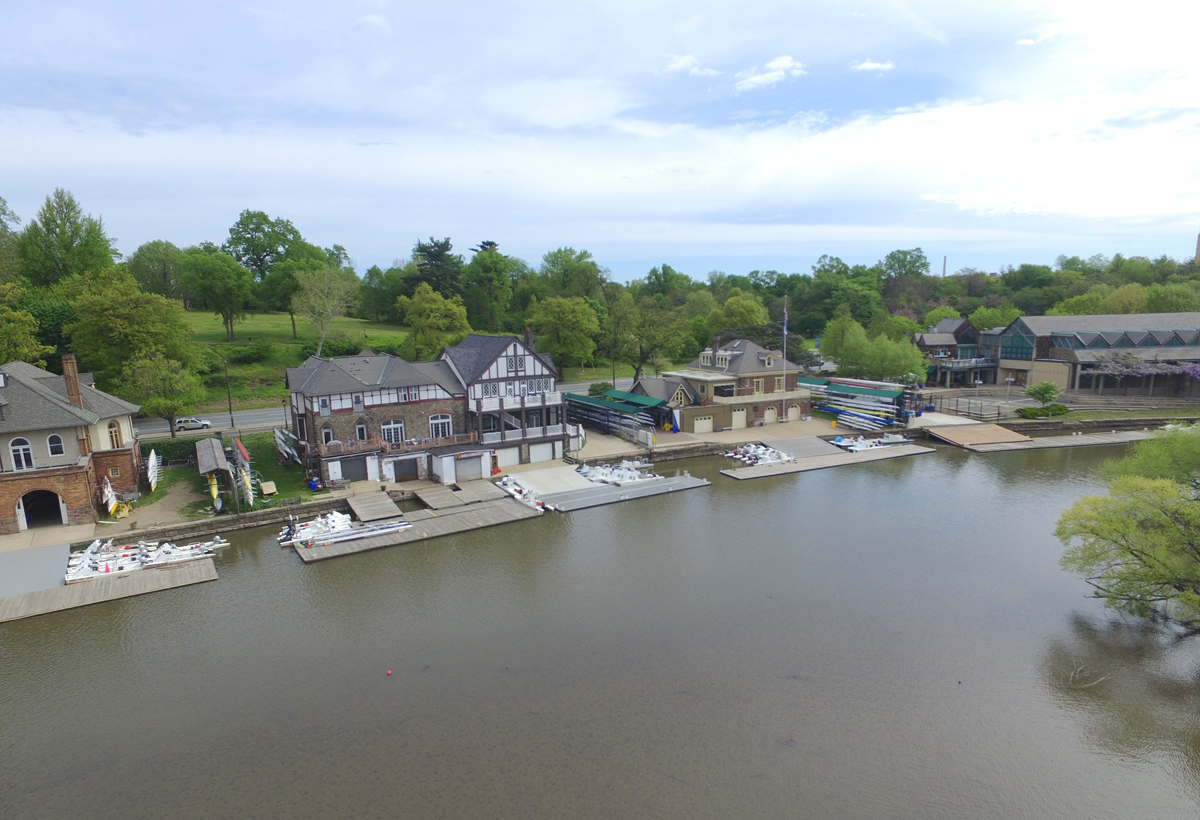
BoardSafe entered into a contract with six of the boathouses on Boathouse Row in Philadelphia. The contracts range from removing the docks and storing them prior to dredging to putting some of them back and installing new floating docks and gangways. They are working with the following boathouses: PA Barge Club, Fairmount, University, U Penn, Crescent, and Malta.
Considerations When Designing and Selecting Floating Docks for Rowing Centers
Rowing centers on the East Coast and across the United States want to ensure safety for their athletes and longevity for their rowing center investments. Not all floating docks perform well in varying situations, especially under the heavy use of a rowing season. There are several factors to be considered when a rowing club, school, college, or association, designs or purchases docks for their rowing center. BoardSafe is an expert in designing and manufacturing floating docks for rowing centers. The below characteristics are built into the unparalleled design and construction of each BoardSafe dock.
Environment
The first question for any rowing center project is, "Where is the rowing center located?" Floating docks manufactured for lakes that have little variation in water levels are much different from floating docks built for tidal waters, like bays and marshes, that see dramatic fluctuations in water levels. However, some lakes see elevation changes in water because they are river-fed or have floodgates. Rivers experience a constant downstream force and vertical movements with the change in seasons and weather patterns. These factors are calculated into the production of the docks — not only their long-term durability, but also their stability and integration. Integrating a floating dock into a rowing center includes many calculations, such as the size and location of the bulkheads, pilings (internal pilings guides or external piling guides), and gangways.
Stability
As mentioned above, stability is an important factor for floating docks in rowing centers as crewmembers board and exit their boats. Additionally, rowers must remove and carry their boats from the water. BoardSafe has a proprietary calculation for floating docks to adequately support many people, accommodate point loads, and maintain a consistent position above the water level. This includes the exact placement, size, and type of floating on the floating dock. BoardSafe rowing docks also have a 5-inch freeboard. This, coupled with the dock’s overall stability, gives rowers confidence as they enter and exit their rowing shells.
Use
Rowing centers and rowing docks are obviously used for rowing. The real question is, "How are they used?" How many crews, staff members, and others, will be using the floating docks? What are the ideal dimensions for the floating docks, finger docks, and gangways? Where are the boats stored and loaded? What is the configuration of the rowing center, floating docks, finger docks, gangways, etc.? Are the boats parallel or perpendicular to the main floating docks when they are boarded?
Safe surfaces
BoardSafe specializes in manufacturing aluminum docks with composite or synthetic lumber. Specifically, BoardSafe uses NyloDeck, a composite lumber made of recycled carpet fibers, that contains no wood flour or PVC. This means that NyloDeck is ground-rated and resistant to rot, insect damage, and other wood afflictions. NyloBoard has a slip-safe surface, and the decking is held in place by the proprietary TimberStrong hidden fastening system. There are no face-nailing, splinters, or nail pops, and boards stay consistently in place over time.
High quality
All BoardSafe docks use the highest-quality materials. These include marine-grade 6160 aluminum, a proprietary extruded-aluminum frame, and plastic-encapsulated foam floats. The NyloDeck composite lumber decking on the floating dock is the only 1-inch composite deck board rated to span joists at 24 inches on center and at 16 inches on diagonals. It is twice as strong as other leading decking materials. Lightweight and easy to work with, NyloDeck is impervious to moisture, mold, mildew, and insects. The NyloDeck boards are fastened with a unique hidden fastener system developed by TimberStrong. Additionally, the hinges on the floating docks are mechanically attached to the dock. This means they are stronger. There is no welded connection holding the floating docks, like on competitors’ docks, that can compromise the integrity of the dock. It also means that dock sizes can easily be increased by connecting additional floating docks together.
Options
BoardSafe docks are built smart. They are environmentally-friendly, offering a float-through-float design that allows light to pass through to vegetation and water, and debris and plants and wildlife to pass underneath unhindered. We recommend that rowing centers work with experienced dock manufacturers who can anticipate needs and issues as well as offer solutions that make the rowing center the best it can be.
BoardSafe manufactures aluminum floating docks, piers, and gangways. We have designed and manufactured numerous specialty projects, including rowing centers and ADA docks and boat launches. For more information on your rowing center project, marina, and commercial or residential docks, call 610-899-0286 or visit boardsafedocks.com/.
Best Rowing Dock in Philadelphia Is not at Boathouse Row
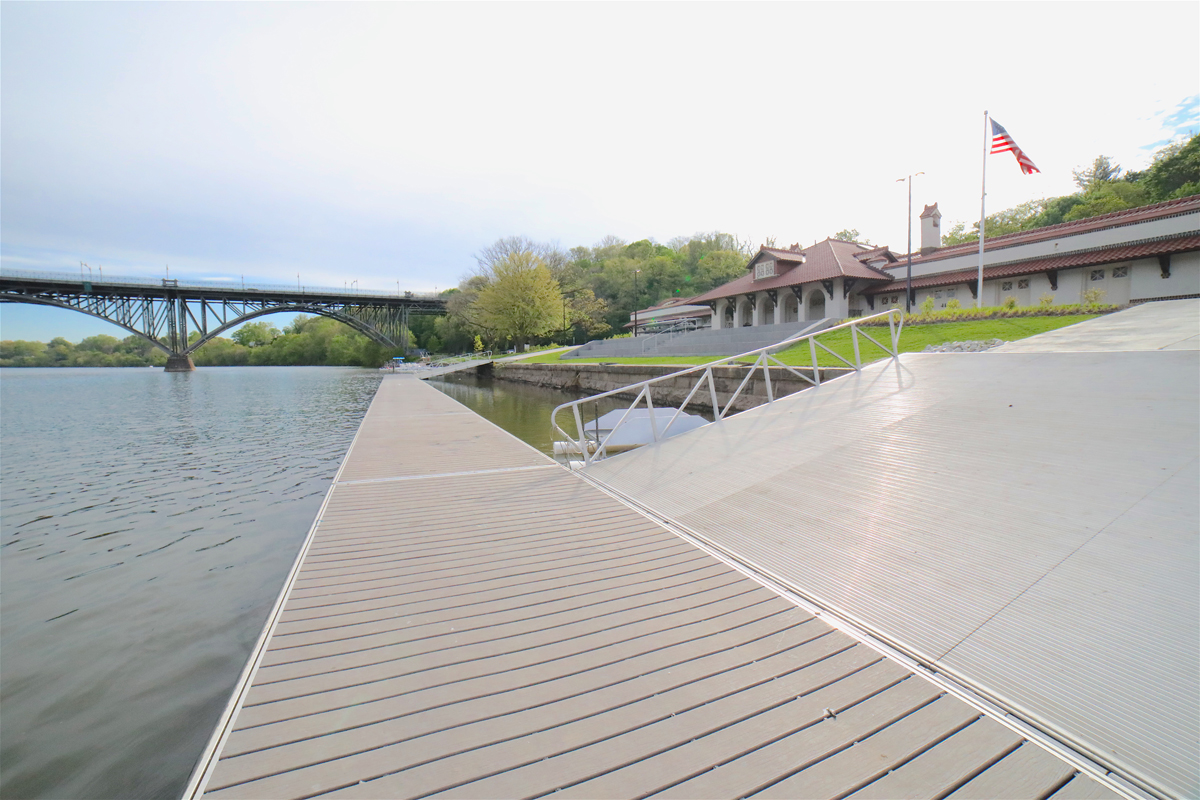
Like any sport, rowing is competitive. Not only is there competition in the water, but there is also competition out of the water. Temple University's rowing coach says that they have the best rowing dock in Philadelphia. We concur because we believe that we design and manufacture the finest rowing docks and rowing centers around. An aluminum rowing dock with synthetic lumber decking that is 280-feet long, and that is accessed by two 24' x 40' aluminum gangways, is very hard to compete with. That is why Temple is bragging (and so are we). There is pride in rowing and pride in manufacturing great products. Watch the video:
The Temple University Rowing Center is a state-of-the-art facility on the Schuylkill River, characterized as "the best rowing center in Philadelphia" by their crew coach, Brian Perkins. The Temple boathouse is located 2.5 miles north of the famed Boathouse Row, and 11 miles south of the Conshohocken Rowing Center. The site is specially engineered to be fastened into the river bank anchor points above the historic cement riverbank wall. It is also designed to handle the torque from the river current and water level fluctuations. Additionally, the design maintains a 6" freeboard for easy entry and exit from boats and can support varying weight requirements during large events and regattas.
The rowing center was designed, manufactured, and installed by BoardSafe, an experienced manufacturer of aluminum floating docks, aluminum gangways, pedestrian bridges, and other marina access products. For more information about BoardSafe's products or to see their list of rowing center projects, visit boardsafe.com.
Penn's Landing, Pennsylvania, Commercial Gangway
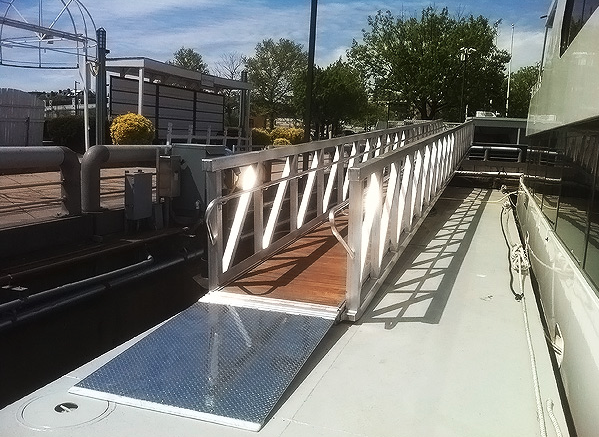
Penn's Landing, Philadelphia's premier waterfront destination located on the Delaware River, is the home port of the Freedom Elite, one of the area's newest private yachts. The new ship required dockage that included removing old mooring pilings, installing new mooring pilings, installing two 10-foot-by-40-foot barges, and installing a landing platform cantilevered off the existing bulkhead wall. When it was determined a gangway and stairs would need to be included for the project, BoardSafe was naturally asked to provide those items.
BoardSafe met with company officials and determined that, because of the elevation difference between the new landing platform and the barge surfaces at mean low tide, an 80-foot long gangway would need to be provided. BoardSafe suggested using dock products engineered, designed, and manufactured by BoardSafe. Design loads were determined, calculations completed, and a final design generated. The fabricators at BoardSafe then consulted the drawings and manufactured the gangway, landing platform, and stairs. The components were constructed using BoardSafe proprietary shapes and standard shapes. Decking was Ipe, supplied in panel form by TimberStrong.
"We have had a few events on the new yacht and we are getting many compliments on the ramp! It looks great." — Mary Rinaldo, General Manager
Quaker Penn Park, PA, Floating Docks and Gangway
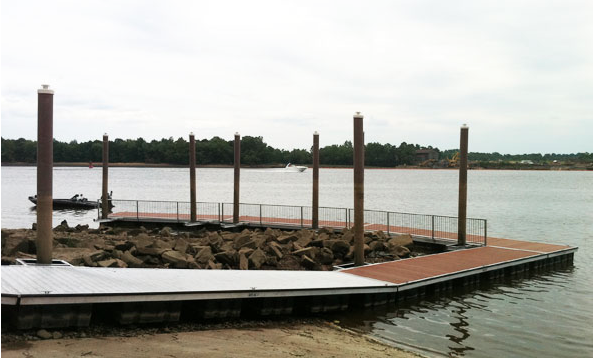
Falls Township's vision was to provide township residents and boating enthusiasts in general with a state-of-the-art boat launching facility. To put their plan into motion, they contracted with T&M Associates to prepare a master plan for the facility located on the Delaware River.
The plan was to include a parking lot, boat ramp (to launch 2 boats at the same time), and nearly 2,500 square feet of floating docks. Because of the unique configuration of the floating docks, T&M looked to BoardSafe for design consultation. Unlike most boat launching areas that incorporate floating docks with access provided by a movable gangway, the Quaker Penn Park boat ramp needed to be designed so all floating docks moved in and out with the fluctuation of the tide, which is nearly 8 feet. To allow for the movement, BoardSafe 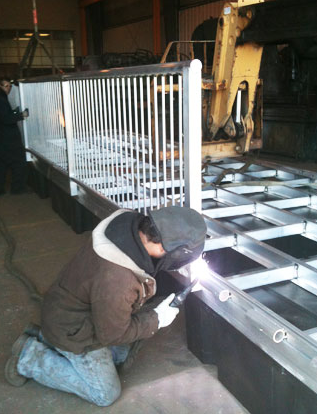 designed custom piling guides that not only provided room for movement, they also were configured to move in and out without binding and possibly tearing the docks apart.
Because of Falls Township's commitment to using sustainable materials for the project, they approved the use of TimberStrong Deck Panels featuring GeoDeck composite decking. In addition to the decking, fiberglass composite pilings from Pearson Pilings were used to secure the floating docks. All frames were aluminum, using BoardSafe aluminum decking on the angled sections of the floating docks.
Flat Rock Park, PA, Floating Docks and Gangway
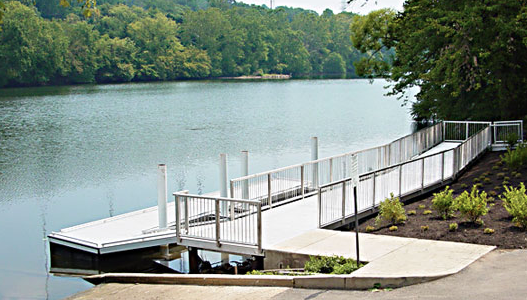
When Lower Merion Township, north of Philadelphia, Pennsylvania, commissioned an upgrade for their public boating facility, Flat Rock Park on the Schuylkill River, they contacted the Pennoni engiuneering firm to produce the drawings and specifications.
In turn, Pennoni contacted BoardSafe to consult on the design of the elevated walkway, gangway, and floating docks. During the design phase of the project, the designers at BoardSafe suggested that the original pier — specified to be constructed from pressure-treated lumber — be upgraded to a design consisting of all-aluminum construction. Township officials were consulted and agreed the all-aluminum upgrade would eliminate any maintenance issues as well as provide a pier that will have a much longer life cycle than the original design.
Construction drawings were prepared, reviewed by an independent professional engineer, then stamped by the PE. The drawings were then sent to the BoardSafe manufacturing facility where all of the components were manufactured. Once completed, the dock sections were delivered to the job site for installation by an independent contractor.
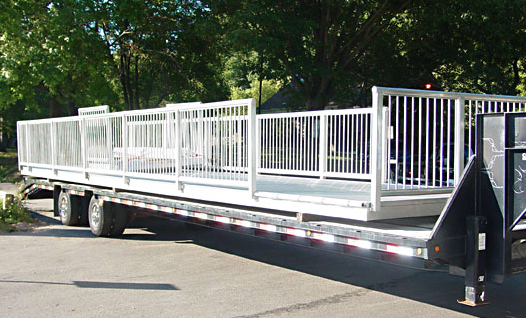 The final design consists of an 8-foot-wide-by-80-foot-long stationary pier, 6-foot-by-12-foot gangway, and a two- section 6-foot-by-40-foot-long floating dock. The floating dock required four custom-made piling guides. The piling guides were made in two pieces so they could easily be removed from around the Pearson Fiberglass Pilings and allow the floating dock and gangway to be removed at the end of the boating season for winter storage, then easily be reinstalled in the beginning of the boating season.
The project has been well-received by the Township and acknowledged by the community as an enormous upgrade from the antiquated pressure-treated dock system that existed prior to the installation of the new aluminum floating boat dock, gangway, and stationary walkway.
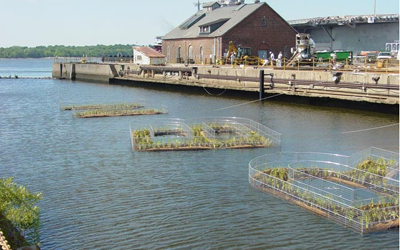
Urban Outfitters Floating Garden
Urban Outfitters, Inc., is a large clothing and accessory retailer offering the brand names of Urban Outfitters, Anthropologie, Free People, Leifsdottir, and Terrain. Urban's corporate headquarters is located at The Navy Yard in Philadelphia, Pennsylvania, on the Delaware River.
As part of the master plan for their facilities, they desired to construct floating hydroponic gardens in Dry Dock #1. The challenge was to create individual gardens in the shape of 4 distinct letters: URBN (this is Urban's designation on the Nasdaq).
The completed letter assembly would need to be nearly 30 feet high and 150 feet long. In addition to the gardens, a trash boom spanning nearly 100 feet long had to be installed at the mouth of the dry dock to prevent debris from entering the dry dock.
To accomplish their vision, Urban contracted with BoardSafe to make their plan a reality. The initial concept drawings were completed by the landscape architectural firm D.I.R.T. Studio of Charlottesville, Virginia. BoardSafe then took the concept drawings and designed a floating structure that not only included the floating letters, but also a massive underwater support structure connecting the letters together.
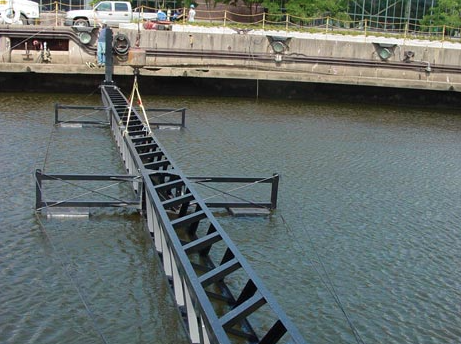 In addition to holding the letters together, the support structure allowed the entire assembly to move up and down with the fluctuation of the tide. The challenge was to make the entire structure "non-permanent" so the use of the dry dock could be changed at any time. The trash boom presented the same challenge. To facilitate the easy removal of the assemblies, powder-coated steel I-beams were attached vertically to the side of the dry dock in 6 locations, providing an attachment point for the underwater boom assemblies.
On the end of each boom, a roller assembly travels up and down the I-beams, following the tidal elevation. The letter frames, booms, underwater support structure, and trash boom, were fabricated from aluminum and then powder-coated black. Once each letter was assembled on land, a plastic Brillo©-like material was installed and the different species of vegetation were planted. A 2-foot high fence was then constructed to outline each letter. The fence serves two purposes: to keep wildlife from nesting in the gardens, and to delineate each letter once the plants began to grow.
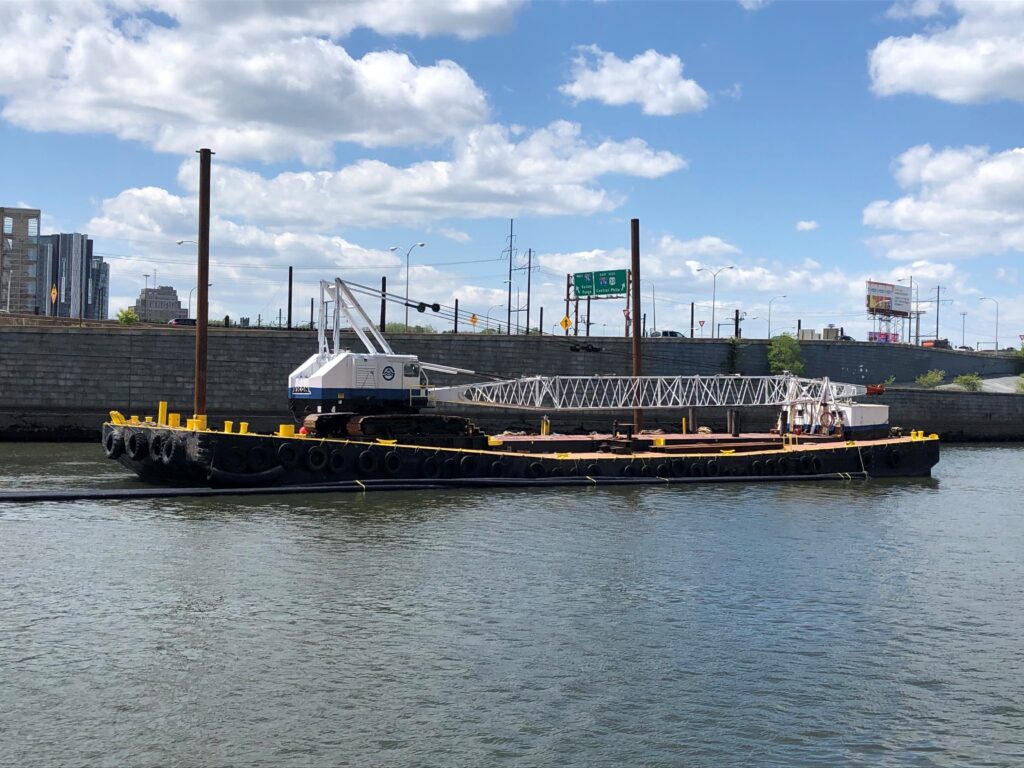
All components were assembled on land, then installed using a crane, workers on the ground, and scuba divers.
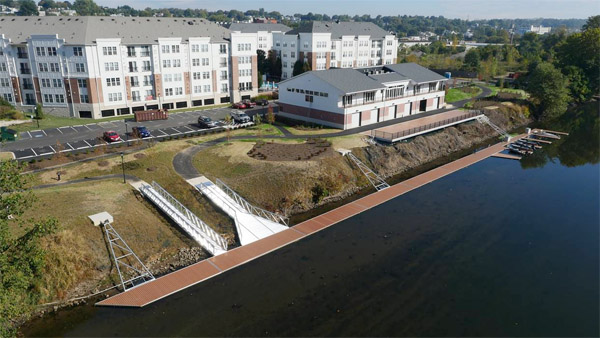
Conshohocken, PA, Rowing Center Features BoardSafe Aluminum Docks and Products
One of the centers of the rowing community in the United States is Boathouse Row in Philadelphia. Rowers from the boathouses compete at every level, including local clubs, high schools, colleges, summer racing programs, and international-level athletics. The newest and finest facility in the area is not at Boathouse Row, but a few miles upstream.
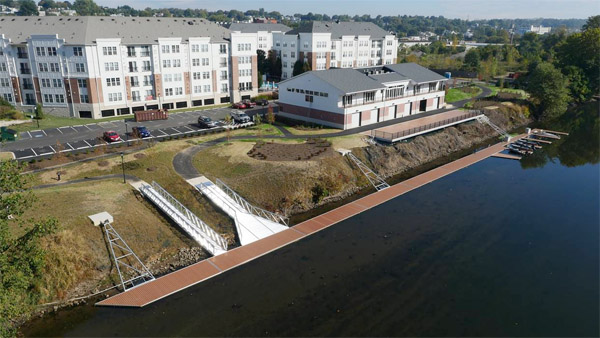
Conshohocken is located just north of Philadelphia, PA, on the Schuylkill River. The Conshohocken Rowing Center was unveiled in October 2014. The state-of-the-art facility is a 6-bay building that houses The Haverford School , Malvern Preparatory School, and the Borough of Conshohocken. The operation of the building is a public and private relationship that encourages local and youth rowing. Because rowing is serious business in Philadelphia, the members of Conshohocken Rowing Center wanted the best dock builder they could find.
They did not have to look hard to find Pennsylvania-based BoardSafe, a trusted and expert dock builder with projects up and down the east coast. BoardSafe custom-designed, manufactured, and installed the docks and the observation deck.
The observation deck is an aluminum frame dock with Nylodeck synthetic wood, featuring the TimberStrong fastening system. The large observation deck was designed to provide great views and accommodate several hundred fans. The deck runs along the rear of the rowing center building and was engineered to cantilever over the riverbank. It measures 24-feet by 122-feet and features:
- a concrete foundation system (engineered by Innovative Marine Solutions , a sister company of BoardSafe - PE stamped drawings).
- a galvanizedstructural steel support frame (also engineered by Innovative Marine Solutions - PE stamped drawings).
- fifteen (15) 8-foot-by-24-foot aluminum joist system panels.
- a 42-inch high ultra aluminum rail - powder-coated black.
- docks designed to provide a 6-inch freeboard under no live load. The docks are BoardSafe Commercial Aluminum, featuring NyloDeck (Desert Spice color) attached to the frame with the TimberStrong fastening system.
- steel frame components, aluminum panels, decking, and railings, installed by Innovative Marine Solutions employees.
As impressive as the observation deck is, the floating docks and structure are unparalleled (scroll down to watch aerial videography of the project).
The floating docks project includes:
- one main aluminum dock measuring 10-feet wide by 360-feet long.
- six finger piers and three support arms.
- a 42-inch high ultra aluminum rail - powder-coated black
- The docks were designed to provide a 6-inch freeboard under no live load. The docks are BoardSafe Commercial Aluminum, featuring NyloDeck (Desert Spice color) attached to the frame with the TimberStrong fastening system.
All of the steel frame components, aluminum panels, decking, and railings, were installed by BoardSafe.
BoardSafe specializes in manufacturing aluminum docks, gangways, and rowing centers, all in the USA. If you have a rowing center or marina project and you would like to learn more, visit BoardSafeDocks.com or call 610-899-0286.