


BoardSafe Docks Assists Legacy Parks for Annual Luncheon for the Parks
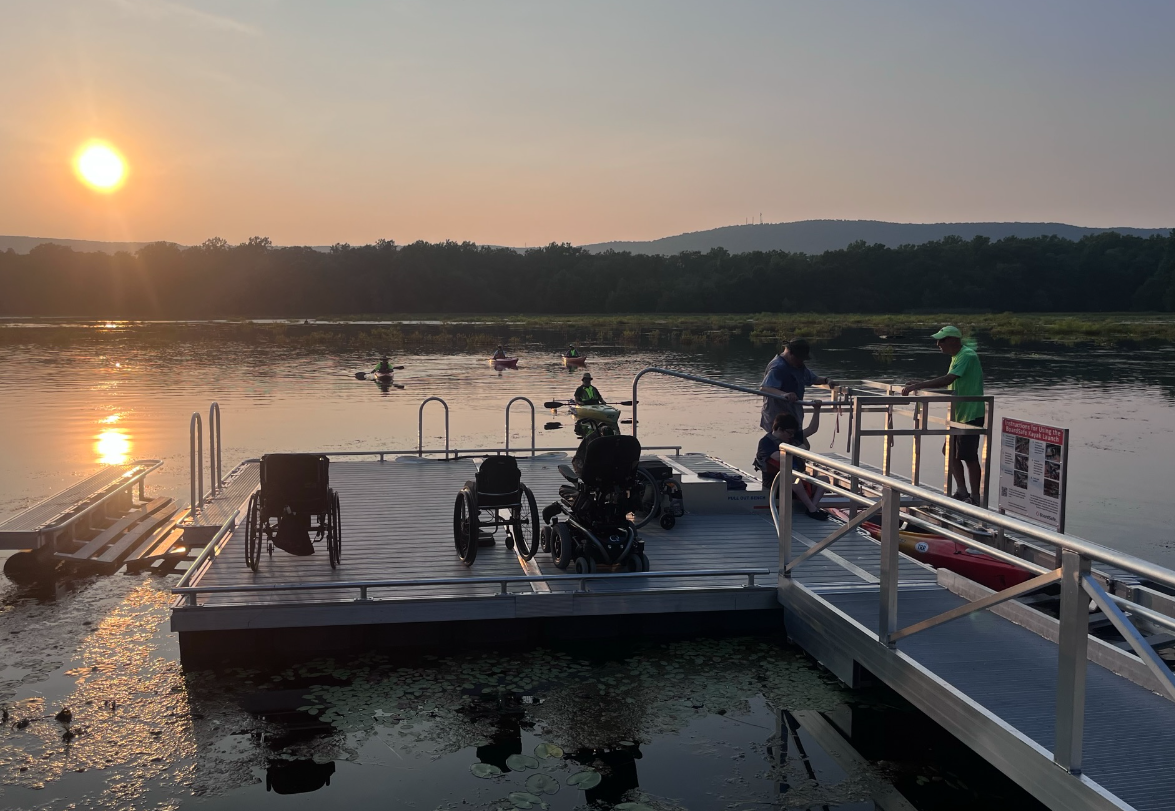
Legacy Parks Foundation is making final preparations for its annual Luncheon for the Parks on September 29, 2023, from 11:30 a.m.–1:00 p.m. at Seven Islands State Birding Park. The luncheon raises funds to conserve natural resources, create public places for recreation, and connect Tennessee communities. Through the generous support of donors, incredible open spaces are shaping into attractive recreational sites throughout the Knox County region. BoardSafe Docks provides water access products for Legacy Parks throughout East Tennessee by designing and manufacturing Adaptive Kayak Launches, Fishing Piers, Floating Docks, Gangways, and Pedestrian Bridges.
The guest speaker at this year’s sold-out luncheon is Chuck Leavell, who has been pleasing the ears of music fans for more than 40 years. His piano and keyboard skills have been part of The Allman Brothers Band, Eric Clapton, The Rolling Stones, The Black Crowes, Blues Traveler, Train, George Harrison, The Indigo Girls, Montgomery-Gentry, and many more. Watch his impressive documentary here: Chuck Leavell: The Tree Man (1080p) FULL MOVIE …

In addition to his brilliance in the music arena, Leavell is also a respected authority on conservation and forestry. He is a published author, co-founder of The Mother Nature Network, and host of the PBS series, “America's Forests.” In 2019, he and his wife, Rose Lane, were recognized as National Outstanding Tree Farmers of the Year.
His mission shares an important message about caring for and saving our forests.
Head of the Tennessee Initiative creates accessibility for all
Starting at the Seven Islands State Birding Park location, Legacy Parks, in collaboration with Knox County, TVA, Tennessee Wildlife Resources Agency, Tennessee State Parks, UT Research Park, and BoardSafe Docks, is working to create inclusive access to East Tennessee’s waterways. Together, they share the vision to expand access points along the 25-mile water trail between Seven Islands State Park and UT Research Park, and create recreational sites that are accessible to all.
Features of the Tennessee Rivers
The French Broad and Holston Rivers confluence at Knoxville to form the beginning of the Tennessee River. They are tremendous natural assets with exceptional recreational potential for Knox County and surrounding communities.
The French Broad River
The French Broad River is believed to be one of the oldest rivers in the world based on the dating of rocks examined along its riverbanks. Locally, it offers a variety of recreation opportunities, including tubing, paddleboarding, kayaking, and fishing. Its tributaries are ideal habitats for several trout species, bass, bluegill, crappie, and the eastern spiny softshell turtle.
The Holston River
The picturesque Holston River begins in the foothills of the Blue Ridge Mountains and runs for 274 miles through Virginia into Tennessee. The part of the river below Cherokee Dam is possibly the most scenic water trail in the Tennessee Valley. Paddlers enjoy this panoramic paddle as it winds its way into the Tennessee River at Knoxville.
Between 1940 and 1950, the Tennessee Valley Authority built four dams on the Holston to provide electricity and control flooding. Today, the river is the most critical source of drinking water for communities south of the river and a place for fishing and recreation.
The Importance of paddle access for all
Paddling and exploring the water bring people and nature together for a blend of relaxation and good physical fun. They bring families and friends together, connect people with nature, and most importantly, promote exercise and wellness. There are so many reasons propelling around the water is attractive. When you step into a kayak, push off into a canal or river, and take those first few paddle strokes, nature surrounds you at every level. People are getting hooked on paddle sports. Paddling is an activity that almost everyone can participate in—young and old, novice and experienced, and people with mobility limitations.
Kayaking has become increasingly popular for paddlers with physical disabilities, amputees, and those with paralysis. It offers rehabilitation, exercise, and socialization. Most importantly, kayaking allows adaptive paddlers to be out on the water like everyone else. They describe the freedom of leaving their wheelchairs and transitioning into a kayak as “liberating.”
According to the Disability & Health U.S. State Profile Data from the CDC, 15% of adults in Tennessee experience a mobility disability. Nationally, one out of four people lives with a disability, limiting their options for recreation and play.
Ensuring that water access points are inclusive and accessible to all encourages more people to participate in outdoor activities on the water. Disability transcends all ages, political persuasions, races, incomes, titles, and degrees. It impacts everyone, and yet, there is still work to be done to ensure that everyone feels welcome and included. The Legacy Parks Foundation invites everyone to be part of the solution to change things that have kept people with disabilities and physical limitations from participating and enjoying the water. Our Work—Legacy Parks Foundation shows the results of and improvements from the combined efforts of many stakeholders, yet there is so much more they can accomplish.
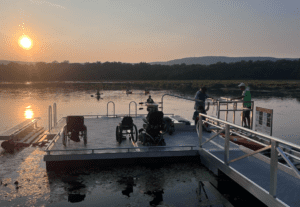
Financial gifts play an important role in supporting programs that offer accessibility to all, improve parks, and allow people with disabilities and mobility limitations to be active in their communities and feel welcome to participate with families and friends.
There are many ways to support the Legacy Parks Foundation and the Head of the Tennessee Initiative. To become a friend, read more about their initiatives, or talk about planned giving or providing gifts of land or trail easements, head over to How to Help—Legacy Parks Foundation.
BoardSafe Docks is honored to partner with the Legacy Parks Foundation and be a Platinum Sponsor for their upcoming Luncheon for the Parks. BoardSafe’s Accessible and Adaptive Kayak Launch provides paddlers the ability to enjoy the outdoor lifestyle they’re looking for—safely, easily, and responsibly. They understand the value their accessibility products bring to communities and to the people using them. BoardSafe’s aluminum floating docks, fishing piers, and boat launches are easy to install and will look amazing for many years to come.
Contact BoardSafe Docks at 610-899-0286 to learn more about the most durable and accessible aluminum floating launch options for any location. Our team will help you find the ideal solution to meet your water access needs.
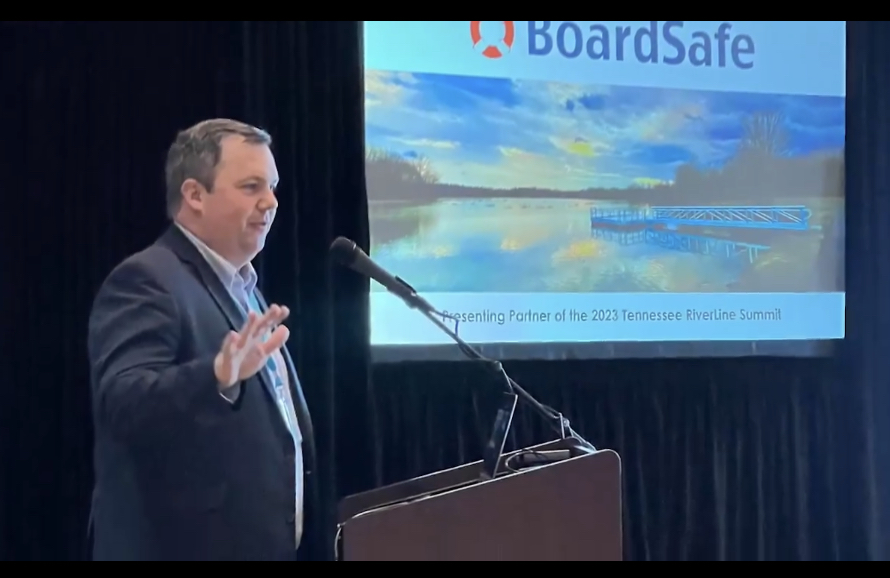
BoardSafe Docks Recognized as Platinum Sponsor for SOBA's 2023 Symposium
BoardSafe Docks is thrilled to be among the largest group of professionals actively engaged in improving and expanding public boating access across the United States at the SOBA Annual Education & Training Symposium, happening now in Tacoma, Washington. The symposium attracts nearly 200 state program specialists, boating and marine-related manufacturers, engineers, materials specialty industries, contractors, educators, state and federal agencies, consulting firms, private and nonprofit companies, and other boating organizations.
As a forum for water and boating access resources, the four-day SOBA symposium is the place to be for boating access and outdoor recreation professionals and any organizations wishing to keep abreast of the latest materials, designs, and construction techniques.
This annual event is the largest gathering of professionals and affiliate organization representatives engaged in improving and expanding public boating access. This year’s lineup of dynamic speakers is sharing insights into work happening in motorized boating access and non-motorized inclusive river access throughout the United States. SOBA is an organization devoted to the acquisition, development, and administration of public recreational boating facilities nationwide.

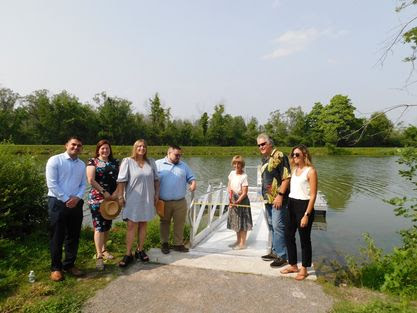
Manlius Recreation Department Installs BoardSafe Accessible Kayak Launch
The recreation department in the Town of Manlius, New York, recently celebrated the addition of a BoardSafe Adaptive Kayak Launch with a ribbon-cutting ceremony.
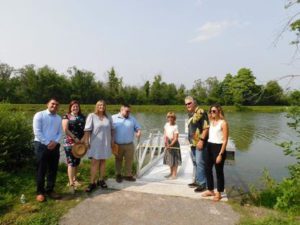
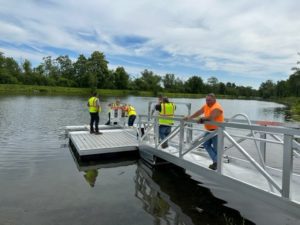 The Town of Manlius is located in Onondaga County, a southeast suburb of Syracuse, New York. The town was settled in 1794 and includes the villages of Manlius, Fayetteville, and Minoa. During its early years, its economy mainly focused on trade generated by the Erie Canal, which contributed to the early development of the town. Today, the Town of Manlius is the third largest suburb surrounding Syracuse. The town’s recreation department was looking to provide expanded accessibility to canoes and kayaks and provide safer and easier access to its waterway.
The accessible launch system manufactured by BoardSafe Docks includes an adaptive kit equipped with features for paddlers in wheelchairs, and a 24-ft.-long accessible gangway providing accessibility for all while offering differently-abled paddlers the opportunity to paddle the canal with family and friends.
BoardSafe Docks worked with Madison County, the Town of Manlius, and the NYS Parks on the original design and layout to ensure the optimal site was selected to access the lake and ensure accessibility from the parking area. The Town of Manlius highway department installed the foundation and dock system with construction oversight provided by BoardSafe Docks.
The kayak launch was installed in the Old Erie Canal State Historic Park at the Poolsbrook Picnic Area in Kirkville. This park offers pedestrian and biking access along the Canalway Trail and is an excellent location for launching a kayak or canoe.
Inclusive waterways create economic renewal
The economic benefits of inclusive water trails provide communities with opportunities for economic renewal and growth while providing close-to-home recreation. Increased property values, tourism, and recreation-related spending on items such as paddling equipment, kayaks, boats, and bicycles, are just a few ways that inclusive water trails positively affect communities and the local economy. Paddling encourages good stewardship of parks, natural resources, and riverside land. Enjoyment and protection of the great outdoors are valuable investments in communities and their future.
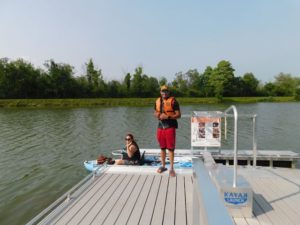
Since no two waterfront projects are exactly alike, BoardSafe Docks works with its customers to design optimum solutions for each launch site and ensure they have the best design for their location. This unique service typically isn’t offered by other dock-building companies who often mass produce the same dock. BoardSafe’s site evaluation services and consultation ensure a structurally-sound and long-lasting design for many years to come.
To view over 20 different possible launch configurations, click here:
BoardSafe Kayak Launch Layout Options.
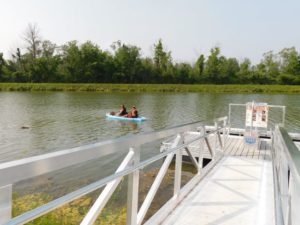
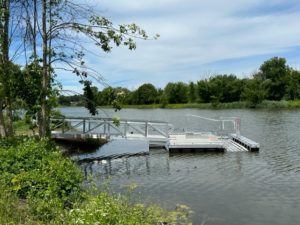
An accessible and inclusive kayak launch helps paddlers enjoy the lifestyle they’re looking for—safely, easily, and responsibly. Plus, an aluminum dock is easy to install and will look fantastic for many years to come, with minimal maintenance and upkeep.
Read more about the benefits of planning for an inclusive launch system here:
6 Reasons for Designing a Universal Access Kayak Launch.
BoardSafe Docks understands the benefits and impact their floating dock systems offer to communities and park systems. Their inclusive launch is fitted for kayaks, canoes, and SUPS, and gets everyone in the water safely. We know paddlers want close-to-home recreation; safe, easy, and inclusive access to the water; and the ability to connect their families to nature and their local community. BoardSafe’s fishing piers allow their users to enjoy the outdoors safely away from active boat launches and access points.
To discuss your project and create a water entry site that offers safe and easy access with inclusive and adaptive features, contact us at 610-899-0286 or through our website at BoardSafeDocks.com.
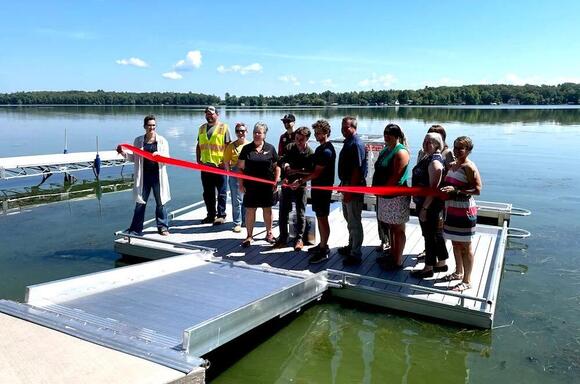
Rice Lake WI Makes Strides in Accessibility with BoardSafe Kayak Launch
Equitable access to the outdoors is essential for everyone and offers recreational, economic, and ecological benefits to communities. The small town and lakefront community of Rice Lake, Wisconsin, has made great strides by offering everyone who lives near the lake the opportunity for inclusive recreation on the water.
The lack of access to places of recreation has large repercussions and can leave communities disenfranchised. Access to the outdoors is a basic human right and essential to good health. When communities like Rice Lake work together, they create a sense of belonging for their members, bring communities together, and connect them with nature.
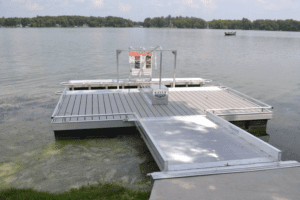
Rice Lake’s Main Street Association initiated a “Rock the Dock” Fundraiser to help raise funds for the accessible kayak launch. The association was overjoyed to learn they were the recipient of a $40,000 Hometown Grant from T-Mobile. “The grant funded the ADA-compliant kayak launch in its entirety,” said a very appreciative Rice Lake Main Street Association Board Member, Chris Olsen. “It’s a huge domino for the development of the lakeshore and makes the lake accessible to everybody. The newly installed BoardSafe Adaptive Kayak Launch and 5-ft. X 8-ft. gangway provide accessibility for everyone on Rice Lake.
Sami Mohr, the store manager at the new T-Mobile location, said the Hometown Grants are a commitment to bring 5G to communities such as Rice Lake. “Over the next five years, T-Mobile is going to be giving away $25 million in grants like this,” she said. T-Mobile is proud to support local communities like the Rice Lake Main Street Association and mentioned, “We wanted to show we are more than just a retail storefront and we want to be a part of the community.”
Rice Lake is an 859-acre lake located in Barron County, Wisconsin. Its visitors have access to the 19-foot-deep lake from several public access boat landings. Fish that are common to the lake include Musky, Panfish, Largemouth Bass, Northern Pike, and Walleye. In addition to fishing, the lake now offers a variety of accessible activities, including an accessible launch site for adaptive paddling. The town will also be supplying four kayaks to go along with their new launch, and an additional two kayaks will be uniquely-fitted adaptive kayaks so paddlers with disabilities can paddle the lake with family and friends.
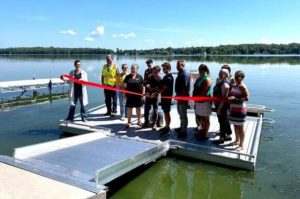
The kayak launch on Lakeshore Drive across from City Hall is officially open after a recent ribbon-cutting ceremony. The Sheriff's Department has provided life jackets for paddlers to borrow, use, and return.
At the ribbon-cutting, Chris Olsen of the Main Street Association said private and public entities and a foundation all worked together on the project. He thanked the city for providing the heavy machinery, and recognized private businesses who helped with construction and landscaping, and all others who volunteered time and manpower. "Anybody and everybody can use the lake now—there's full access to our lake," Chris Olsen said.
Library director Rachel Thomas thanked Mayo Clinic Health System and Rice Lake Celebrity Charity Classic for their financial donations that were used to help purchase the kayaks. The kayaks are available to be checked out at the library, just like checking out a library book. A user’s agreement must be signed and borrowers must be over 18 years of age. The library director did not know of any other libraries that had kayaks available for check-out but said there probably are some, somewhere.
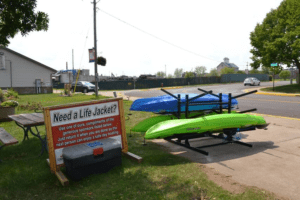
Thanks to the sponsors and volunteers, and all the involved stakeholders, Rice Lake now has an ADA-accessible BoardSafe Adaptive Kayak Launch and a rack of kayaks available for the community to borrow and use to enjoy the paddling on Rice Lake.
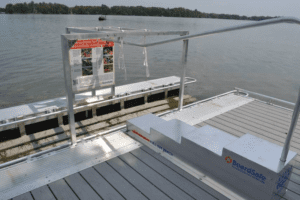
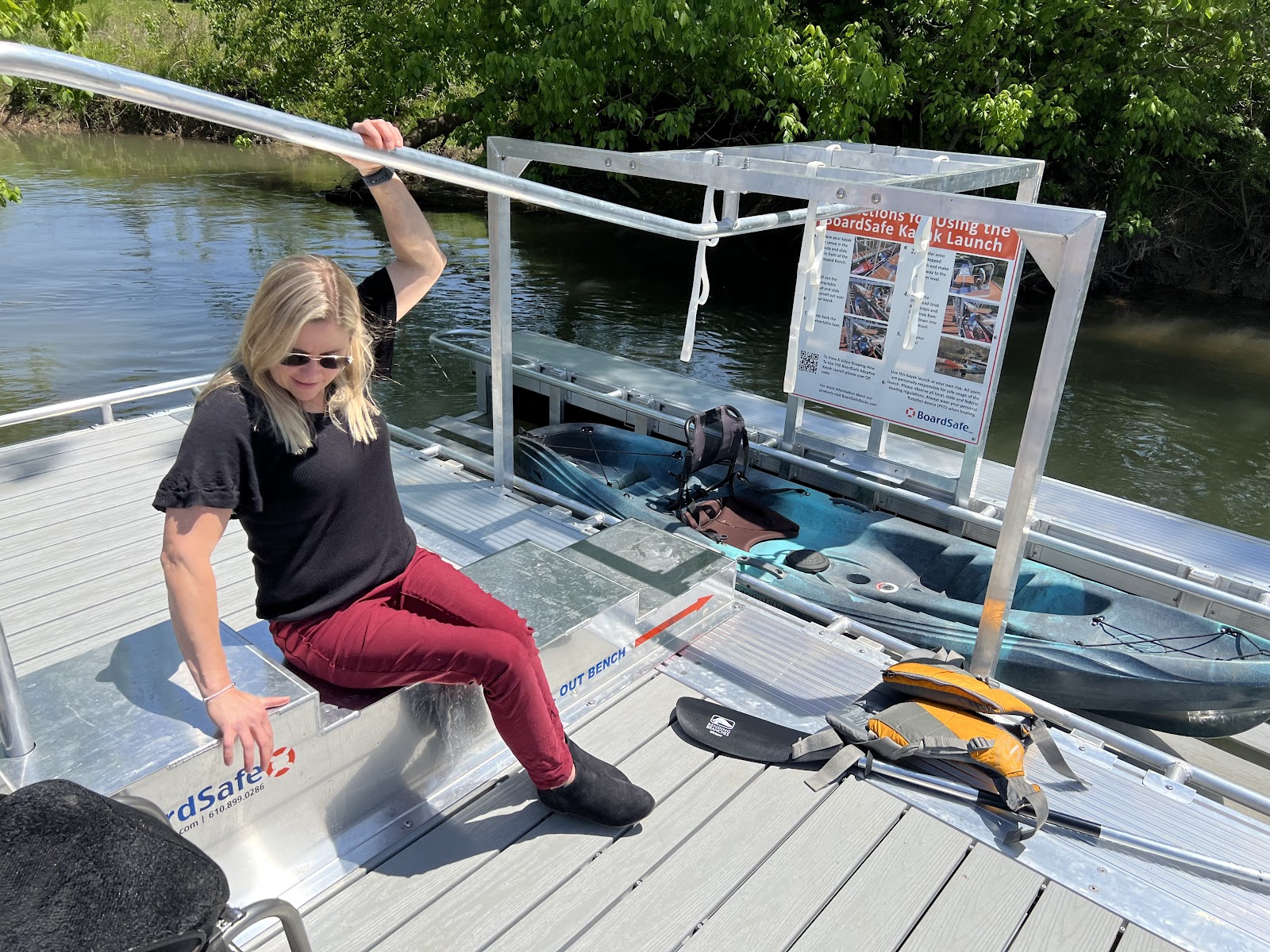
The accessible kayak launch offers adaptive features, which means that ANYONE, including folks with physical disabilities, and those who struggle with mobility limitations, can enjoy kayaking with family and friends. The launch features include a ramp, stabilizing kayak chute, overhead grab bar, hand straps, pull bars, and a step-down bench that enhance the paddling experience for all.
The volunteers and sponsors who worked together on this project for the good of the Rice Lake Community are:
- T-Mobile—provided the $40,000 grant towards the purchase of the BoardSafe Adaptive Kayak Launch, the inclusive launch system designed and manufactured by BoardSafe.
- Mayo Clinic Health System—donated $3000 towards the purchase of kayaks.
- Rice Lake Celebrity Charity Classic—donated $2000 towards the purchase of kayaks.
- Barron County Sheriff's Department—provided life jackets for kayak users to borrow while paddling.
- City of Rice Lake Community Services Department—provided heavy equipment for installation of the launch.
- Scott Kucko of Hooch’s Hardwood & Masonry—donated excavating, framing, and prep work.
- Jeremy Scheu of Summer All Year—donated time for excavation and prep work.
- Jon Klump and Ryan Ebner of @K&E Construction—Poured and finished the concrete walkway.
- @Northwoods Promotions / Ventures Apparel—purchased all sand and concrete for the project.
- Chris Olsen of Northwoods Promotions & Apparel—volunteered for the installation.
- Chad Peterson of Business & Estate Advisers—volunteered for the installation.
- TJ Olsen—volunteered for installation.
- Creating Ability—outfitted the kayaks for adaptive paddlers. In 2004, Creating Ability designed the Universal Paddling Seat. Since then, Creating Ability has developed and provided fully-outfitted kayaks with adaptations that enable people of all abilities to participate in the sport of adaptive kayaking. They travel tens of thousands of miles annually, volunteering at various events and venues in support of persons with disabilities and their families. Creating Ability provides on-site support, education, and outfitting to enhance the paddling experience and create freedom and independence for the adaptive paddling community.
On Rice Lake Public Library’s website, they share a belief statement that says, “We believe in Community, Access, Service, and the Public Good.” This belief resonates with the whole community and their inclusive efforts to make their community accessible to all. Kudos to the small town and the stakeholders involved in this inclusive project. Everyone is welcome to paddle the lake!
BoardSafe Docks was honored to contribute to this project and understands how projects like these enhance communities and empower adaptive paddlers.
BoardSafe Addresses Growing Need for Non-Motorized Paddle Access
The 2023 SOBA Symposium is less than three weeks away, and the growing need for non-motorized paddle access is on its agenda.
With paddlesports on the rise, recreation stakeholders share responsibility for shaping our country’s water access spaces, ensuring their accessibility, and improving the user experience for all. Tom Warchol, from BoardSafe Docks, will be speaking about adaptive water access products and the value they bring to the communities.
Intentionally investing in adaptive water access products enhances economic growth in terms of jobs and revenue, promotes tourism, supports community equity plans, and improves the quality of life for all paddlers.
When you step into a kayak, push off into a canal or a river, and take those first few paddle strokes, nature surrounds you at every level. It’s easy to understand why people are getting hooked on paddle sports.
Paddling and exploring the water bring people and nature together for a blend of relaxation and fun. There are so many reasons propelling around the water is an attractive diversion from today’s fast-paced world. It brings families and friends together, connects people to nature, and most importantly, it promotes exercise, health, and wellness. Paddling is an activity that almost everyone can participate in—young and old, novice and experienced, and people with mobility limitations.
Kayaking has also become increasingly popular for paddlers with more serious physical disabilities, like amputees and those with paralysis. It offers rehabilitation, exercise, and socialization, and is proven to improve one’s mind, body, and spirit. Most importantly, kayaking gives adaptive paddlers an opportunity to be out on the water like everyone else. They describe the freedom of leaving their wheelchairs and transitioning into a kayak as “liberating.” This only occurs when kayak launches and water access points are designed to provide accessibility to all.

The popularity of paddlesports like kayaking is on the rise
According to a report published by the Statista Research Department, nearly 18.6 million Americans went kayaking at least once in 2021, demonstrating an increase in the popularity of paddlesports. From 2010–2021, kayaking participation in the United States grew by 87.3 percent. Kayaking, canoeing, and all paddlesports are truly inclusive recreational activities when launch sites include adaptive features like an ADA gangway, kayak chute, boarding bench, hand straps, and grab bars.
How do we continue to make kayaking appealing and accessible for older adults, and ensure that those with mobility limitations or physical disabilities are included?
To attract paddlers to return to the water and build legacies for people to use and enjoy for many years to come, designers, architects, and engineers must include features that get paddlers in and out of the water safely and remove barriers to participation.
The most significant difficulty reported by almost all paddlers is getting in and out of their vessels. Upon entry, kayaks and canoes can tip, shift, or roll over. Adaptive features can ensure safe access in and out of the water. It’s encouraging to see leaders and planners striving to create a more inclusive society. They understand the importance of inclusive outdoor recreation. As recreation stakeholders, we all share responsibility for shaping the future of our country’s outdoor spaces and inclusive lifestyle and improving the quality of life for all. According to the World Health Organization (WHO) fact sheet on Disability, an estimated 1.3 billion people experience significant disabilities. This represents 16% of the world’s population, or 1 in 6 people.
According to the CDC Disability Impacts All of Us Infographic, 11.1 percent of U.S. adults have a mobility disability with serious difficulty walking or climbing stairs.

The value of an accessible and adaptive kayak launch
An accessible kayak launch with adaptive features can benefit a significant portion of the population, including people with mobility impairments, older adults, and people with temporary injuries or permanent conditions.
Ask any adaptive kayaker about their feelings of enjoyment, liberation, and empowerment after they complete a paddle. Many will tell you they cannot wait to get back out in the water!
Kayaking promotes healthy living, connects friends and families with each other and with nature, and encourages paddlers to be good stewards in caring for our natural resources.
People attending the 2023 States Organization for Boating Access in Tacoma, Washington, on August 28–31, can expect to learn about planning, permitting, engineering, manufacturing, ecological impact, economic impact, and grant funding for motorized and non-motorized boating access projects like these and others.
Information about the symposium is available here: Welcome to Washington - SOBA 2023.
Register here: SOBA Education & Training Symposium.
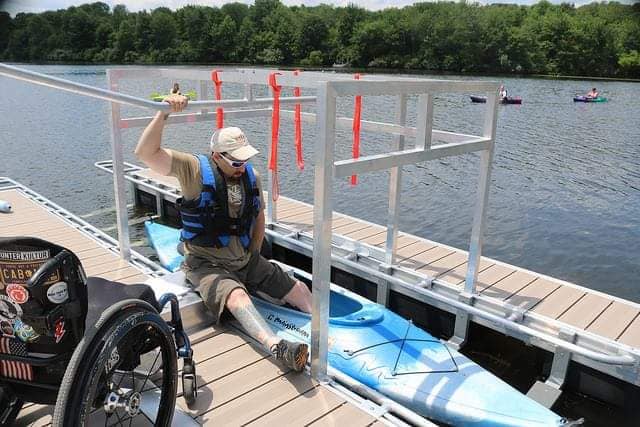
SOBA Gears Up for Annual Symposium
The 2023 States Organization for Boating Access (SOBA) is completing its preparation for its annual Education & Training Symposium running August 28–31, 2023, in Tacoma, Washington.
BoardSafe Docks will serve as the Symposium’s Platinum Sponsor for the second year, continuing our mission to provide education and advocacy for safe and accessible non-motorized boating access. BoardSafe designs and manufactures the most structurally sound and durable water access products on today’s market, with inclusive features designed for the widest range of paddling abilities.
Co-hosting this year’s symposium will be the Washington State Parks and Recreation Commission, Washington Recreation and Conservation Office, and the Washington Department of Fish & Wildlife.
State boating officials, boating organizations, engineers, manufacturers, and design experts from all over the U.S., who are interested in learning more about improving access sites for safer and more accessible boating, will want to attend this event. The venue will allow attendees to exchange ideas, share information, and discuss solutions to common problems related to motorized and non-motorized boating access.
Accessible Boating Projects Happening in Seattle
Symposium attendees may consider attending a local presentation with Stephen Levengood, Senior Capital Projects Coordinator, and Moshe Hecht, Senior Project Funds and Agreement Coordinator, both with Seattle Parks and Recreation. They’ll highlight details of two noteworthy public boating access projects for the City of Seattle on Lake Washington.
Planned improvements for Seattle’s South Leschi Marina include providing accessibility to boaters with disabilities and offering an additional 53 boat tie-ups for transient mooring and guest boaters for up to 72 hours.
“South Leschi Transient Moorage will be the only public transient moorage along the 20 miles of Seattle shoreline on Lake Washington and will fill a need that exists,” said Levengood.
Improvements Planned at South Leschi Marina
- Adding transient moorage and guest boating tie-ups for 53 additional boats will provide access to the Leschi community and local parks, and the ability to access the City of Seattle
- Creating accessible pathways from the parking lot to the ADA-compliant gangways and new floating docks
- Removing an ineffective breakwater and contaminated creosote timbers, replacing them with a wave attenuator to improve the existing marina's protection
- Improving the pump-out amenities for boaters
These improvements will bring positive ecological benefits and benefit the local economy.
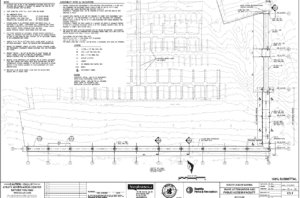
Redevelopment of Stan Sayres Boat Launch
The second accessibility project they’ll be discussing is the redevelopment of the Stan Sayres Memorial Park Boat Launch. This project will provide safer and more accessible access at the launch site by replacing the aged concrete boat ramps, extending and improving existing fixed piers that are not functional to boaters, and adding new gangways and floating dock sections to extend the launch area.
Stan S. Sayres Memorial Park, located on Lake Washington, is a popular public boat ramp on the second-largest lake in Washington State. The launch site is referred to as "Sayres Pits" because of its association with Seattle's annual Seafair Hydroplane Races. The races are the city’s largest draw to the lake and have a significant impact on Seattle’s economy. In addition to the Seafair races, the launch site was used by nearly 4,000 motorized boats last year, which necessitates its urgent attention.
The replacement of, and improvements to, the boat launch ramp will provide greatly-needed queuing space and make the boat launch more accessible for public boating. Two of the existing 4 launch sites are currently in disrepair and closed down at the very popular and busy launch site. “These improvements will serve everyone throughout the city due to its location. The ability to provide equitable access to serve everyone, especially those who live nearby or wish to trailer their boats and put them in and out the same day, and offer improved and safer access to all boaters, is our goal,” said Hecht. The boat ramps are primarily designed for motorized boats; however, it’s a popular launch site for non-motorized vessels such as kayaks and canoes. As they renovate, they’ll be removing old creosote-contaminated materials, which will offer an ecological benefit to the fish and wildlife in and around the lake. The proposal was subject to review by local, state, and federal regulatory agencies and tribal authorities. Grant funds were used to supplement part of the project's costs. This is a complex project with many involved stakeholders.
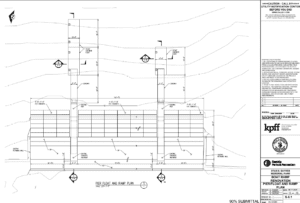
Non-Motorized Boating Access Topics
The latest data from the Outdoor Foundation specific to kayaking, canoeing, and stand-up paddle boarding found a record number of 37.9 million Americans engaged in paddle sports during 2020, with 2.5 million new paddlers enjoying American waterways.
The growth in kayaking, kayak fishing, and other paddlesports, has paddlers seeking launch sites to access the water, but too many access sites exclude paddlers with disabilities and mobility limitations. BoardSafe Docks has designed a launch system to allow users to enter and exit the water safely and easily. Through partnerships with adaptive paddling groups, government agencies, communities, park systems, and recreation stakeholders, we manufacture an Adaptive Kayak Launch that’s inclusive and accessible for all.
Tom Warchol of BoardSafe Docks said, “Attendees will learn how accessible launch systems add value to communities by offering close-to-home recreation and connecting paddlers to the outdoors. Accessible and adaptive access products for fishing and paddling enhance economic growth in terms of jobs and revenue, promote tourism, support community equity plans, and improve quality of life by offering therapeutic, social, inclusive, and community connections to all users.”
Those attending the symposium can expect to learn about planning, permitting, engineering, manufacturing, ecological impact, economic impact, and grant funding for boating access projects like these and others. We hope you’ll consider joining us for some education—and fun!
Information about the symposium is available here: Welcome to Washington - SOBA 2023.
Register here: SOBA Education & Training Symposium, and BoardSafe’s team will be there to greet you in Tacoma!
BoardSafe Docks Provides Paddling Accessibility for Allentown Waterfront
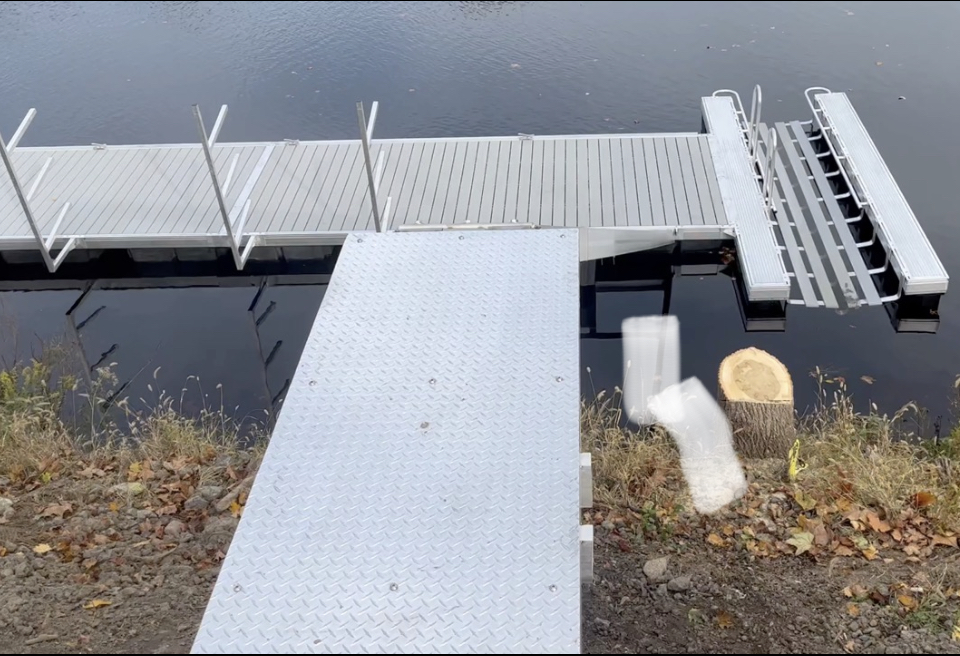
In October 2022, BoardSafe Docks completed the installation of a custom gangway, floating dock system, kayak launch, and storage racks on the Lehigh River in Allentown, PA. The Allentown Waterfront Project, developed by Jaindl Enterprises, is part of a redevelopment effort to revitalize an unused twenty-nine-acre industrial site, formerly home to Lehigh Structural Steel, into a vibrant mixed-use campus along the western banks of the Lehigh River.
The complex will revitalize the site’s industrial history and blend it with a beautiful new waterfront community. The design includes a mix of commercial and residential properties that will host restaurants, retail stores, and recreational amenities, and will offer convenient lifestyle and growth opportunities to the local economy.
Work hard, play easy
Lifestyle communities hold corporate allure by offering a desirable location between suburban and city work-life. Walkable communities are attractive to both residents and businesses because of their accessible amenities and work-life balance.
Recreational amenities, like parks, trail systems, and water access for kayaking, available at Allentown’s Waterfront, will help build the community the Jaindls envision. Waterfront communities bring like-minded people together by fostering shared interests and connecting people to nature. With the Lehigh River in their backyard, it’s a place where people can go after work or on weekends to take advantage of the close-to-home recreation and activities.
Building and investing in our natural resources brings communities together and builds friendships,—particularly among communities that have not been connected in the past.
The custom waterfront project developed by Jaindl Enterprises had a vision that included providing water access to paddlers wishing to paddle the Lehigh River. The shoreline approaching the Lehigh River is very steep and was inaccessible when the planning for the project began. BoardSafe Docks of Fleetwood, PA, was hired to design and manufacture a floating dock system and kayak launch that would open up accessibility to the beautiful riverfront for the new tenants.
A BoardSafe Kayak Launch provides safe and easy access and cannot be found anywhere else on the Lehigh River, making it an attractive feature for those living and working by the river.
Waterfront Project features
BoardSafe’s custom project along the Lehigh River includes a commercial floating aluminum dock, gangway, Clip-a-Launch, and kayak storage racks.
Watch the project video here: Allentown Waterfront Floating Dock and Kayak Boat Launch on the Lehigh River
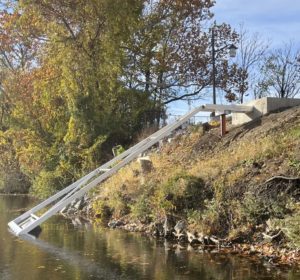
Due to the steep slope of the shoreline and possible flooding and drought conditions along the river, a concrete foundation was formed to secure the floating dock system to land. Heavy-duty engineered support arms were used to secure the dock system to the land. The massive arms provide structure and durability to the dock, allowing it to rise and lower with changing river levels while maintaining a fixed distance to the shoreline. BoardSafe Docks also manufactured an 80-ft.-long industrial gangway to connect to the floating dock. On the river are (4) floating dock sections, each 20 ft. in length, forming a large 8 ft.-wide by 80 ft.-long floating dock. The structure provides a stable system that will be flood-resistant for decades to come.
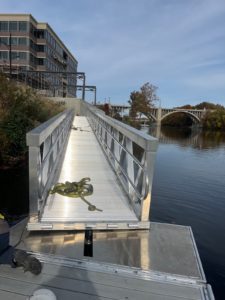
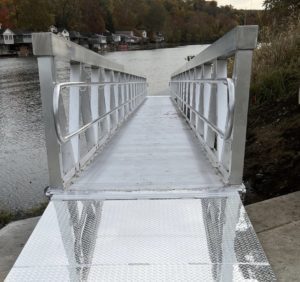
Features of the floating dock include a BoardSafe Kayak Clip-a-Launch to allow for easy boarding and exiting, kayak racks that store 3 kayaks per racking system, a protective dock bumper system, and adjustable cleats to tie up to the perimeter of the dock.
What’s unique about the floating dock structure is the two support arms that allow the system to go up and down as the river fluctuates. The arms will provide stability to keep the floating dock system in place during flooding and drought conditions.
About the Lehigh Valley
The Lehigh Valley is located near the Pennsylvania-New Jersey border and is home to more than 600,000 residents. The area boasts over $40 billion of economic output each year. In 2015, the valley was recognized in the top five regions for development in the Northeast by SiteSelection magazine.
The region named for the Lehigh River connects the area's three largest cities: Allentown, Bethlehem, and Easton. Along the river near the Allentown-Bethlehem border is The Allentown Waterfront, the new lifestyle destination for living and working, offering restaurants, retail stores, and recreation options, all in one place. Amenities include a riverwalk, outdoor amphitheater, plentiful parking, views of the water, and the ability to safely and easily launch a kayak.
Jaindl Enterprises believes The Waterfront is part of the next beautiful chapter for the city of Allentown. It’s taken about 10 years for developers to convert Allentown’s long-deteriorating riverfront into a complex of office and residential buildings. Buildings in the new community are named after William H. Mohr, Les Kift, and Thomas R. Mullen, original founders of the Lehigh Structural Steel site where they fabricated everything from bridges to hangars to highrises.
Allentown’s convenient location
The Allentown Waterfront’s convenient location boasts:
- 12 universities in a 20-mile area.
- 2 top-tier health systems: LVHN and St. Luke’s.
- 15,000 businesses in the ABE area.
- 90 minutes from NY.
- 60 minutes from Philadelphia.
Living on the water is desirable.
It’s easy to understand the draw that pulls people to the water. When you step into a kayak, push off into a canal or river, and take those first few paddle strokes, nature surrounds you.
Paddling and kayak fishing have become everyone’s favorite hobbies and sought-after forms of outdoor recreation. They bring families and friends together, connect people to nature, and most importantly, promote exercise, good health, and wellness. They have become activities that almost everyone can enjoy. Paddling encourages good stewardship of our parks, natural resources, and riverside land. Enjoyment and protection of the great outdoors are valuable investments in our communities, now and into the future.
The popularity of paddlesports like kayaking is on the rise.
According to a report published by the Statista Research Department, nearly 18.6 million U.S. Americans went kayaking at least once in 2021, demonstrating an increase in the popularity of paddlesports. During the 2010–2021 season, kayaking participation in the United States grew by 87.3 percent. Paddlesports like kayaking draw people to the water and together along the waterfront.
Here’s a short video of the Kayak Launch at Allentown’s Waterfront: Lehigh River Aluminum Floating Docks and Kayak Launch in Allentown
BoardSafe Docks has four other launches in the ABE area that are adaptive and inclusive for paddlers of all abilities. You will find them at Leaser Lake in Kempton, Beltzville Lake at Preacher’s Camp, Lake Nockamixon in Quakertown, and Lake Minsi in Northampton County. We invite all paddlers to try them out. We promise you will be impressed with how easy it is to get in and out of your vessel. BoardSafe Docks is proud to contribute to making paddling an activity that almost everyone can participate in. We are especially honored to offer our kayak launch to our local community.
BoardSafe Docks is the industry leader in adaptive kayak launches and fishing piers, gangways, pedestrian bridges, collegiate rowing centers, and marinas. We specialize in design consultation, engineering, and manufacturing, and will work with you to ensure your project is accessible. To discuss your project’s vision and learn more about BoardSafe Docks, our water access products, and the long-term value they bring to communities, please contact us through the website at BoardSafeDocks.com or call us at 610-899-0286.
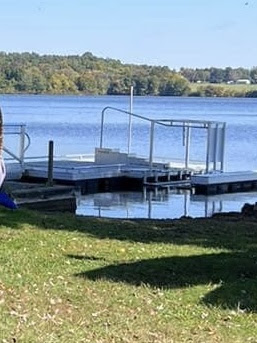
Gifford Pinchot State Park Improves Accessibility with Adaptive Kayak Launch in Lewisberry, PA
Gifford Pinchot State Park, a 2,338-acre recreation destination, is located in northern York County, PA, between the towns of Rossville and Lewisberry. The park consists of reverted farm fields and rolling wooded hillsides that surround the 340 acres of Pinchot Lake, the park’s prime attraction. The lake was named in honor of noted conservationist and former Pennsylvania Governor, Gifford Pinchot.
For paddlers looking for a quiet place to boat or fish, Gifford Pinchot State Park is worth the visit. The scenery is beautiful and located in the middle of beautiful woods. A paddle around the lake probably takes 2–3 hours. It’s a great place to kayak, and just got easier for everyone with its newly-installed BoardSafe adaptive kayak launch.
The state park also offers additional accessible amenities like picnic areas, restrooms, swimming areas, and an accessible cabin that can be reserved in advance when camping in the park. Some of its trails are also identified as accessible.
There are no fees for boating, but there are fees for campgrounds and boat rentals. Motorboats must display a boat registration from any state. Non-powered boats must display their current boat registration from any state and a launching permit from any office at Pennsylvania State Parks or a use permit from the Pennsylvania Fish and Boat Commission.
Project location
The adaptive kayak launch at Gifford Pinchot State Park is located at 800 East Camping Area Road, Lewisberry, PA 17339.
GPS DD: Lat. 40.05883 Long.76.90116
The contact number for the campground office is 717-292-4112 and the park office is 717-432-5011. The email address at the park is [email protected].
Design services and products supplied by BoardSafe Docks for this project included:
Gifford Pinchot State Park is a very pleasant surprise for many paddlers, hikers, and campers, and absolutely worth the trip. The kayak and canoe launch adds another opportunity for kayakers of all abilities to safely enter their vessel and launch into the water. The serene lake offers paddlers the experience of flat-water kayaking, canoeing, or paddleboarding on their beautiful Pinchot Lake.
BoardSafe Docks is the premier designer, engineer, and manufacturer of aluminum floating docks and accessible and adaptive kayak launches and fishing piers. BoardSafe’s commitment to advocacy and education has made them a trusted expert in accessibility design, as well as the manufacturing source for the best-performing and highest-quality launch systems available.
BoardSafe Docks' products ensure the inclusion of all abilities to benefit the widest range of users. To view the BoardSafe adaptive launch system in use, click on this link or copy it to your browser: youtu.be/vUVoc8a7EV8. To learn more about our projects or to discuss your accessibility vision, please visit our website, BoardSafeDocks.com, or contact us at 610-899-0286.
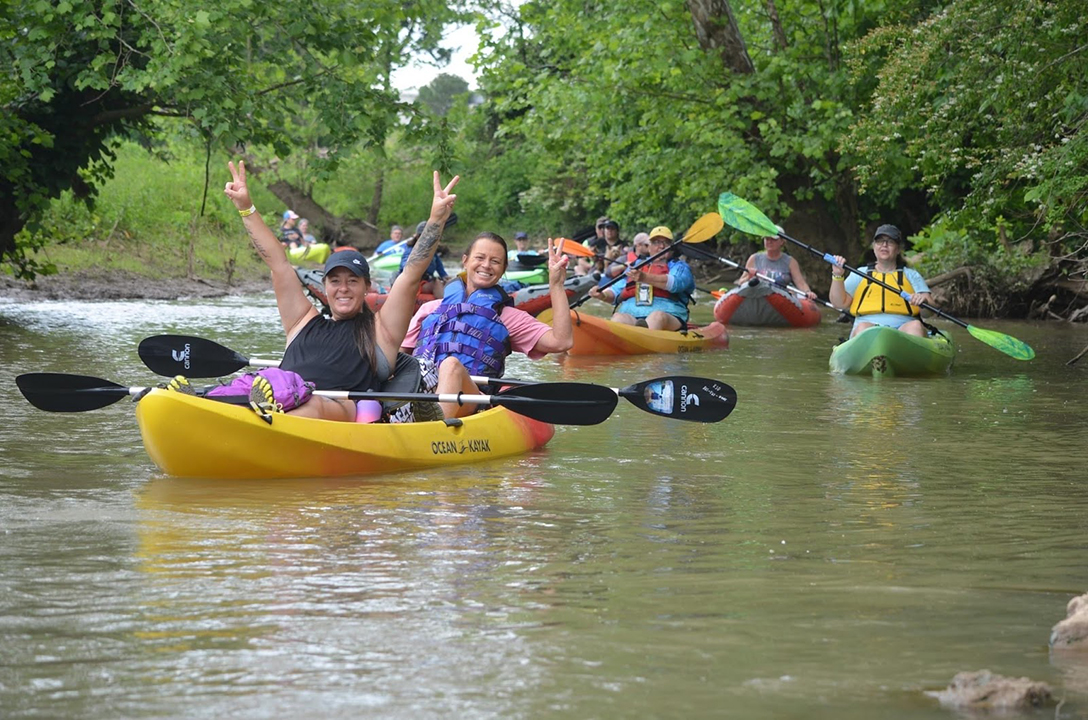
Beaver Creek Kayak Club Hosts 6th Annual Flotilla
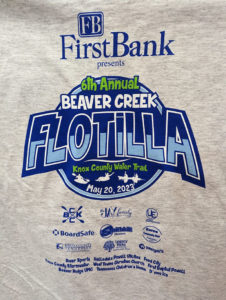
What a wonderful adventure the participants in the 6th annual Flotilla, sponsored by FirstBank, experienced on Saturday, May 20, 2023. It was a day that brought communities and families together with nature!
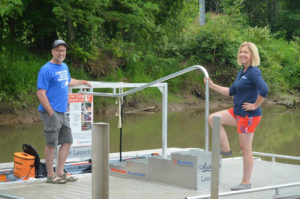
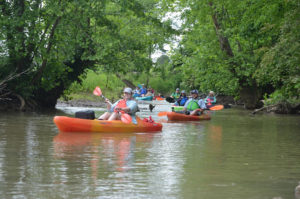
The Beaver Creek Kayak Club, located in the small communities of Powell and Karns, had over 430 kayakers registered to “float the Beaver.” Over the last several years, these communities have created a very special water trail that offers close-to-home recreation for local paddlers. The popularity of the trail has grown to include paddlers from all over the Knoxville area.
The Blueway project started with a few community-minded people with a strong interest in paddling and has become a county-wide aspiration. The plan to turn the meandering 44-mile stretch of water that had a history of flooding and pollution issues into a family-friendly destination has gained the support of the Knox County Stormwater Division, the Knox Parks & Recreation Department, Knox County Mayor and Commissioners, Legacy Parks Foundation, and the local community.
Over the last few years, Knox County Parks and Recreation, the manager of the trail, has made the trail a top priority. The beautiful stretch of water is regularly cared for, cleaned, and cleared by crews to ensure a safe and smooth water trail for paddling and fishing. There is a dedicated crew who works on the trail daily to continue its progress and maintain what has been cleaned and cleared.
Officially named the Knox County Water Trail, the 44-mile stretch of navigable water crosses five communities between Clayton Park in Halls and Melton Hill in Hardin Valley. Nourishing their natural resources is something the department focuses on and something they take pride in. To date, the park department reported they’ve removed about one thousand tons of debris and jams from 12 miles of the 44-mile-long creek, completing Phase I of the project. To learn where it all began, watch this video: Knox County Water Trail.
This year's float started at Aubrey’s Launch, behind Powell High School, and ended at the Roy Arthur Stormwater Park Launch on Harrell Road in Karns. The 12-mile-long Flotilla section is the only section that is completely cleared and currently floatable without any portage. On Saturday, over 430 registered boaters took to the water for some relaxing fun. What made the Flotilla popular and easy to access are the two BoardSafe Adaptive Kayak Launches located at the launch headquarters and take-out. More adaptive launches are planned to be put in place as the cleaning and clearout continue along Beaver Creek. This will make the water trail inclusive and accessible for the widest range of users, because the long-term plan is to continue down the 44-mile-long stream to Melton Lake.
The two BoardSafe Adaptive Kayak Boat Launches were called “a huge asset to the Beaver Creek project, for making it easier to get in and out of kayaks.” Read more about the Beaver Creek project here: https://loom.ly/Zrjta2M.
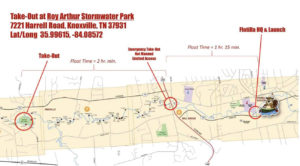
The Beaver Creek Kayak Club has a membership of over 4200 paddlers. The Flotilla receives support from Knox County Parks and Recreation, Legacy Parks Foundation, Karns Community, Knox County Watershed, Knox County Mayor, Knox County Commissioners, Weigel’s, Aubrey’s, BoardSafe Docks, and numerous other stores, restaurants, and businesses.
All event proceeds for the Flotilla have been dedicated to continuing the improvement of Beaver Creek with debris cleanout, creek bed clean up, and installation of courtesy and accessible adaptive kayak launches. Flotilla highlights can be viewed here:
6th Annual Beaver Creek Flotilla video highlights
Contributing to the Flotilla’s success is the hardworking group of community-minded people from the Beaver Creek Kayak Club. Most notably, Charlie Austin, BCKC president, received well-deserved recognition for his endless efforts over the years. The BoardSafe Adaptive Kayak Launch at Roy Arthur Stormwater Park take-out was renamed “Charlie’s Launch” to recognize his leadership and spirited commitment to Beaver Creek. Charlie grew up on the creek, believes in the value of caring for the natural resource located in their community’s backyard, and has led the volunteer efforts through promotion, advocacy, and physical efforts to clear, clean, and care for their beloved Beaver Creek.
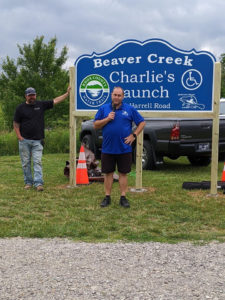
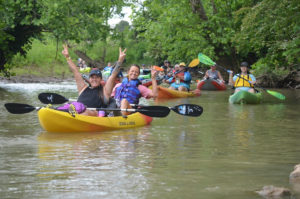
Despite the threat of rain— which stayed away until the Flotilla ended—over 430 paddlers still showed up and had a blast. There was a light sprinkle of rain before paddlers hit the water, and they received a beautiful rainbow prior to the 3 hours of kayaking down Beaver Creek. As expected, the day did not disappoint and everyone left with a smile!
The 6th Annual Beaver Creek Flotilla, presented by FirstBank, was another great day for community and fellowship. The community and its sponsors are due huge accolades for hosting one of the biggest and best paddling events in the region. One paddler was overheard saying, “The Flotilla was the best-organized event of any kind I've ever been to, bar none!”
Learn more about the Flotilla here:
floatthebeaver.com/?fbclid=IwAR3WSprCnp7DXc1uI_DQrzeEoPdXCBaH9SDStclkLsWgl0yNEeH9C2HQaEU.
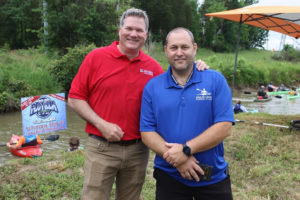
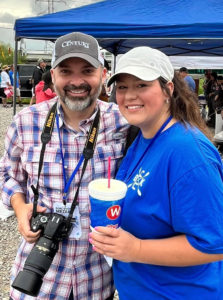
Another paddler remarked, “Who would have ever thought so many people would fall in love with our little creek?” The communities will benefit from these inclusive improvements to the creek—even people with mobility limitations. Active adults, families, and children, can now enjoy recreational experiences in a beautiful public space. This is what community is all about. Until next year—Happy paddling on Beaver Creek!
Oswego, NY, Adds BoardSafe Personal Watercraft Docks to Their Marina
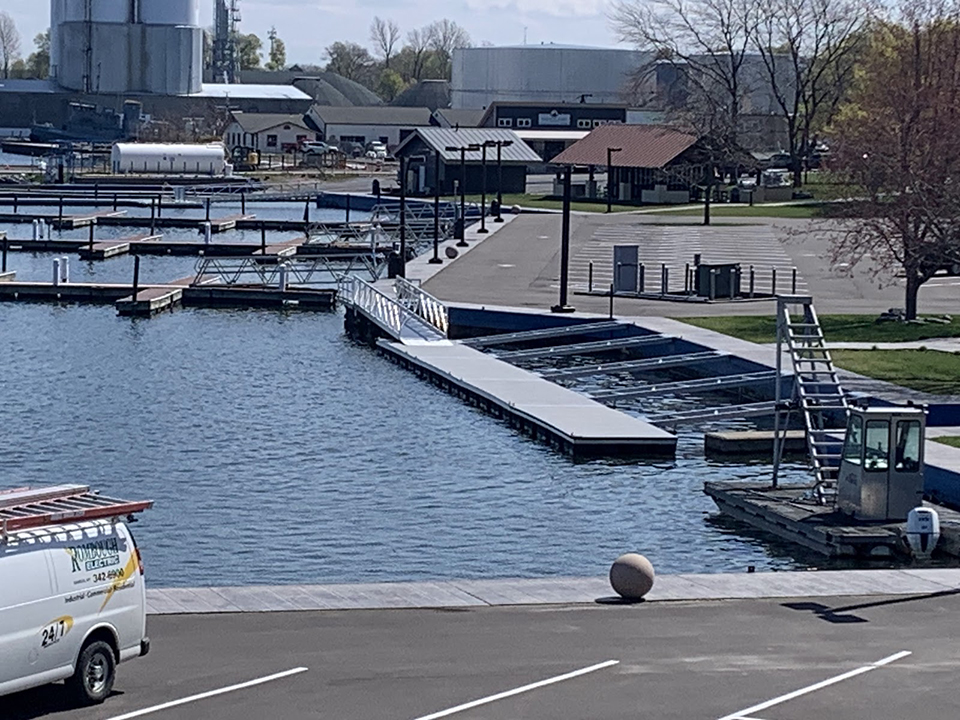
Wright’s Landing, Oswego, NY, is the recipient of a new personal watercraft floating dock system at their marina on Lake Street in Oswego, NY.
Wright’s Landing is a deep-water marina close to the NYS Canal System and Lake Ontario intersection. Its boat slips offer electric and water hookups and can accommodate 20′ to 60′ boats. The marina is open to boaters from May 1st through October 15th.
As a result of the marina’s improvement project, the city of Oswego @ Wright’s Landing is able to offer docking for jet skis and personal watercraft and has created a better marina and lake experience for its visitors.
Please watch this video for a bird's-eye view of this unique installation:
https://youtu.be/Go0Um-KYMO8
The scope and unique features of the project
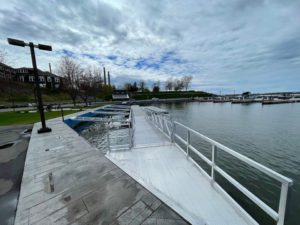
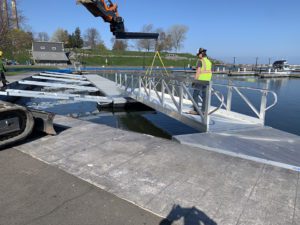
The City of Oswego was looking for ways to add PWC docking to their marina. The custom project was designed and manufactured by BoardSafe Docks of Fleetwood, PA. The project features an aluminum-welded floating dock system that includes a cantilever deck, gangway, four floating dock sections, and PWC docks for jet skis and other personal watercraft. BoardSafe partnered with RBI Contracting of New Haven, NY, to assist with installation. Tim Rice managed the project for the City of Oswego.
A cantilevered deck section was installed parallel to the marina’s existing seawall. This enabled the gangway to offer a smooth and easy transition to and from the parking lot area. Four floating dock sections, each 25 feet in length, are secured to the seawall with five support arm structures. The hinged support arms provide additional structure and stability to the dock system and allow the floating dock sections to rise and fall with changing water levels on Lake Ontario. The project also includes 10 new EZ Dock PWC ports that are attached to the outer edge of the aluminum dock’s frame. BoardSafe floating docks’ welded aluminum frame offers a design feature that allows the plastic PWC ports to be connected to the proprietary extrusion around the perimeter of the dock. This demonstrates how BoardSafe’s product line can complement and enhance other marine products to increase their functionality.
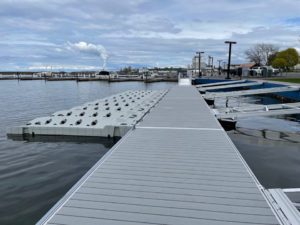
Components of the project include:
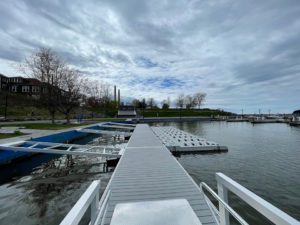
- a 100-ft long dock made of up of four 25-ft. aluminum floating docks supported by plastic encapsulated flotation.
- a 5-ft. wide x 32-ft. long aluminum gangway.
- an aluminum cantilevered deck structurally fastened to the existing seawall.
- five aluminum support arms for stability to hold the floating dock in place and move up and down with the rise and fall of the lake.
- Ten PWC ports connected to the floating docks for jet ski and PWC storage and dockage at this location.
The cost of the project was in the $150,000 range.
What makes Lake Ontario attractive to boaters?
Wrights’ Landing is well known in the City of Oswego for its wide range of services and amenities for boaters and visitors. Situated on the southern shore of Lake Ontario, the marina can accommodate boaters looking for seasonal slip rentals and transient dockage for a short stay. In addition to boat storage and docking, Wright's Marina offers a fueling station, providing gasoline and diesel fuel for boaters. The marina includes a 3–4 lane boat launch, a fish cleaning station, a boat pump-out, 24-hour restrooms and showers, and nighttime security. They also have a ship store for purchasing boating essentials, accessories, and supplies. They have experienced staff members who can assist with boat launching, haul-outs, and maintenance services.
Factors that make Wright’s Marina unique
The marina's location in Oswego is advantageous for boaters and provides easy access to Lake Ontario. The lake is known for its excellent fishing opportunities—particularly salmon and trout. Many boaters choose Wright's Marina as a starting point for fishing trips and recreational boating on the lake.
Wright's Marina is conveniently located near downtown Oswego, where boaters can find restaurants, shops, and other attractions. The city itself has a rich history and offers various recreational activities, including exploring Fort Ontario State Historic Site, visiting the Oswego Speedway, and enjoying the beautiful Oswego River.
The geographical location of Wright’s Marina contributes to its uniqueness. It is situated in a scenic area that provides access to Lake Ontario’s attractions. Wright’s Marina offers desirable amenities and services that cater to boaters. Their services and amenities include boat rental, repairs, fuel station, restaurants, wi-fi access, swimming, picnic areas, and a store to make the marina stand out when compared with others.
BoardSafe’s design improves boater experiences
The new PWC docks are part of Wright’s Landing Marina Boater Services Improvement Project, and will further strengthen, support, and complement the ongoing momentum to revitalize Oswego’s waterfront. The intent of the project is to provide enhanced amenities that will appeal to existing boaters and attract new visitors to enjoy the picturesque waterfront on Lake Ontario.
BoardSafe’s experience in construction and manufacturing gives them unparalleled expertise and innovative solutions to address the changing conditions of tides, currents, and other water fluctuations that range from severe flooding to drought conditions. Their experience and customized waterfront solutions have made BoardSafe the trusted expert for park directors, civil engineers, landscape architects, and communities who desire only the best-engineered and highest-quality aluminum floating docks and launch systems for their water access points. BoardSafe’s structural and durable aluminum floating docks are safe and environmentally friendly. Read more about BoardSafe’s design and manufacturing experiences here: BoardSafe Manufactures Marinas, Rowing Centers, Adaptive Launches, Gangways, and Bridges.
View BoardSafe’s About Us video by clicking this link: BoardSafe Docks: Industry Leader in the Manufacturing of Marinas, Rowing Centers, Adaptive Launches, Gangways & Bridges.
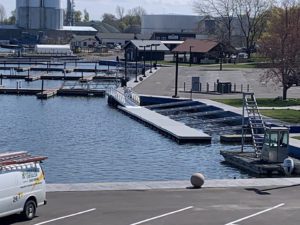
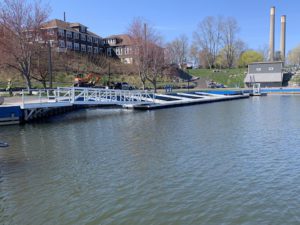
More about Wright’s Landing Marina Boater Services Improvement Project
Oswego’s mayor, Billy Barlow, expects the improvements will transform Wright’s Landing Marina into a modern, state-of-the-art marina that will attract more boaters, visitors, and Oswego residents to the marina and along the waterfront. For years, the city has failed to capitalize on the beauty of its waterfront. These improvements are projects identified by boaters during a 2016 waterfront feasibility study. Barlow believes the marina can help market the entire Oswego community.
The construction, renovation, and improvements to improve boater, recreational, and leisure amenities include:
- ADA-accessible marina access.
- marine fuel availability.
- renovated bathrooms and showers.
- new welcome center and gift shop.
- new steps connecting the marina to Breitbeck Park.
- stone fire pits along the water that can be rented by the hour.
- rental kayaks, peddle boats, cruiser bikes, and a fishing boat.
The entire marina has been elevated by three feet to help offset flooding.
The city hopes these improvements will bring more foot and boat traffic to the area since the improvements have made the marina ADA-accessible. Visitors are encouraged to check out the boater access services building, new pavilion, and amenities.
BoardSafe Docks understands the benefits and impact their floating dock systems offer to communities and park systems. BoardSafe knows boaters want safe, easy, and inclusive access to the water and the ability to connect their families to nature and the water. BoardSafe’s floating dock systems for marinas enhance the ability to safely secure vessels in the water, allowing boaters to come onto land for dining and other recreational activities.
To discuss your project and create a water entry site that offers safe and easy access with inclusive and adaptive features, contact us at 610-899-0286 or through our website at BoardSafeDocks.com.