

Offer ADA Inspired and Adaptive Accessibility at Your Marina
The Village of Fairport on the Erie Canal recently redesigned its waterfront to improve accessibility for its adaptive paddling community. The Erie Canal Boat Company is proudly equipped with a custom BoardSafe Adaptive Kayak Launch, part of a complete waterfront redesign at its Erie Canal entry point. GPI, the design engineer on the project, sought out BoardSafe Docks for their assistance in developing a design solution for the Fairport Village Boat Launch and Marina.
The initial plan was to provide universal access to the water. The community is proud to be working together to make inclusion happen. Our customer was looking for an adaptive kayak launch that would be placed in an area that rests next to their newly-designed boat ramp. BoardSafe was able to work with the design engineers on their initial concept and came up with a unique design solution.
The adaptive launch system was designed with a concrete trench at the top of the launch and included a bulkhead angle and a related hinge pin that attached to the floating dock system. The space allowed for the pin to be easily installed and removed if necessary and provided a secure attachment of the floating dock system to the concrete wall.

Bulkhead angle attached to launch
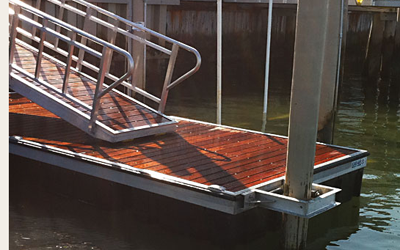
The scope of this customized project included an 8-foot-wide gangway that fit into the designated launch space. The kayak chute was designed to be 8 feet in length. The adaptive system included an 8-foot by 20-foot floating dock and Clip-a-Launch 20S (designed for entry from one end). The loading and unloading area was designed to accommodate multiple wheelchairs and is welcoming to adaptive paddling groups. The cost of this project was in the $50,000 range, and it was installed at the location of the Erie Boat Company, Inc., operated by Peter Abele.

8-foot-wide aluminum gangway
The beauty of a project like this is its ability to be used in almost any unused marina slip. BoardSafe Docks will work with its customers to design the floating dock system to any length and width to add these accessibility features to your existing marina. The desirable features of the BoardSafe inclusive launch system are that it offers boaters the ability to kayak, canoe, or SUP, safely and easily from the launch, and serves the widest range of users, from those who are able bodies to those who are in wheelchairs. It will allow your guests another option to see and explore the villages and towns surrounding your marina.
What draws boaters to this marina
The Erie Canal Boat Company is known for its kayak rentals and excursions along the Erie Canal. There are plentiful walking and bike trails along the canal to explore. The boat company offers accessible kayak, canoe, paddleboard, pontoon, and bicycle rentals to people of all abilities. The launch offers universal access for its residents and visitors, making it a popular tourist destination and a solid revenue stream for the town, marina, and businesses located along the canal.
Boaters may dock their boat in one of the marina’s boat slips and use all of the additional recreational opportunities available at the marina. The additional activities beyond boating take visitors to places they may not be able to get to with their boats, and allow visitors to enjoy the sites, both on and off the water.
The BoardSafe Adaptive Kayak Launch supported the Erie Canal Boat Company with its mission and has helped make Fairport an inclusive destination for boaters and paddlers of all abilities. Tourism is on the rise in Fairport, and it’s receiving many praises, being recognized for its ability to provide universal access.
Not far from Fairport, the Village of Brockport also installed a BoardSafe Adaptive Kayak Launch. The adaptive system is located in downtown Brockport along the Erie Canal, and the popularity of the launch has been good for the town as showcased in this link: http://ow.ly/rSEv50IRMIm.
You can learn more about BoardSafe's exclusive adaptive products here.

Take a video tour of the Fairport accessible kayak launch at the link below.
Village of Fairport, NY Accessible Kayak Launch with ADA Features
Contact BoardSafe Docks at 610-899-0286 if you're looking for ideas on making your marina more accessible to your users or for using an existing boat slip to offer an adaptive kayak launch.
Durable Floating Docks and Launches Endure Frozen Lakes, Ice, and Winter Elements
People who enjoy water sports are often subject to climates and locations that experience winter conditions.
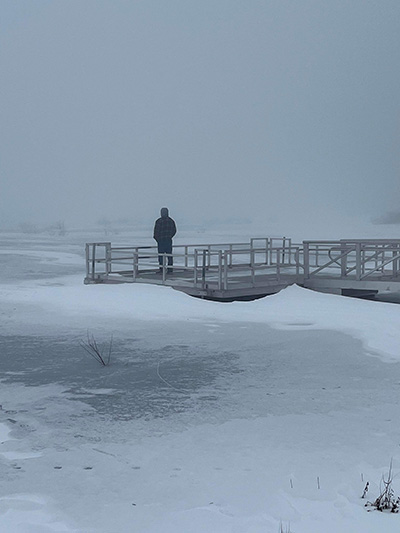
For example, people in New England and the Midwest face extremes of heatwaves and frigid blizzards. Many of our clients in these areas are concerned about protecting their floating docks, fishing piers, gangways, and adaptive accessible kayak launches. Parks and outdoor spaces must winterize their areas by putting items into storage, placing covers on items, and spending time to protect objects against the harshness of winter. Many customers ask if BoardSafe products need to be removed from the water and stored during the winter. The short answer is, “No, Board Safe’s floating docks, fishing piers, gangways, and adaptive accessible kayak launches do not necessarily need to be removed for the winter.”
BoardSafe’s products use high-quality grades of stainless steel, synthetic lumber, fiberglass, hardware, and other materials that are selected for their durability and ability to withstand extreme winter elements.
BoardSafe products are engineered and manufactured to perform well on rivers and tidal waters and can support various loads of spectators and athletes at rowing centers. BoardSafe takes special care to design products that are sturdy and can withstand both the elements and heavy use. Athletes in the northern United States and Canada will be happy to know that Board Safe’s docks and launches can remain in the water for the winter as long as the water levels do not fluctuate and there are no ice pack movements. Unusual situations, like draining a lake or chunks of ice floating down a river, could result in damage to the product. That said, a floating dock, fishing pier, or adaptive launch, that has a steady level and flow of water around it, will endure the winter and can be left in the water.
Each location and application is different, and BoardSafe should be consulted prior to allowing products to sit in the water all winter. With hundreds of installations across numerous climates and environmental conditions, BoardSafe is an expert in location selection, site work, design, engineering, manufacturing, and installation of floating docks, piers, and adaptive launches.
To discuss your project and to learn more about BoardSafe Docks, call 610-899-0286.
BoardSafe Adaptive Fishing Dock & Kayak Launch—McNeely Lake Park, Louisville, KY
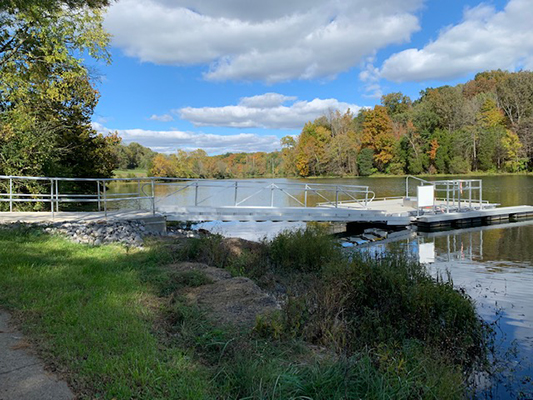
McNeely Lake Park, Louisville, Kentucky, one of the largest in the Metro Parks system, features a scenic 46-acre fishing lake with an accessible pier and boat ramp that are owned by the Kentucky Department of Fish and Wildlife. The Korean War Memorial is also in the park.
BoardSafe Docks recently installed an adaptive fishing dock and kayak launch to make this popular lake accessible to all.
[metaslider id="7371"]
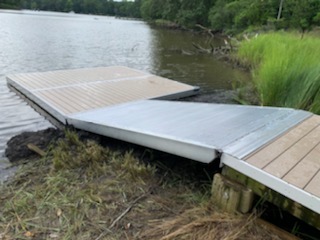
What Length Gangway Provides Handicap Access for an ADA Floating Dock, Fishing Pier, or Adaptive Kayak Launch?
Many states, cities, and other government and nonprofit entities, are promoting safe water accessibility products for adaptive athletes and individuals living with a handicap. These include a range of products, like adaptive and accessible kayak launches, ADA fishing piers and floating docks, aluminum floating rowing docks, and more. As this new industry grows in popularity, there is much uncertainty about how to design and engineer products that truly accommodate all ages and abilities. BoardSafe has become the trusted expert to engineer, design, and manufacture accessibility products for those who are serious about ADA access for their community.
We often get asked, “What length gangway do I need for my dock project?” There are many site conditions that need to be considered before this question can be answered.
One of the most important considerations is the vertical dimension from the top of the floating dock to the connection point on land. The connection point may be a concrete foundation or fixed wood pier. It is important that this dimension be determined when the water is deemed at its lowest recorded daily average. This water elevation is referred to as “mean low water” (MLW).
The slope requirement for the gangway is also an important consideration. You will need to find out what regulations you are required to follow, such as those regarding the Americans with Disabilities Act (ADA). If your project is for commercial or public use, this is something that needs to be considered. If so, you will most likely need a gangway that provides either a 1/12 (8.3%) or 1/20 (5.0%) slope. Again, this needs to be clarified by your local permitting authority. If your project is a residential application, there may be no slope requirements you need to follow. We have, however, determined that a slope of 2.75/12, or 22.9%, is the maximum slope that is comfortable to walk up or down.
Another consideration is water depth. We manufacture our gangways with flotation added to the bottom of the gangway. The reason we do this is to ensure the weight of the gangway does not put an additional point load on the dock. Quite simply, we don’t want to sink the dock because of the gangway’s weight. As a rule of thumb, we require a minimum water depth of 18 inches at the end of the gangway. This dimension may be larger for longer, more heavy gangways.
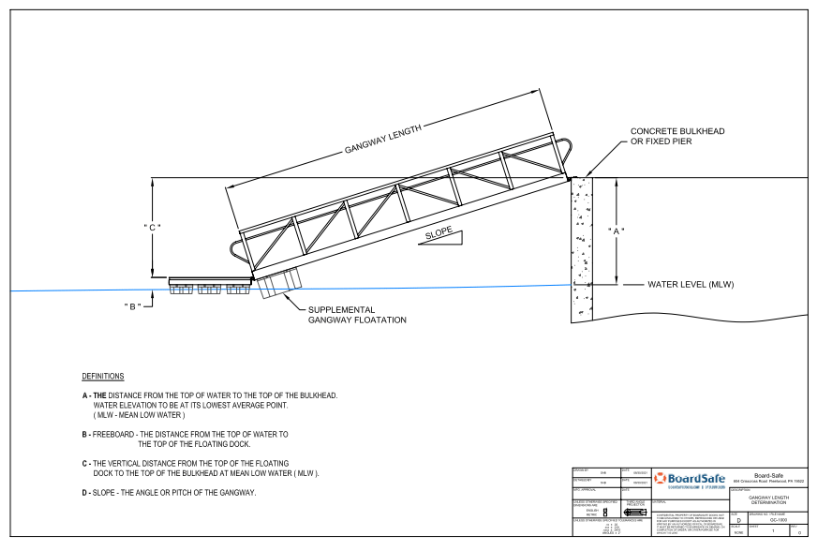
To help you determine what length gangway you will need, we’ve developed a drawing showing key dimensions and definitions. Gangway length will be based on your specific site dimensions and dock freeboard (the dimension from the top of the water to the top of the dock — please reference sketch below).
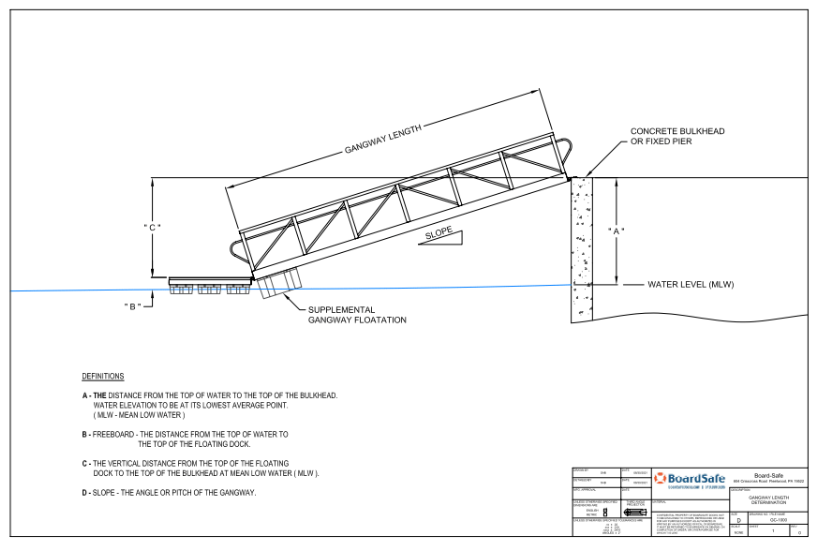
It is important to understand that BoardSafe Docks manufactures its gangways to be attached to our floating docks, not to sit on top of them.
For assistance in designing, engineering, and ordering an aluminum gangway for your project, please complete the contact form or call us at 610-899-0286.
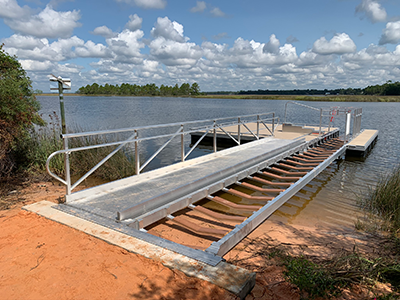
How to Calculate ADA Gangway Length to Provide Handicap Access for an ADA Floating Dock, Fishing Pier, or Adaptive Kayak Launch
Boating, paddling, and kayaking, have exploded in popularity as people of all ages and abilities seek new and exciting outdoor activities. Many community groups and government officials have taken notice of this trend and seek to open safe water access for all abilities — young and old, able-bodied and adaptive athletes. Some of the most popular accessibility products include adaptive kayak launches and accessible fishing piers that include many features that are considered Americans with Disabilities Act (ADA)-compliant. Included in this compliance is the slope of the gangway when the user moves from land, across the threshold, and onto the gangway that has a modest slope or pitch leading to the floating dock, pier, or boat launch. The slope requirement for the gangway is an important consideration.
The first step to compliance is to find out what regulations you may be required to follow, such as the Americans with Disabilities Act (ADA). If your project is for commercial or public use, this is something that needs to be considered. If so, you will most likely need a gangway that provides either a 1/12 (8.3%) or 1/20 (5.0%) slope. Again, this needs to be clarified by your local permitting authority. If your project is a residential application, there may be no slope requirements you need to follow. We have, however, determined that a slope of 2.75/12, or 22.9%, is the maximum slope that is comfortable to walk up or down. Even if your floating dock project is not subject to ADA requirements, following these requirements and features will ensure that the maximum number of users can safely use the dock or launch.
The second consideration regarding the gangway dimensions after the slope is identified is to calculate the length of the aluminum gangway. Understanding all site conditions is imperative, including the vertical dimension from the top of the floating dock to the connection point on land. The connection point may be a concrete foundation or fixed wood pier. It is important that this dimension be determined when the water is deemed at its lowest recorded daily average. This water elevation is referred to as “mean low water” (MLW).
Another consideration is water depth. BoardSafe manufactures our gangways with flotation added to the bottom of the gangway. The reason we do this is to ensure the weight of the gangway does not put an additional point load on the dock. Quite simply, we don’t want to sink the dock because of the gangway’s weight. As a rule of thumb, we require a minimum water depth of 18 inches at the end of the gangway. This dimension may be larger for longer, more heavy gangways.
Refer to the charts below to estimate the gangway length based on two factors: Dimension “C” and the slope required for your project.
Typical Gangway Layout
Please note: Dimension “C” is determined by subtracting your dock’s freeboard (dimension “B”) from your overall height (dimension “A”) as shown on the layout below.
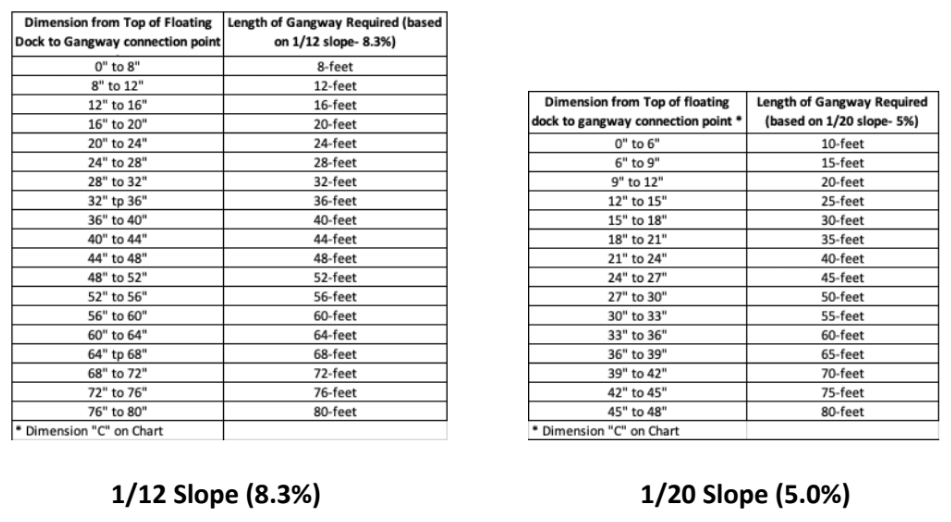
It is important to understand that BoardSafe Docks manufactures its gangways to be attached to our floating docks, not to sit on top of them. If your gangway sits on top of your floating dock, the slope and length may be different from what is shown on our charts above.
To help you determine what length gangway you will need, we’ve developed a drawing showing key dimensions and definitions, as well as charts showing gangway lengths based on your specific site dimensions and dock freeboard (the dimension from the top of the water to the top of the dock — please reference sketch below).
Please do not hesitate to contact BoardSafe Docks if you need assistance sizing the gangway for your project. Use the contact form or call our office at 610-899-0286.
BoardSafe Spokesman and Accessible Sports Advocate Ken Ryno Keeps Chugging Along
At the age of 17, Ken Ryno had a motorcycle accident that changed his life. It did not ruin his life, but changed it for the benefit of others.
Ken was told he would never walk again. For 23 years, this was true, but it did not stop him from trying. Long story short, Ken is now a spokesman for BoardSafe Docks, touting the benefits of our ADA-accessible launches, docks, and piers.
Read Ken's remarkable story here: tnonline.com/20210612/warmest-regards-little-engine-that-could-still-chugging/.
Links to our ADA-accessible products:
Adaptive Products
Accessible Kayak Launch
Adaptive Fishing Piers
Clip-a-Launch
Instructions for Using the BoardSafe Kayak Launch
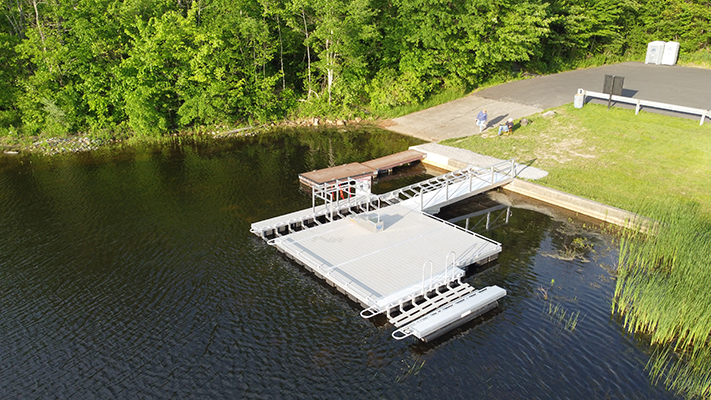
Minsi Lake Wilderness Area, PA, Proud of Their New ADA-Accessible Kayak Launch
Minsi Lake Wilderness Area is a 311-acre park, with hiking trails, picnic areas, woodlands, wetlands, and a 117-acre lake for public fishing and boating. Northampton County Parks & Recreation manages the parkland around the lake. Facilities include two paved boat launches, two parking lots, two picnic areas, and two trails. The park recently reopened after replacing, renovating, and rebuilding decades-old park amenities and infrastructure; building new recreation and park facilities; and making Minsi Lake an accessible recreation area for everyone throughout the region — opening up access to all of their community members, regardless of their physical abilities.
Of course, part of that renovation included three of BoardSafe’s innovative products. There is an ADA-accessible launch, as well as 2 ADA-accessible, 6' x 25' fishing piers. One pier is accessed by a 5' x 20' gangway, and the other by a 5' x 40' gangway.
This installation was featured on WFMZ, an Allentown, PA, news station, in this article and video.
Here are some pictures of the installation, followed by 2 recent videos:
[smartslider3 slider="5"]

BoardSafe Is a Member of PA COSTARS' Purchasing Program
BoardSafe is a participant in the Pennsylvania COSTARS Cooperative Purchasing Program. COSTARS is the Commonwealth of Pennsylvania's cooperative purchasing program that serves as a conduit through which registered and eligible local public procurement units and state-affiliated entities are able to leverage contracts established to cost-effectively and efficiently identify suppliers with whom to do business. This streamlines the purchasing process for both sides.
The COSTARS Program's goal is to provide members with contracts that are competitively priced while delivering increased opportunities for our supplier and member partners.
Membership in COSTAR facilitates the purchase of supplies, services, and construction by entities that spend public funds, such as a council of governments or an area government, or an organization that receives public grant funds.
COSTARS suppliers, such as BoardSafe, must demonstrate high standards of responsibility and responsiveness. Many purchasers use a shortlist of preferred suppliers that they know they can depend on to deliver the goods in a timely manner and at competitive prices. Amazing customer service plus competitive pricing will go a long way to winning a member’s project!
Government agencies large and small, up and down the East Coast, have found BoardSafe to be a reliable supplier of the finest aluminum floating docks, gangways, adaptive kayak launches, and other marine recreation products. We have lived up to their COSTARS standards and reputation.
Other clients, from private citizens to boating and kayak clubs to public schools and universities, have relied on the trusted BoardSafe name.
For more information, contact us at 610-899-0286 or continue to browse our website, especially our Projects page.
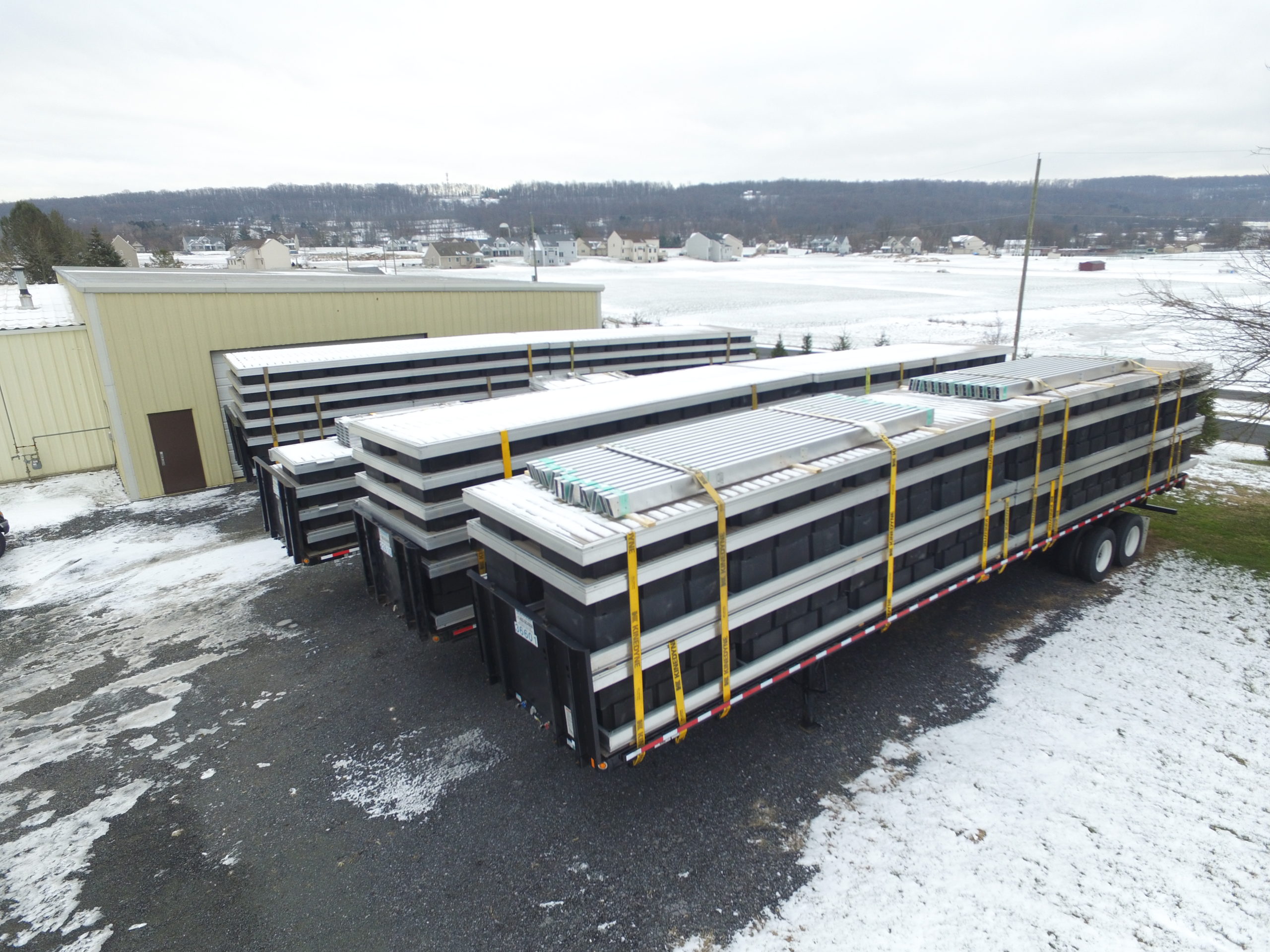
BoardSafe Manages All Shipping Details

As you can imagine, shipping tons of materials to any site, near or far, can be complicated. With BoardSafe, clients don't need to worry — we take care of all the shipping details.
Just one example is our large rowing center project in Austin, Texas. The main dock will be 15,000 square feet and will house two 3,000-square-foot boathouses. These boathouses will store rowing equipment and gear right on the dock. A total of 5 trucks will carry the materials from our manufacturing center to the site in Austin, Texas.
Composite Decking vs. Pressure-Treated Lumber for Docks and Piers
Composite decking is superior to pressure-treated lumber for floating docks and piers regarding performance and total cost of ownership.
BoardSafe has manufactured millions of square feet of aluminum floating docks, piers, and gangways. The goal of BoardSafe is to provide the highest-quality product for owners of rowing centers, marinas, and other commercial and resident docks. In the construction of these products, composite decking is superior.
Many purchase pressure-treated lumber because of the perceived cost savings. If the application is in a warm climate, the sun will destroy the wood in less than 8 years. If the application is in the northern part of the United States, the wood is subjected to freezing temperatures and ice, making its lifespan approximately 8 – 9 years. Manufacturers of composite lumber confidently state that this synthetic wood product will last over 20 years. This being the case, the total cost of ownership for a composite wood dock is less than a dock made of pressure-treated lumber.
Treated lumber today
Recently, the process and chemicals used in creating pressure-treated lumber have changed to become more environmentally-friendly. The new chemicals have created an inferior treated-lumber product that is not as durable as the pressure-treated lumber of yesteryear. Additionally, the pressure-treated lumber is more corrosive to fasteners. Experts recommend using stainless steel screws and bolts in lieu of the traditional galvanized steel. To jack up costs even more, the environmentally-friendly pressure-treated lumber is now more expensive to produce than ever before.
Consider composite decking
Composite lumber is stronger and longer-lasting. Within the family of composite wood, one product leaves the others in the dust: NyloDeck. NyloDeck is the only composite deck board that BoardSafe uses to manufacture its floating docks and piers. NyloDeck contains no wood particles; it is made of recycled carpet fibers — essentially, fiberglass. For these reasons, NyloDeck is rated for ground contact because it resists moisture, mold, and mildew. It is also the only 1-inch composite deck board rated to span joists at 24 inches on center and 16 inches on diagonals. It is twice as strong as other leading decking materials, and lighter, too. On BoardSafe docks, the NyloDeck boards are fastened with a unique hidden fastener system developed by TimberStrong. This means no nail pops or face nailing.
The last feature that makes composite wood superior is the frame. BoardSafe manufactures floating docks, gangways, and piers from 6160 marine-grade aluminum, with their proprietary extruded-aluminum frame. When looking at the quality of the overall investment, aluminum-frame docks with synthetic-wood deck boards are the way to go.
When it comes to building floating docks and piers, composite lumber is best. When it comes to manufacturing aluminum floating docks, BoardSafe is the best.
BoardSafe manufactures aluminum floating docks, piers, and gangways. They have designed and manufactured numerous specialty projects, including rowing centers and ADA-featured docks and boat launches. For more information on your rowing center project, marina, or commercial or residential dock, call 610-899-0286 or visit BoardSafe.com.