


Syracuse Inner Harbor Welcomes BoardSafe Adaptive Kayak Launch
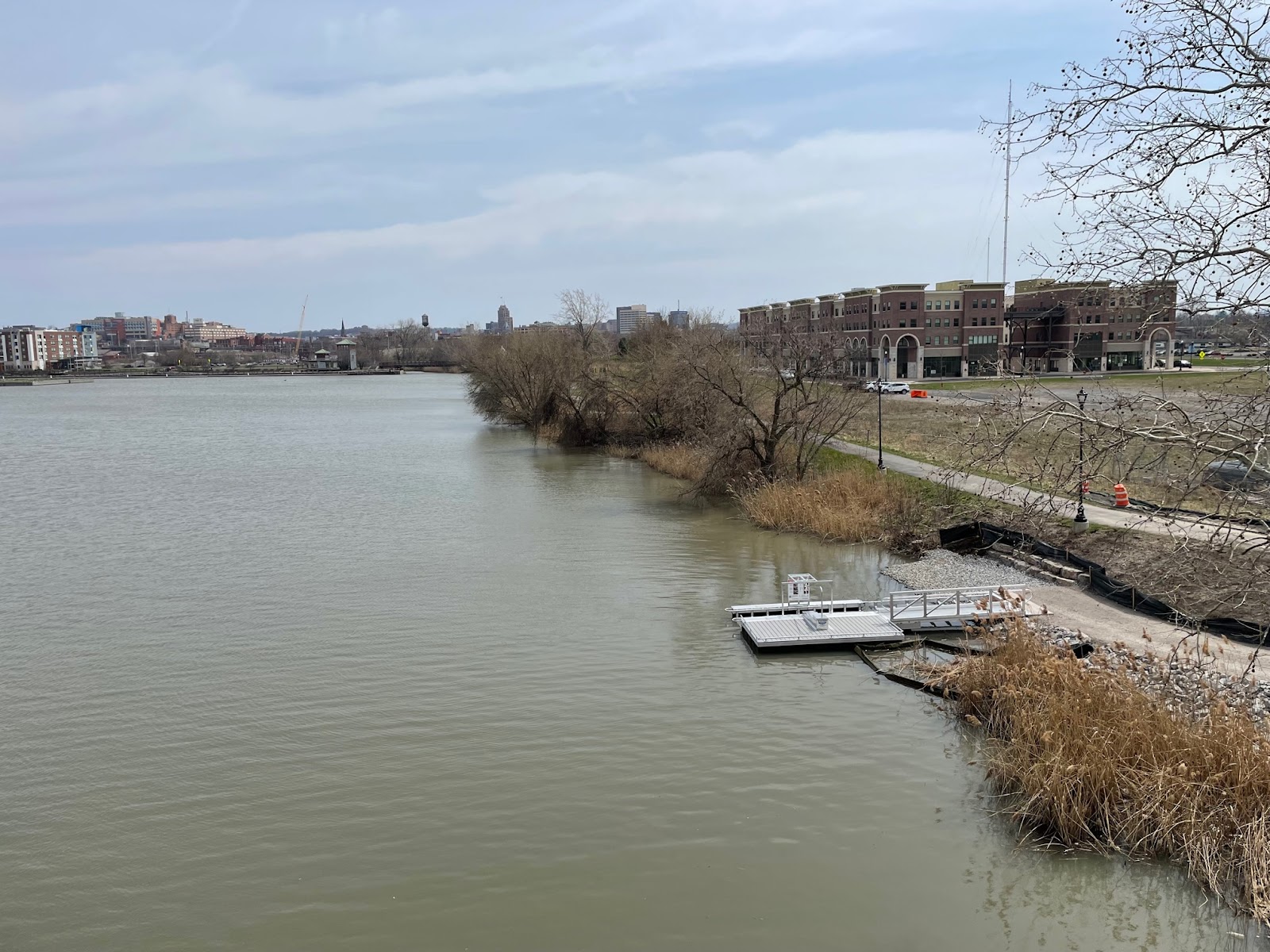
Syracuse Inner Harbor is the recipient of a newly-installed BoardSafe Adaptive Kayak Launch, bringing accessible and adaptive kayaking, canoeing, and stand-up paddle boarding to the residents and visitors of Syracuse, NY.
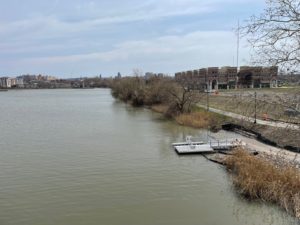
The BoardSafe Adaptive Kayak Launch is located at the south end of Onondaga Lake. Syracuse’s Inner Harbor is an up-and-coming urban neighborhood with unique waterfront access. Paddling, biking, and hiking are just some of the draws to the water where residents and visitors can now dine, visit, stay, and play around Syracuse’s growing Inner Harbor.
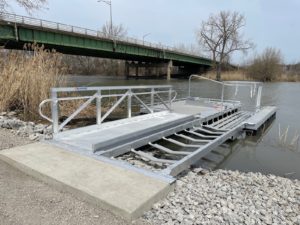
The adaptive kayak launch was installed on the creek between Syracuse Inner Harbor and Onondaga Lake. The launch is served by an 8-space accessible parking area connected via a paved walking path. The launch is directly tied to the Empire State Trail, a 750-mile-long trail that connects Buffalo to Albany and NYC to the Canadian border.
The fully-accessible floating dock project includes a 16-ft. long gangway and kayak chute connected to an 8-ft. x 16-ft. floating dock and kayak launch that provides specialized adaptive features.
Benefits of a BoardSafe Adaptive Kayak Launch
The launch boasts a strong and durable aluminum-welded frame. Aluminum is a sustainable material that can withstand harsh weather conditions and heavy use.
Aluminum is a low-maintenance product. It’s non-polluting and resistant to rust and corrosion; therefore, less maintenance is required over time.
An aluminum floating dock system is relatively lightweight, making it easy to install and move if necessary.
BoardSafe kayak launches are easily customizable. Since no two waterfront projects are exactly alike, BoardSafe offers over 20 different configurations to meet the specific needs and design preferences of our customers.
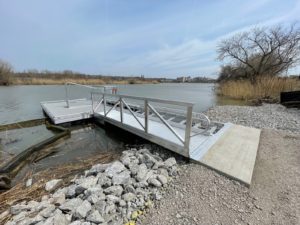
The full waterfront project was contracted by Ballard Sports out of Syracuse, NY. BoardSafe Docks of Fleetwood, PA, designed and manufactured the adaptive launch system and Tom Warchol of BoardSafe provided on-site supervision to guide the installation of the launch. Russell Houck, Facilities Engineer for the City of Syracuse, was the project manager. BoardSafe also collaborated with the Syracuse Parks & Rec to bring this accessible and inclusive water experience to the community. Through everyone’s combined efforts, the city is excited to welcome both seasoned and novice paddlers to explore the beauty of the harbor. The new inclusive launch offers safe and easy access to paddle and explore the creek.
The vision for the Inner Harbor is to continue to expand the pedestrian-friendly, mixed-use community that focuses on public access to the water. The city plans to continue to expand its growth so residents and visitors can shop, dine, and recreate.
Visitors describe Syracuse’s waterfront as a “great place to watch the sunset in the city or go for a run on the trail or kayak.” Everyone loves the peacefulness and serenity of being by the water.
Accolades about the new BoardSafe ADA Kayak Launch
Inner Harbor’s Facebook page, https://www.facebook.com/syrinnerharbor, has already received numerous accolades for the inclusive kayak launch. The adaptive features make entry into the water easier for everyone; however, the launch features are built specifically with adaptive paddlers in mind and a focus on inclusive recreation.
The additional adaptive features found only in a BoardSafe Kayak Launch are what sets our launch apart from other accessible launches. While other launches may offer some features, many of them lack adaptive features, or the features offered have not been developed to the extent necessary to work for adaptive paddlers.
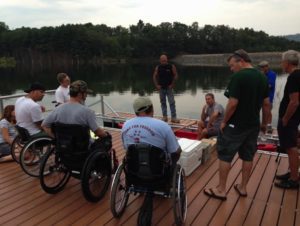
In 2015, BoardSafe’s team was approached by an adaptive paddling group and asked to design and manufacture a launch that would work to meet the varied needs of the disabled paddlers in their group. Together, they identified what features work and are necessary to ensure the launch works for those who need it the most. The end result is our feature-rich and inclusive BoardSafe Adaptive Kayak Launch.
Fun facts about Syracuse
Burnet Park in the City of Syracuse is home to the first public golf course in the USA.
The 24-second shot clock used in the NBA was invented in Syracuse by the owner of the Syracuse Nationals Basketball Team.
The New York State Fair is held annually in Syracuse and is the longest-running state fair in the USA.
Syracuse Inner Harbor is the first in its city to offer a truly accessible kayak launch with adaptive features that offer safe and easy access for all paddlers looking to enjoy a day on the water. Syracuse is making inclusion happen!
Interested in learning more about paddling in Syracuse?
The Syracuse Inner Harbor Fest is scheduled for 9/20/23–10/1/23. This year's festival will include paddle races for community members, sports, and youth teams, as well as military teams. Participants can learn how to paddle a dragon boat and form a team. In addition to the races, there will be music, awards, food and drink vendors, entertainment, and a family fun zone with carnival rides. More information is available at this link: syracuseinnerharbor.ticketsauce.com.
BoardSafe Docks is the trusted designer, engineer, and manufacturer of aluminum floating docks, gangways, kayak launches, pedestrian bridges, and rowing centers for nationally-ranked rowing teams. Our sales team is available to answer any questions you may have and to assist you with finding your optimal waterfront solution. Our launches can go anywhere your heart takes you paddling! To learn more about BoardSafe Docks, check out our website and contact us through BoardSafeDocks.com or by calling 610-899-0286.
BoardSafe Adaptive Kayak Launch—Instructions for End-of-Season Removal
BoardSafe Adaptive Kayak Launch—Instructions for End-of-Season Removal
Estimated Time Required: 2 hours
Recommended Crew Size: 1 equipment operator and 2 laborers
Equipment Needed
- Loader / machinery to lift dock components from water
- Rigging straps
- Sledgehammer
- Allen Wrench Set
- Box Wrenches
- Safety Equipment: Hard Hat, safety glasses, gloves, proper footwear, life vests
Process
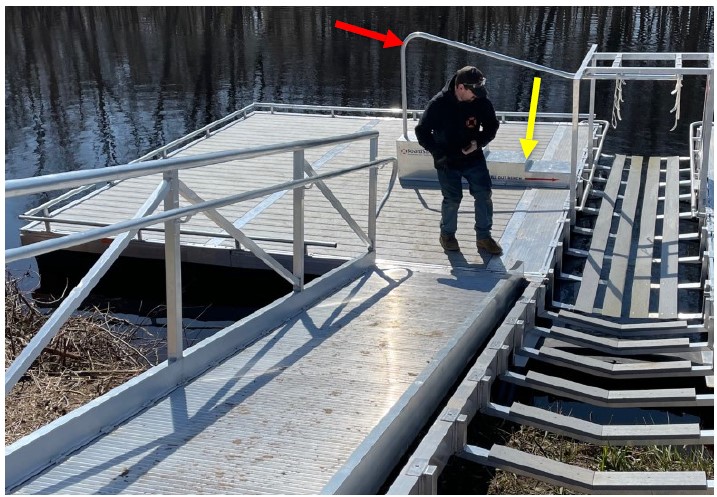
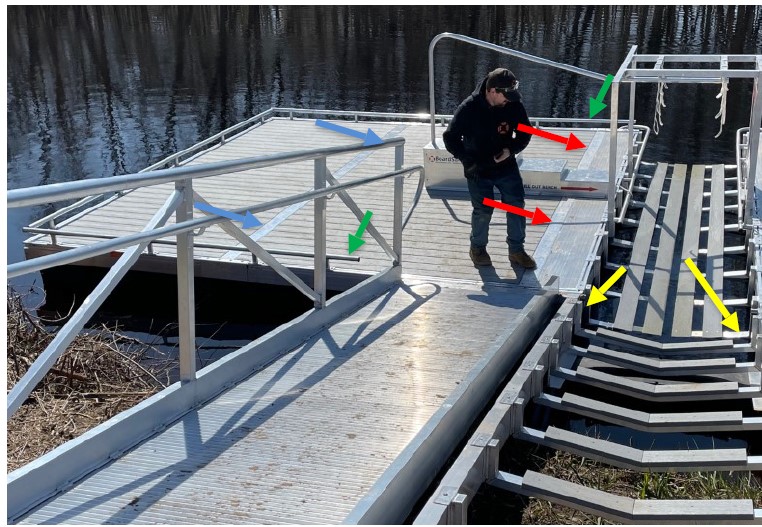
- Unbolt the overhead grab bar (tubing) shown with the red arrow below. Unbolt the Allen bolts connecting it to the roll cage first, then lift it out of the boarding bench to finish. Then, unbolt the bench (yellow arrow) from the deck surface using your Allen wrench and set the bench aside. After the bench is removed, remove the sliding bench seat that is bolted to the deck surface. Set these items aside up on shore and out of the way.

- Remove any toe-kicks that span over connecting dock sections. These toe-kicks are shown in the photo below with green arrows.
- Next, remove the transition plate connecting the kayak launch to the main dock portion. This is removed with an Allen wrench. Make sure to keep the Allen bolts contained in a container and prevent them from falling in the water. (The transition plate is shown with the red arrows below). Then remove the ‘Dock Mending Plate’ that is connected to the outer edge of the floating dock. This mending plate connects the kayak launch to the 8x16 floating dock and is fastened to the channel with (4) bolts.
- If there are secondary floating docks connected to the primary 8x16 dock (such as shown in the photo below), remove the transition strips connecting the two. (Reference the blue arrows) Once the transition strip is removed, you will be able to pull the freed dock over to the shoreline and lift it to the staging area.
- Remove the piano hinge bolt that connects the kayak launch to the kayak chute. This is removed by hammering out the 1-1/2” hinge pin located in the area shown by the yellow arrow on the right side of the photo below. Note that the primary 8x16 dock and kayak launch share a hinge pin shown by the yellow arrow on the left. This specific pin will need to be hammered only enough to free the kayak launch while keeping the floating dock connected. Set the pin and hardware aside with the bench.
- Now the kayak launch can be freed from the main dock. Using ropes, pull this section over to the shoreline. Secure your rigging points and use a spreader to prevent the rigging straps from pressing in on the overhead grab bar. (If you do not have a way to spread the straps, remove the overhead grab bar components prior to lifting). Rig your straps to the launch and pick it out of the water. While keeping the launch lifted, bring it to the laydown area and carefully set on the ground.
- Fully remove the 1-1/2” piano hinge connecting the bottom of the gangway to the 8x16ft dock. After the pin is removed, pull the 8x16ft dock to the shoreline. Secure your rigging and pick the dock for removal.
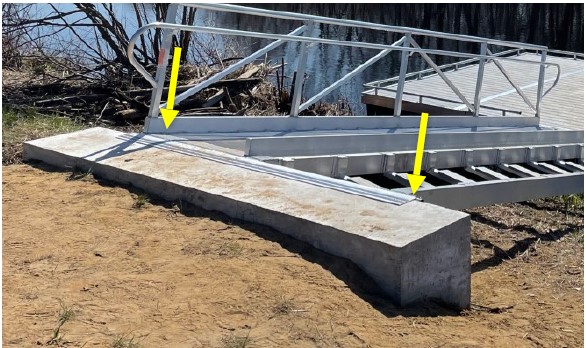
- Finally, remove the two hinge pins that connect the gangway and kayak chute to the concrete bulkhead. Once these are removed, the chute and gangway can each be lifted up to the staging area. The pin is located in the area shown by the yellow arrow below. The aluminum bulkhead mounting angle permanently stays fastened to the concrete bulkhead.
6 Economic Benefits of Adding an Accessible-Adaptive Kayak Launch
Building an accessible kayak launch with adaptive features provides a wide range of benefits to communities. Why? Because people of all abilities are hooked on paddle sports. When you step into a kayak, push off into a canal or river, and take those first few paddle strokes, nature surrounds you. It’s easy to understand the draw that pulls people to the water.
Paddling and kayak fishing has become everyone’s favorite hobby and a sought-after form of outdoor recreation. It brings families and friends together, connects people to nature, and most importantly, it promotes exercise, good health, and wellness. It’s become an activity that almost everyone can do. When launches are designed and built with inclusive and adaptive features, paddling can be an activity that includes amputees, paddlers with mobility limitations, and even people with lower body paralysis. Kayaking is an inclusive activity that offers adaptive paddlers the opportunity to be out on the water like everyone else.
Until recently, no one really fully understood the economic benefits of investing in an accessible and adaptive kayak launch. However, we are now learning more about the economic, recreational, and environmental impacts.
The 2017 Outdoor Recreation Economy Report identified outdoor recreation as one of our nation's largest economic sectors. Outdoor recreation represents thousands of American communities and provides livelihoods for millions of American workers. The outdoor recreation economy generates $887 billion in consumer spending annually, 7.6 million American jobs, $65.3 billion in federal tax revenue, and $59.2 billion in state and local tax revenue.
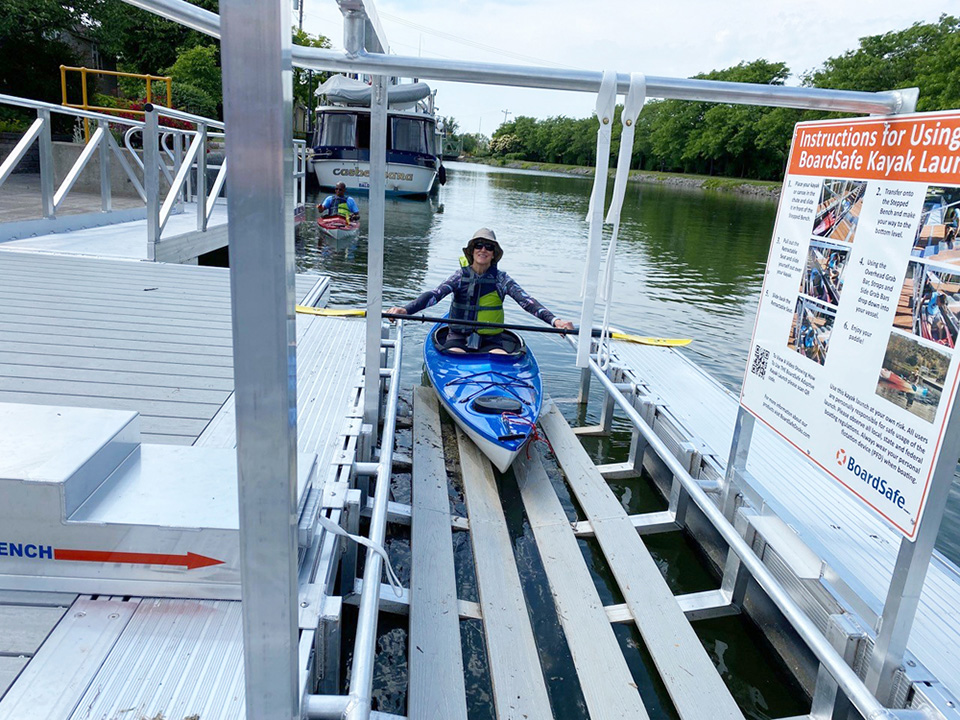
BoardSafe Adaptive Kayak Launch, Fairport Village, Erie Canal, NY
Inclusive Waterways Encourage Economic Renewal
The Economic Benefits of inclusive water trails provide communities with opportunities for economic renewal and growth. Increased property values, tourism, and recreation-related spending on items such as paddling equipment, kayaks, boats, and bicycles are just a few ways that inclusive water trails positively affect communities and the local economy. Paddling encourages good stewardship of parks, natural resources, and riverside land. Enjoyment and protection of the great outdoors are valuable investments in communities and into the future.
Three out of every four Americans participate in active outdoor recreation each year and paddlesports are among the fastest-growing segments of the industry. It’s been reported watersports directly support more than 800,000 jobs annually and statistics show more people go fishing (30 million) each year than go to Disney World (16 million).
The Erie Canal in upstate New York is just one example of intentional planning for accessible recreation. The benefits of being an inclusive destination are positively impacting tourism along the historic canal. Read the full article here:
BoardSafe Improves Accessibility for Adaptive Paddling along Erie Canal.
The Story of the Erie Canal
Hospitality and heritage bring hundreds of thousands of tourists to the Erie Canal each summer. People are attracted to the region by different activities: biking, paddling, camping, hiking, sightseeing, and enjoying its history. The tourists who visit are as diverse as the region itself. Tourists with limited mobility who may be hindered by age, arthritis, or more significant disabilities are now able to pedal and paddle along the canal with their families and friends. As a tourist, there is nothing worse than having your group — whether family or friends — fragmented because one member in the group is unable to access a particular location or activity. Everyone in the tourism industry knows the importance of being hospitable, and this includes accommodating those with disabilities. The Department of Environmental Conservation has teamed up with Rochester Accessible Adventures to ensure people with disabilities have access to outdoor recreation. An inclusion team has completed over 25+ site visits through 8 counties along the Erie Canal and evaluated their accessibility thru the lens of inclusion. The team developed operational action items to enhance access and inclusion in the outdoors by removing barriers and enhancing access.
As the Erie Canal Heritage Corridor strives to better accommodate all visitors, many local leaders have recognized the popularity of paddling and the need to provide safe and convenient access in and out of the water. The recent addition of three adaptive kayak launches along the canal has improved accessibility for the adaptive paddling community and all visitors hoping to paddle the historic canal. BoardSafe Docks manufactures a well-known inclusive, adaptive kayak launch that allows people in wheelchairs to safely transition into their kayak and out on the water. It ensures that groups of family and friends may paddle together. The launch system has been engineered with specific adaptive features to improve the paddling experience for a wide range of users. The launch is a versatile, structural, and durable option for towns, communities, and park systems looking for a truly inclusive launch that removes barriers to participation.
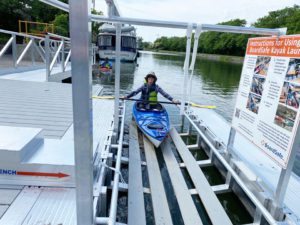
BoardSafe Adaptive Kayak Launch, Brockport, Erie Canal, NY
The Erie Canal is one of the greatest civil engineering feats in our nation’s history. Nestled along the Erie Canal are 234 cities, towns, and villages that touch New York’s 524 miles of navigable waterways. The identities of its communities are all tied to their canal heritage. Historically, the Erie Canal created an economic structure by connecting its small canal towns, opening a water route to the midwest, and allowing for cheaper transportation of goods. The canal provided new opportunities for work and life for Americans living along the canal corridor. The waterway created a social connectedness between villages and served as the information highway for that era. The canal also became instrumental in social reform.
Today, the Erie Canal corridor has become a national treasure because of its help in shaping American history. History and tourism are the crown jewels of each canal town. In-water activities offered along the canal corridor — specifically paddlesports like kayaking, canoeing, and paddleboarding — offer a positive contribution to each town’s economy.
Tourism and Paddling on the Erie Canal
There has been a tremendous increase in kayaking, canoeing, and paddleboarding over the last several years. COVID has added to paddlesports’ popularity. Visitor research completed for the Erie Canalway National Corridor in 2017 reported that 42% of visitors would like to canoe or kayak on the canal.
Erie_Canalway-Visitor_Research.pdf
In the years since that research study was completed, it’s very likely the percentage of visitors interested in paddling the canal has increased and so has the importance of strategically improving access to the water to include the disabled paddlers. Adaptive paddlers require a launch with specific adaptive features so they may experience the joy of getting into their vessel and out onto the water with their family and friends.
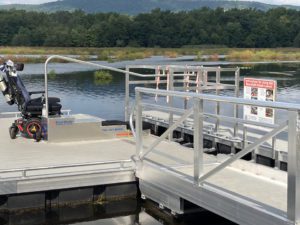
BoardSafe Adaptive Kayak Launch, Lake Minsi, PA
More Features = More Paddlers
In addition to helping Erie Canal communities boost tourism and revenue, adaptive launches serve a wide range of paddling groups, making it safer and easier to enter and exit the vessel and the water. Adaptive launches are all about inclusion and human rights. The Erie Canal has a great history of improving the lives of Americans who lived and worked on the canal and contributed to social reform. Today, the canal and villages have the ability to continue this work and ensure their launches are available to and accessible for everyone.
Water Trails protect and restore America’s rivers, shorelines, and waterways; conserve natural areas along the canal; and increase access to outdoor recreation. Developing accessible trails strengthens the conservation and restoration of the waterways, which are a catalyst for protecting and restoring the health of the waterways and surrounding lands. It pays for communities to develop their landscape, invest in their community, and make sure their community is walkable and connected.
Six Economic Benefits of Building an Accessible Kayak Launch
- Promotes Tourism: A kayak launch can attract tourists to the area and increase annual visitors to the trail. Visitor spending will increase revenue to shops, restaurants, gas stations, and hotels and appeal to nature, history, and culture enthusiasts.
- Job Creation: The construction and operation of the kayak launch can contribute to the economic development of the community by creating jobs for local residents, such as construction workers, small business owners, kayak rental operators, and paddling guides. River communities attract and retain skilled workers and businesses. Economic development inspires entrepreneurship and generates tax revenues for municipalities and states.
- Increases Property Value: Inclusive access to a kayak launch can increase property values in the area, which can benefit local property owners and help to spur economic development. Homeowners desire close-to-home recreation and are looking to connect with friends, family, and nature through outdoor recreation.
- Offers Inclusive Water Access: An accessible kayak launch will encourage more people to participate in outdoor activities on the water. An inclusive launch brings family and friends together and offers a healthy activity for people with mobility limitations and disabilities. As more disabled paddling groups look for recreational opportunities, a fully inclusive launch will draw adaptive paddlers to the water. In turn, this will benefit the local economy by promoting spending on outdoor gear, related activities, and services.
- Offers Increased Recreational Opportunities: An accessible kayak launch can provide new recreational opportunities for residents, which can improve the overall quality of life in a community. A gentle paddle down the river and sightseeing through calm waters offers associated health benefits and improves the overall quality of life.
Adding and updating infrastructures to public river access, its pavilions, riverfront parks, and riverside trails will help expand and grow the connecting greenway and blueway trail systems for hikers, bikers, and campers.
- Environmental benefits: Accessible kayak launches can benefit the environment by helping to protect local waterways and wildlife by maintaining the health of our most valuable natural and cultural resource.
Overall, an accessible kayak launch with adaptive features can provide a range of economic benefits to a community, including increased tourism, job creation, increased property value, inclusive water access, and improved recreational opportunities. When gaps in diversity, equity, and inclusion are bridged by improving safe and inclusive sustainable recreation, the end result will provide economic growth, sustain business activity, and improve people’s quality of life.
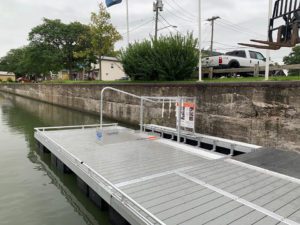
BoardSafe Adaptive Kayak Launch, Medina, Erie Canal, NY
BoardSafe Docks is the industry leader in adaptive kayak launches and fishing piers, gangways and pedestrian bridges, rowing centers, and marinas. They specialize in design consultation, engineering, and manufacturing, and will work with you to ensure your project is accessible to the widest range of users and ensure necessary adaptive features are not overlooked.
You may learn more about BoardSafe Dock’s projects through our website at BoardSafeDocks.com or by calling 610-899-0286.
6 Reasons for Designing a Universal Access Kayak Launch
When you step into a kayak, push off into a canal or a river, and take those first few paddle strokes, nature surrounds you at every level. It’s easy to understand why people are getting hooked on paddle sports.
Paddling and exploring the water bring people and nature together for a mixed blend of relaxation and good physical fun. There are so many reasons propelling around the water is an attractive diversion from today’s fast-paced world. It brings families and friends together, connects people to nature, and most importantly, it promotes exercise, good health, and wellness. Paddling is an activity that almost everyone can participate in—young and old, novice and experienced, and people with mobility limitations.
Kayaking has also become increasingly popular for paddlers with more serious physical disabilities, like amputees and those with paralysis. It offers rehabilitation, exercise, and socialization, and is proven to improve one’s mind, body, and spirit. Most importantly, kayaking gives adaptive paddlers an opportunity to be out on the water like everyone else. They describe the freedom of leaving their wheelchairs and transitioning into a kayak as “liberating.” This can only occur when kayak launches and water access points are designed and engineered from inception for universal access. Adaptive kayak launches include specific features that are often overlooked or not designed to the necessary extent.
The popularity of paddlesports like kayaking is on the rise
According to a report published by the Statista Research Department, nearly 18.6 million U.S. Americans went kayaking at least once in 2021, demonstrating an increase in the popularity of paddlesports. In the period of 2010–2021, kayaking participation in the United States grew by 87.3 percent. Kayaking, canoeing, and all paddlesports, are truly inclusive recreational activities when kayak launches and their accommodations (gangway, chute, boarding bench, hand straps, and grab bars) are included in the design plans.
Water access points need accessibility and additional adaptive features
When civil engineers design neighborhoods and street crossings, curb ramps are now automatically included. However, before January 1992 when the Americans with Disabilities Act was passed, they were not. Curb ramps are now required anywhere a sidewalk or other pedestrian walkway crosses over a curb. Prior to 1992, it was difficult or impossible for a person using a wheelchair, walker, or other mobility device, to cross a street safely or with ease due to raised sidewalks. It was also dangerous. Before curb ramps, individuals were forced to make the difficult decision to stay home or risk personal safety by using their wheelchairs or walkers to travel alongside cars and other vehicles on the street; an unfortunate choice for people with disabilities to make. The same holds true for water access at recreational sites today. Those planning water access points should ensure truly accessible launches are designed from the start. While there has been a steady increase in ADA accessibility at public parks and recreational facilities, water access points need additional attention to ensure they are planned beyond minimum ADA standards. This is the only way to make certain they will be inclusive to all.
More important than the number of access points is the quality of the accommodations at these sites. All too often, when a location is deemed accessible, it still cannot be used by paddlers with moderate to more severe disabilities because most waterfront products are designed by able-bodied people. Many accessible launches may look good, but end up being exclusive, rather than inclusive, due to a lack of adaptive features. Despite good intentions, if gaps in diversity, equity, and inclusion are to be bridged, then the best solutions should come from those who experience the challenges or at the least, designs should include their input on the necessary adaptations.
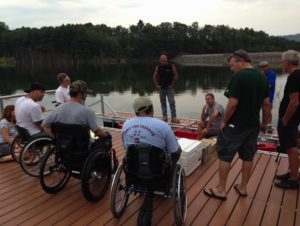
How do we continue to make kayaking appealing and accessible for older adults, and ensure those with mobility limitations or physical disabilities are included?
To attract paddlers to return to the water and build legacies for people to use and enjoy for many years to come, designers, architects, and engineers must include features that get paddlers in and out of the water safely and with minimal discomfort.
Reportedly, the greatest difficulty for almost all paddlers is getting in and out of their vessels (Just ask!). Upon entry, kayaks and canoes can tip, shift, or roll over. Adaptive features can ensure safe access in and out of the water. It’s very encouraging to see leaders and planners striving to create a more inclusive society. They understand the importance of inclusive outdoor recreation. As recreation stakeholders, we all share responsibility for shaping the future of our country’s outdoor spaces and inclusive lifestyle, and improving the quality of life for all.
Here are six reasons why designing docks for universal access is important.
- Inclusion Making docks accessible with inclusive features allows individuals with disabilities to participate in water-based activities and access the recreational opportunities that the water provides.
- Safety An accessible dock with inclusive features is designed to provide a safe and stable environment, allowing people with disabilities to board and disembark from boats. This can include features such as ramps, handrails, and non-slip surfaces.
- Compliance with laws In the United States, the Americans with Disabilities Act (ADA) requires that new construction and alterations of public accommodations, commercial facilities, and state and local government facilities, be accessible to people with disabilities.
- Cost-effectiveness An accessible dock with adaptive features can be designed to be cost-effective. It can include features that are relatively easy and inexpensive to install. Features include a minimally-sloped gangway and stabilizing kayak chute, an adaptive kit with overhead grab bars and hand straps, handrails, pull bars, and a step-down boarding bench. All can be incorporated into a floating dock design that ensures universal access.
- Community benefits An accessible dock with adaptive features can benefit the entire community. It not only improves recreational opportunities for people with disabilities; it also promotes a more inclusive community and encourages people of all abilities to enjoy the water. It can also support the economic growth of the community.
- Increase in visitors An accessible kayak launch with adaptive features can also increase the number of visitors to the area because people with disabilities, their families, and friends may be more likely to visit if the floating dock system and launch are inclusive.
According to the World Health Organization (WHO) fact sheet on Disability, an estimated 1.3 billion people experience significant disabilities. This represents 16% of the world’s population, or 1 in 6 people.
According to the CDC Disability Impacts All of Us Infographic, 11.1 percent of U.S. adults have a mobility disability with serious difficulty walking or climbing stairs.
Therefore, an accessible kayak launch with additional adaptive features would benefit a significant portion of the population, including people with mobility impairments, older adults, and people with temporary injuries or permanent conditions.
Ask any adaptive kayaker about their feelings of enjoyment, liberation, and empowerment after they complete a paddle. Many will tell you they cannot wait to get back out in the water!
Kayaking promotes healthy living, connects friends and families with each other and with nature, and ensures that we are being good stewards caring for our natural resources.
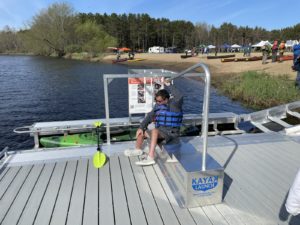
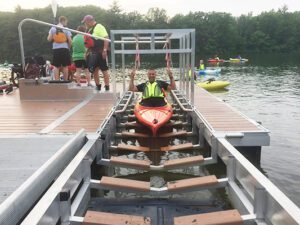
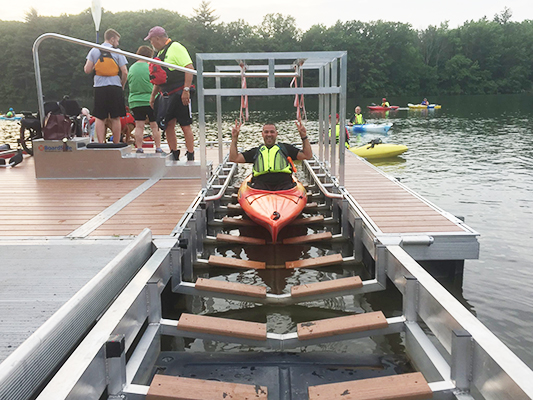
Adaptive paddlers using the inclusive features of a BoardSafe Adaptive Kayak Launch
What adaptive features offer accessibility to paddlers in wheelchairs?
One of the easiest ways to ensure accessibility and safety is by investing in a BoardSafe Adaptive Kayak Launch.
Following is a list of special features found only in a BoardSafe Launch.
- A paved egress from the parking lot to the kayak launch site.
- A gangway that offers adaptive paddlers a way of moving from land to the launch area and vice versa. The gangway should have a maximum of 1:12 pitch.
- A parallel kayak chute large enough to accommodate kayaks with outriggers. If the chute is too wide, it will create too great a distance between the boarding bench and the cockpit of the vessel and decrease the stability needed for a disabled paddler to get into their vessel.
- An aluminum-welded floating dock should offer sufficient space to maneuver a wheelchair and allow room for additional wheelchairs to be left on the deck. The floating dock should also have a protective toe kick around the perimeter as an added safety feature. This prohibits a wheelchair from accidentally rolling off the dock. Both the gangway and floating launch should include a 36″ continuous handrail around the perimeter, consistent with ADA requirements.
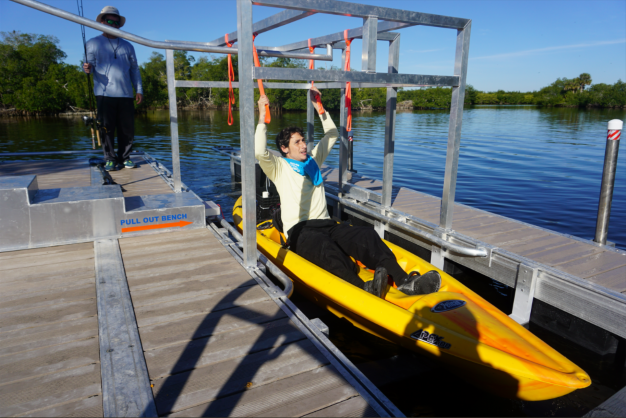
- A tiered boarding bench allows the user to board from their wheelchair. The top step of the bench should be equal to the seat of a wheelchair. The step-down bench should offer a gentle 3.5” drop per step. The bottom step should offer a pull-out bleacher-style seat that slides out over the kayak and directly above the vessel’s cockpit, allowing adaptive paddlers to slide across the seat and lower themselves into the vessel with a minimal drop.
- An adaptive roll cage surrounds the boarding bench. This kit includes a frame of handrails, an overhead grab bar, and hand straps that provide numerous gripping options to lower paddlers into vessels. The overhead handrail runs the length of the bench and offers adaptive paddlers the choice to slide down the bench from either side, depending on their preference.
- Adding to the launch’s stability is a secure chute and saddle. The cradle-like chute holds the kayak securely in place. The chute supports the vessel with a partially-submerged bracket system. The snug fit of the cradle removes any worry about tipping or moving unexpectedly, which is a risk with roller-type launch systems. Adaptive paddlers report roller-type launches don’t hold kayaks in place and can cause the vessel to shift upon entry, making a cradle launch the safest option.
- Once the paddler is securely fitted into the vessel, there should be appropriately-spaced handrails on each side of the cradle to pull the kayak into the water.
Learn about this club’s effort to meet the needs of all paddlers and its impact: Lions Club Raises Money for ADA Fishing Pier & Adaptive Boat Launch
Working with adaptive paddling groups has been a continuous educational experience for the team at BoardSafe Docks. Understanding the difference between an accessible launch and an adaptive kayak launch with additional adaptive features has helped us become the trusted expert when building a launch for the widest range of users. Understanding the difference and knowing what additional features must be included is imperative for anyone wanting a truly inclusive launch for their community. Just remember, “accessible” is not synonymous with “adaptive”! Most accessible launches alone will not work for paddlers in wheelchairs without a lot of lifting, tugging, and pulling, and the chance of someone getting hurt along the way is greater.
To discuss your project’s vision and learn more about BoardSafe Docks, our Adaptive Kayak Launch and Fishing Pier, its durable construction, and the long-term value it will bring to your community, please call us at 610-899-0286 or contact us through our website at BoardSafeDocks.com.
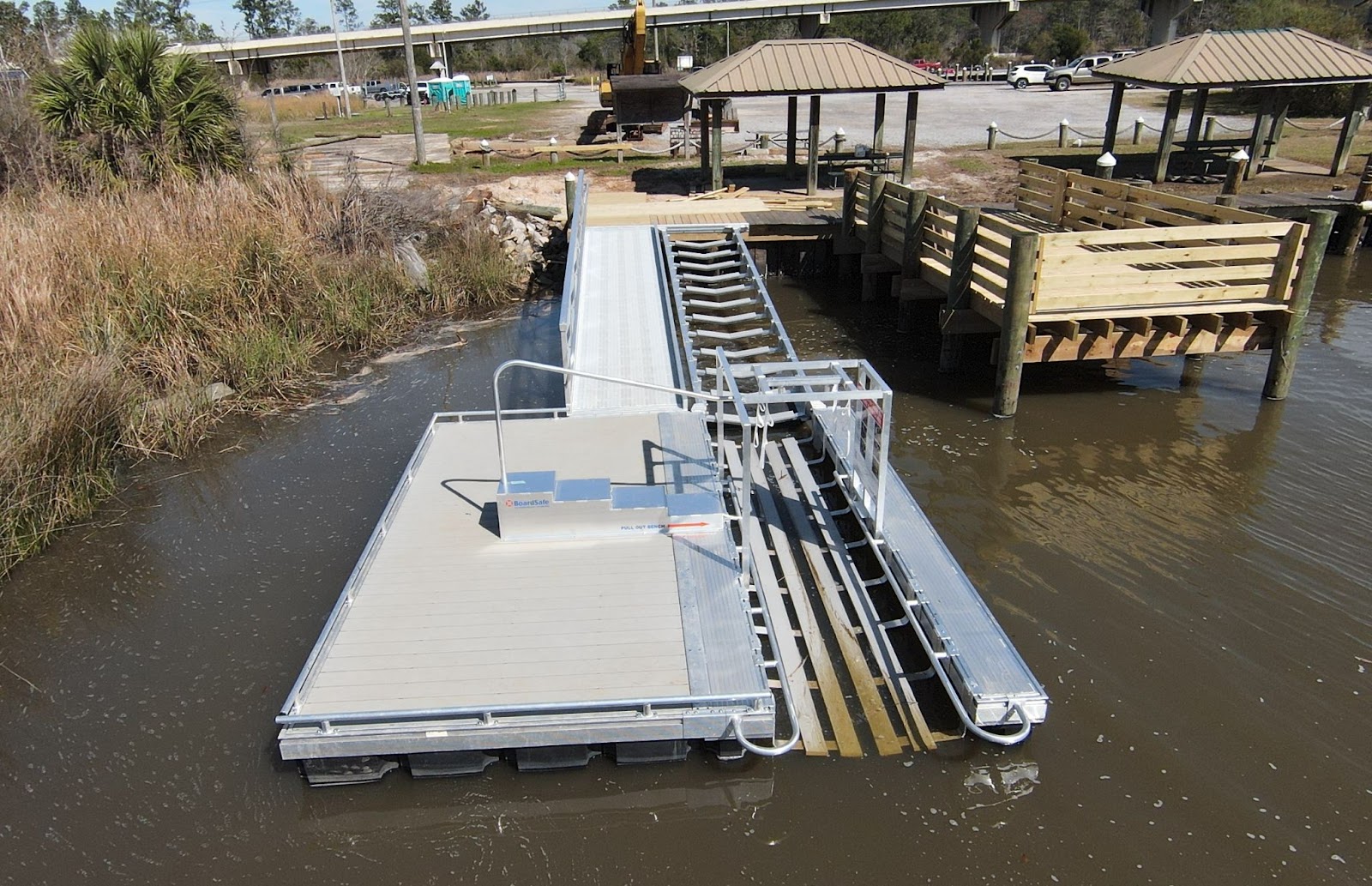
ADA-Accessible Kayak Launch Offers Weeks Bay Adaptive Features
The Weeks Bay National Estuarine Research Reserve in Fairhope, Alabama, recently introduced its inclusive, ADA-compliant kayak launch to its kayakers and canoers so they can enjoy paddling Weeks Bay. What’s most important about the new kayak launch is its unique features that offer inclusivity and the ability for adaptive paddlers and paddlers with disabilities and mobility limitations to enter and exit their vessel safely, and to participate in paddling activities with their non-disabled family and friends.
The Reserve is thankful to multiple organizations and community partners who collaborated, raised funds, and contributed to the new adaptive launch system. The adaptive kayak launch is accessible to all and was designed and manufactured by BoardSafe Docks. To help fund the launch, the Alabama Coastal Area Management Program (ACAMP) used 306a funds designated for low-cost public access improvement projects. Those funds were matched by the Alabama Department of Conservation and Natural Resources (ADCNR). South Alabama Land Trust (SALT), a passionate and community-focused group, also raised funds and donated toward the accessible launch system. Recognition is deserved for all the stakeholders who were involved in this inclusive project which opens up paddling and welcomes everyone to Weeks Bay!
Until recently, Weeks Bay did not have a kayak or canoe launch. Paddlers had to compete with much larger vessels to launch their boats. Their only option was to launch from the motorboat ramp or walk them into the water across jagged rocks and riprap.
The new kayak and canoe launch provides accessibility to non-motorized vessels, and the specialized launch offers adaptive features to include paddlers with disabilities or mobility limitations, making it safe and easy for paddlers of all abilities to paddle on Weeks Bay. It’s a happy day on the bay!
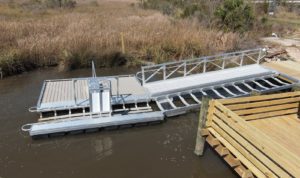
The Weeks Bay Foundation is pleased to share its accessibility for all.
Prior to the installation of the BoardSafe Adaptive Kayak Launch, the bay lacked accessibility for its paddlers. Weeks Bay Reserve takes students and teachers paddling during educational field trips as well as hosts events that attract paddlers to the water. These events allow visitors to connect with nature and socialize with family and friends. The Reserve is happy that these events are now inclusive and accessible for all. One event is a kayak and canoe-based cleanup to remove trash along the Weeks Bay and Fish River shorelines; the shorelines are not accessible by land and must be reached by kayaks, canoes, and other watercraft. The second event occurs during National Estuaries Week when the Reserve hosts multiple paddle eco-tours around the bay. The Reserve is hoping the new launch will attract new paddlers looking to try out the accessible launch.
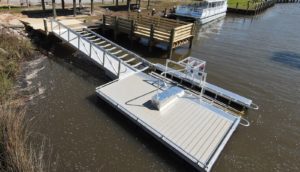
Weeks Bay is well-known for its protected coastline and calm waters. The bay draws thousands of people who enjoy exploring the water by powerboat, sailboat, and paddleboat. Paddling on the bay is a calm, quiet experience that often includes seeing amazing wildlife like manatees and bald eagles. Whether paddling in a kayak, canoe, or stand-up paddleboard, seeing the rare and endangered species adds to the attraction of paddling the bay. The Reserve is proud of its new launch and happy to welcome all interested paddlers to enjoy the beauty of Weeks Bay.
The launch’s unique features are a draw for the adaptive paddling community.
The new ADA adaptive kayak launch allows local paddling groups like Team River Runner, a disabled-veteran and adaptive-paddling group, the inclusive opportunity to get out on the waterway. The Team River Runner group provides paddlers in need of physical exercise the opportunity to get out on the waterway for therapeutic paddling sessions. Team River Runner plans and hosts a number of recreational opportunities for disabled paddlers that improve their quality of life by offering therapeutic, social, inclusive, and community connections to its users. The Reserve is sure the new launch and its features will assist the adaptive paddlers and add to their enjoyment when paddling the bay.
The Reserve is glad to support its community’s equity plan and offer greater opportunities and improved paddling experiences to its disabled veteran community. Paddlers seen using the launch are enjoying the freedom of being on the water. Without safe entry and exit points for people with disabilities and physical limitations, opportunities to experience the beauty of kayaking Weeks Bay would have remained limited.
Where to find the BoardSafe Adaptive Kayak Launch site at Weeks Bay
Paddlers are able to launch their vessels at The Weeks Bay Reserve (just west of the US 98 bridge) that hugs the shoreline going north and south. One may paddle north on Fish River, under the US 98 bridge, and turn left into a little inlet that loops through the back of the Weeks Bay Reserve property and back out to the river a couple of hundred yards above the kayak launch.
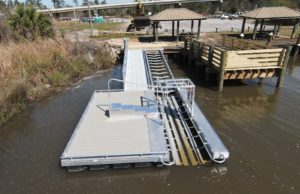
Kayaking and paddle sports' popularity continues to grow.
The latest data from the Research News - Outdoor Industry Association, specific to kayaking, canoeing, and stand-up paddle boarding, found a record number of 37.9 million Americans engaged in paddlesports during 2020, adding 2.5 million new paddlers to America’s waterways. COVID may have contributed to the increase, but a few years later, it appears these numbers are here to stay and continue to grow. The growth in kayaking, kayak fishing, and other paddlesports, has increased the number of paddlers seeking launch sites to access the water. Unfortunately, many access points exclude paddlers with disabilities and those with limited mobility because the infrastructure is outdated or the sites lack the necessary adaptive features to make them truly inclusive launch sites.
BoardSafe Docks is a nationally recognized manufacturer of floating dock systems and a trusted expert who provides education and guidance when planning and designing inclusive water access products, specifically their highly-requested adaptive kayak launch and adaptive fishing pier.
To discuss your inclusive project, or for help designing your non-motorized water access site, contact BoardSafe Docks at 610-899-0286 or through our website at BoardSafeDocks.com.
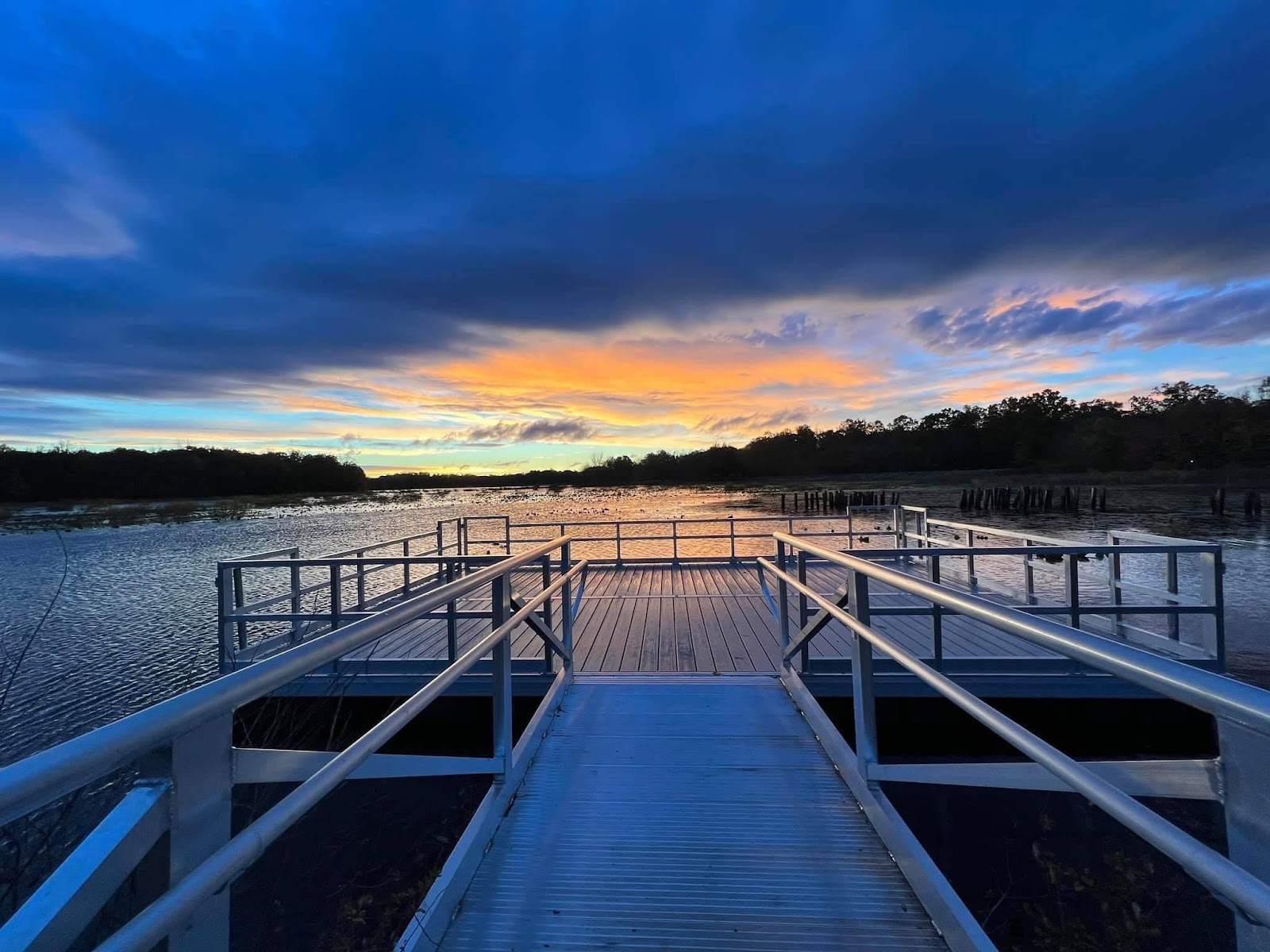
10 Considerations When Choosing a Floating Dock Builder
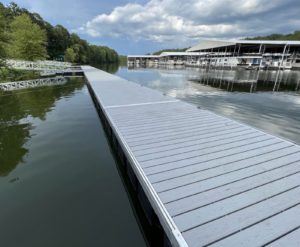
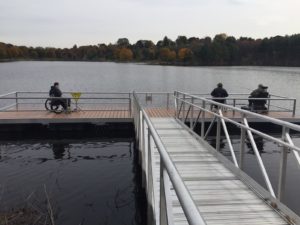
We have listed 10 considerations for prospective buyers to be aware of during the design, engineering, and manufacturing phase of their projects.
If you’ve decided to work with BoardSafe Docks for our industry expertise, you’ve made the right choice. Working with a dock builder you trust will strengthen your professional relationship and translate into a more pleasant building experience.
Following are some key points to learn and understand about the design, engineering, and manufacturing process.
Choose an experienced floating dock builder.
Customers prefer to select a dock builder with prior dock-building experience. Ask how long the dock builder has been doing this type of work. Visit completed dock projects to see what they look like after the installation, as well as jobs they completed five years earlier so you have an idea of their strength, durability, and performance over time. Speak with and review references from prior customers. Since no two waterfronts are ever the same, neither will be floating dock projects. Projects will always vary; therefore, successful prior experience will ensure you’re getting a quality product that lasts. Take the time to research completed projects and reviews before you hire your contractor. Your dock is more than a regular construction project, so don’t waste time with inexperienced or novice builders.
Communicate with your designer-dock builder.
A trusted dock designer will be one you can easily contact and communicate with. Do they respond to your phone calls and emails in a timely manner? Establish in advance your preferred method of communication and the frequency of communication and how payments will be made. Map out a schedule for updates regarding the progress of your project. Dock projects can take time to complete—from designing, engineering, and ordering materials, through fabrication.
Structural integrity of the dock design and materials
You can’t have a quality dock without quality materials! That means asking your floating dock designer about the best type of dock for your environment, its features, and their recommended materials. The kind of dock, its location, and the materials used, will tell you a lot about the quality of their product. If the designer tends to use a certain product or material, you can look up information about the company and decide if you think it’s a good fit. Purchasing a floating dock is a big investment that you want to last for many years to come.
The durability of an aluminum floating dock
Be sure to ask how your dock will stand up against various weather elements. Understand what type of maintenance will be required during the winter months, during changes in tidal conditions, and when there’s flooding or drought. This will reveal the considerations your designer needs to make for your dock regarding the local weather and demands of the waterway. Customers who experience any type of extreme weather, traffic, or tidal conditions, should ensure their designer prepares for it.
Project timeline for the floating dock
When it’s time to really get serious about your project, one of the critical questions you must ask is about your designer’s timeline. Try to zero in on a specific schedule and have some aspect of timeline expectations in your contract.
Site preparation prior to installation
Well before construction even begins, make sure your designer has the plan to protect and prepare your property for the dock’s installation. If trucks and other equipment must be driven through your yard, make sure you know how you want your dock builder to access your property from both land and water. Understand what site work may need to be completed prior to the installation of your floating dock system and who is responsible for that site work. Make sure it is completed prior to the arrival of your dock.
Permits for your water access project
Find out what regulations govern your property prior to starting any waterfront access project. Start with your town building code department and work your way up. Also check for the county, state, and federal regulations that might affect your property. Know who is responsible for obtaining your permits—your landscape architect, the engineer, the dock builder, or the property owner.
Unexpected change orders
There are always unintended changes that may arise during the construction of your project. Ask your designer what the process will be if changes to the design are necessary—especially if they will result in changes in cost. Make it clear that you want to know about changes and any additional costs in advance if necessary.
Consider the end goal early in your floating dock project.
It’s important to consider the entirety of your floating dock project at the start of your project. If you have questions, ask them. If you have your eye set on additional dock accessories, communicate that in advance. Customers who change their design ideas in the middle of the project need to expect additional costs and additional time for completion. These little steps can make a big impact on the timing of construction and your overall satisfaction with your completed boat dock.
Understand the warranty of your floating dock system.
Asking these questions will set you up for an extremely successful relationship with your dock designer. You’re much less likely to face setbacks and disappointments if you set up a good foundation of understanding from the beginning.
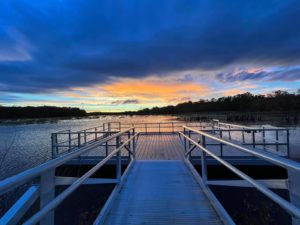
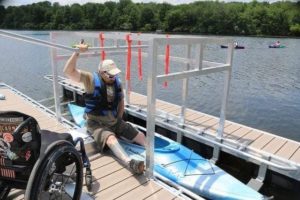
When you find a professional dock builder, ask if they provide annual maintenance packages for your floating dock system, especially if you live in an area where docks need to be removed for the winter months. If they do, it’s a good idea to establish a recurring maintenance schedule.
BoardSafe Docks understands the benefits and impact their floating dock systems offer to communities and park systems. Their inclusive launch is fitted for kayaks, canoes, and SUPS, and gets everyone in the water safely and easily. We know paddlers want close-to-home recreation; safe, easy, and inclusive access to the water; and the ability to connect their families to nature and their local community. BoardSafe’s fishing piers allow their users to enjoy the outdoors safely away from active boat launches and access points. Our floating dock systems for marinas enhance the ability to safely secure vessels in the water, allowing boaters to come onto land for dining and other recreational activities.
To discuss your project and create a water entry site that offers safe and easy access with inclusive and adaptive features, contact us at 610-899-0286 or through our website at BoardSafeDocks.com.
Seven Advantages of a BoardSafe Aluminum Floating Dock
BoardSafe Docks’ customers often ask about the advantages of using an aluminum floating dock system. BoardSafe Docks are used for municipal, commercial, and private projects. While traditional piling structures support stationary, fixed docks, floating docks are supported by flotation and rest on the water’s surface. Though fixed docks are a popular choice, floating docks offer advantages and benefits that cannot be offered with a stationary pier. These benefits may be ideal for your docking system project. Here are the unique advantages of a BoardSafe floating dock.
BoardSafe Aluminum Floating Docks Adjust to Tidal Conditions
Floating docks provide an ideal solution for projects that experience vast changes in water levels. During the change in seasons, tides may rise and fall, allowing floating docks to remain level with your boating vessel. When water levels drop too far below a stationary dock, boaters may experience difficulty boarding. When water levels rise too high, fixed docks become submerged. Floating docks will self-adjust with water levels and provide safe, constant access to your vessel. So whether you experience drought or flooding conditions, a BoardSafe aluminum floating dock maintains the same freeboard.
Click the following link to read and learn more about freeboard:
Five Most-Commonly-Asked Questions About Floating Dock and Rowing Dock Freeboard
BoardSafe Aluminum Floating Docks Offer Structural Integrity
According to the Federal Emergency Management Agency (FEMA), floating docks acclimate to weather conditions and provide greater protection for boats. During a storm or hurricane, stationary docks may succumb to submersion, damage, and collapse. Floating docks move with the water, and their elasticity reduces damage due to inclement weather.
[table id=3 /]
Sirenia Vista Kayak Launch and Park, three weeks after Hurricane Ian, 10/22/22. BoardSafe’s Kayak Launch system floated with the rising waters and maintained its structural integrity, withstanding sustained winds reaching 100–140 mph with significant tidal flooding.
BoardSafe Docks Are Built for Versatility
Floating docks offer increased versatility compared to stationary docks. With more options for customization, BoardSafe Docks can design floating dock configurations to meet their customer’s needs. They can reposition, remove, and add additional floating docks with ease. BoardSafe Docks are designed with proprietary extrusions and connecting hinge pins that allow them to be easily dismantled and stored for the winter.
User groups in the northern United States and Canada will be happy to know that BoardSafe’s docks and launches can remain in the water for the winter as long as there is no fluctuation in the body of water where the launch is located and there are no ice pack movements that could damage the floating dock system. That said, a floating dock, fishing pier, or adaptive launch that has a steady level and flow of water around it will endure the winter and can be left in the water. However, this decision should not be made in isolation without having conversations about winter weather conditions with both the park operations manager and BoardSafe Docks. The adaptability of floating docks makes modifying your space and dock easier and less expensive than a stationary dock.
BoardSafe Docks Offers Quick, Affordable Installation
Municipalities and park systems can install floating docks quickly and more affordably than stationary docks. Floating docks do not require pilings or substructures for support, making them simpler to install and potentially cheaper. For projects in deep waters, buyers can avoid the cost of expensive, lengthy pilings. Floating docks usually take less time to install than stationary docks, and some floating docks can even be installed and be ready to use in a day. BoardSafe Docks provides installation guidance and manuals to its customers and will even send an installation specialist to assist your crew with the floating dock system’s installation.
BoardSafe Aluminum Floating Docks Are Easy To Expand
For projects tight on space, floating docks grant a convenient opportunity for expansion. Marinas often choose to incorporate floating docks among stationary docks to increase boat docking capacity, or to separate their boat launch and docking areas from fishing piers and kayak launches. Should you desire more dock space, you can simply add another section of floating docks with a floating finger pier. BoardSafe Docks designs multiple configurations for its adaptive kayak launch.
![KA-2003 Sheet 1[4]- 20 std layouts](https://boardsafedocks.com/wp-content/uploads/2023/02/KA-2003-Sheet-14-20-std-layouts-300x232.jpg)
BoardSafe Docks Offers Accessibility and Inclusivity to Adaptive Paddlers
BoardSafe Docks works regularly with adaptive paddling groups, veterans groups, parks and recreation departments, government leaders, landscape architects, and design engineers looking to make their waterfront accessible to all. While the launch system is designed with adaptive paddlers in mind, it creates safer and easier access for novice paddlers, children, and paddlers with joint and mobility issues looking for an easier way in and out of their vessels. The features and stability offered by BoardSafe’s Adaptive Kayak Launch are truly a model for universal access to the water.
BoardSafe Docks understands the benefits and impact their adaptive launch system offers communities and park systems. Their inclusive launch is fitted for kayaks, canoes, and SUPS, and gets everyone in the water safely and easily. It is evident that paddlers want close-to-home recreation, safe, easy, and inclusive access to the water, and the ability to connect their families to nature and their local community.
Universal access is key to any program’s success. All too often, accessible docks are built to minimum standards and do not take into consideration the needs and abilities of the disabled paddlers using the launch system. BoardSafe Docks seeks continuous input and feedback from paddling groups and end users, making BoardSafe an industry leader in the design and manufacture of an all-inclusive launch system with specific adaptive features that will work for the widest range of users.
BoardSafe Docks Are a Floating Dock System Designed and Built To Last
In addition to structural integrity, versatility, safety, expandability, and inclusivity, BoardSafe’s aluminum-welded floating docks are manufactured with non-polluting materials, are corrosion-resistant, and require minimal maintenance.
BoardSafe is a leading national manufacturer of high-quality aluminum-welded adaptive kayak launches, fishing piers, marinas, rowing centers, gangways, pedestrian bridges, and other water access products. Whatever type of access your project needs, BoardSafe Docks provides turn-key service, from product design and inception through delivery.
BoardSafe’s sales team is available for questions and consultation and will assist you with finding your optimal waterfront solution. You can learn more about BoardSafe Docks’ projects at our website, BoardSafeDocks.com, or by calling 610-899-0286.
BoardSafe’s Aluminum Gangways Offer Accessibility to All
Gangways are raised walkways or connected platforms that allow pedestrians to walk safely from one point to another. Gangways help pedestrians walk from land to water, function as a bridge between sites, provide a stable walkway for pedestrians when boarding and disembarking boats, and connect to floating docks and marinas to create passageways from land to a structure in the water.
Gangways are necessary around high pedestrian-traffic areas around waterfronts, rowing centers, parks, lakes, marinas, rails to trails, and access points, allowing safe entry to waterfronts. BoardSafe Docks offers multiple solutions to their customers with their accessible aluminum-welded gangways, ramps, fixed piers, and pedestrian bridges.
Allentown Waterfront, Allentown, PA Boston Garden, Boston Harbor, MA
BoardSafe aluminum gangways are manufactured to Americans with Disabilities Act (ADA) standards by including a ramp with a 1/12 pitch or less, two full-length handrails, aluminum toe-kick plates preventing sliding off the edge, and special accessibility grab-bars for wheelchair users. BoardSafe’s products are constructed for strength, durability, safety, and accessibility with additional adaptive features.
Although standard-size gangways are stocked for immediate delivery and available for convenience, BoardSafe designs and manufactures gangways to meet custom specifications in sizes from 8′ to 100′ in length. Width varies depending on the project's needs and applications.
Based on architectural and engineering specifications, gangways can be fixed or floating piers that offer seamless transitions to land that ensure full accessibility. ADA-designed gangways increase accessibility for anyone who is disabled, and will allow people using wheelchairs to access locations safely and easily. BoardSafe is a recognized expert and specializes in ADA-compliant designs, as seen in product pictures and videos available at BoardSafeDocks.com.
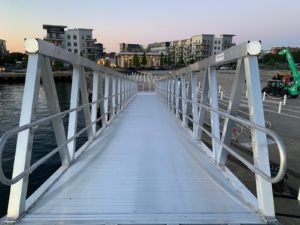
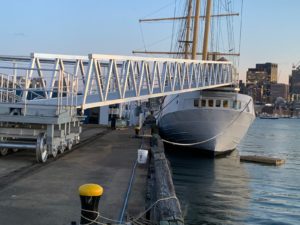
Tall Ship Gangway, Boston, MA
Benefits of a BoardSafe aluminum gangway or fixed pier
Aluminum gangways are much lighter than steel and other materials, making them easier to handle and install.
Aluminum is durable, rust-resistant, and can withstand harsh weather conditions, making aluminum a long-lasting option. It is virtually maintenance-free. Unlike other materials, aluminum requires no painting or other forms of maintenance, saving time and money. Aluminum is corrosion-resistant, making it ideal for use in marine environments, and is recyclable—therefore, an environmentally-friendly option.
Aluminum is a cost-effective option being less expensive than other materials; therefore it’s financially desirable to customers.
Click here to view a video of an 80’ gangway project along the Allentown Waterfront: Allentown Waterfront Floating Dock and Kayak Boat Launch on the Lehigh River
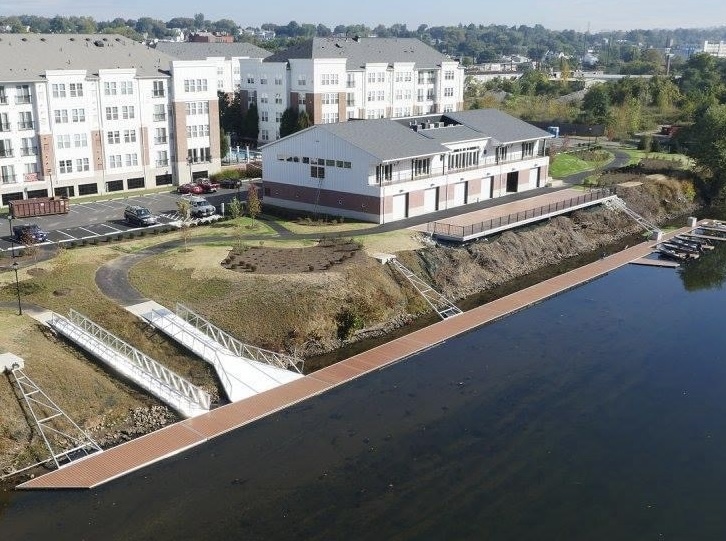
The Allentown Waterfront redevelopment project is an effort to revitalize an undeveloped area along the Lehigh River. Water access along the river is a key feature and will support the success of the mix of retail, commercial, and residential development planned for the location. A custom landing and hub for the top of the gangway was built into the bank with two large support arms providing additional structural integrity to the gangway’s and dock’s connection to the riverbank. The custom floating dock was designed in four sections that allow for movement as the river’s elevation changes throughout the seasons or die to river flooding.
BoardSafe gangways are fabricated with their own proprietary extruded components. Boardsafe’s custom commercial gangways reduce the number of mechanical joins, making the frame components stronger and less likely to loosen over time. All of BoardSafe’s gangways, including the handrails, are manufactured using an aluminum welded design.
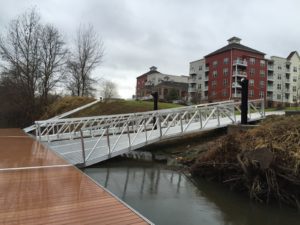
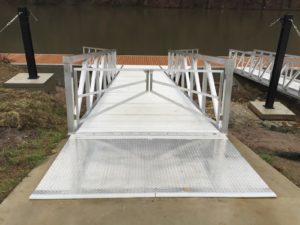
Conshohocken Rowing Center Gangway
Many competitors use bolt-together assemblies that reduce structural integrity and durability. BoardSafe’s railings are constructed with a free-span truss design, with exposed surfaces and welded joints that are smooth and free of sharp or jagged edges. BoardSafe gangways use stainless steel hardware to ensure long-lasting performance. The gangways stay cool to the touch and are built for harsh and high-use environments. Aluminum welds are able to withstand high winds and environmental flooding. The decking materials we offer are slip-resistant, using self-mating extruded aluminum or composite. These choices have proven the optimal choice for year-round access to frequently flooded areas and seasonal streams.
A video example of a 54’ custom gangway can be viewed here: Aluminum Floating Docks and Gangway at Riverside Dock
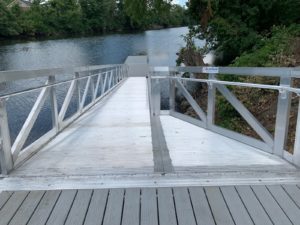
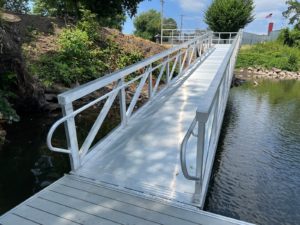
BoardSafe Docks was contracted to come up with a design for a new floating dock system on the Schuylkill River, across from Pottstown, PA, in North Coventry Township. The site included an existing boat ramp with signs of a previous dock system that had washed away in a flood years ago. The customer asked if BoardSafe could design a new dock system that would stand up to flood conditions. It also had to be ADA-compliant and not project too far out into the river.
BoardSafe’s solution was to evaluate the site conditions and design and manufacture and install a foundation that included a cantilevered deck that projected out over the river. A concrete foundation supports the cantilevered aluminum deck bolted into the foundation. The gangway is connected to the side of the deck and runs parallel to the river bank. Supplemental flotation was placed at the bottom of the gangway to provide adequate buoyancy for its weight and to maintain a freeboard of 16 inches, the same as the floating dock. The gangway is connected to the floating dock via a piano hinge. The hinge allows the dock system to move up and down as the water level fluctuates. The floating dock was made up of two 8’ x 20’ dock sections connected together with a piano hinge. Rubber dock bumpers and adjustable cleats were installed into the dock's custom aluminum extrusions. The components of the dock system include:
- 8’ x 10’ x 4’ concrete foundation supported by a rebar cage and driven steel pilings
- 8’ x 20’ cantilevered deck with aluminum frame and galvanized steel structural support members, composite deck boards
- 5’ x 54’ gangway with an expanded section at the top with non-skid aluminum decking
- 8’ x 40’ floating dock with 16-inch freeboard, manufactured in two sections
North Coventry Township, PA
Gangway design considerations
Understanding the type of gangway needed for a location can help determine the length and width of the gangway. Design concerns to keep in mind are the environmental conditions of the location and the durability and design life of the project. There is an inherent correlation between cost and the lifespan of an aluminum welded gangway. A gangway constructed of wood may be the least expensive option; however, it may only last a few years due to UV, water, and bug damage.
The following video is a site visit of a BSD aluminum gangway and adaptive kayak launch in Cleveland, OH, approximately one year after its installation. BoardSafe Docks engineered, built, and installed the unique ADA-inspired gangway and accessible launch system to make the waterfront accessible to adaptive paddlers.
East 55th Street Adaptive and Accessible ADA Kayak Launch by BoardSafe Docks
Why docks should be designed for accessibility
Designing docks for accessibility is important for several reasons.
Inclusion Making docks accessible allows individuals with disabilities to participate in water-based activities and access the recreational opportunities the water provides.
Safety An accessible dock is designed to provide a safe and stable environment for people with disabilities to board and disembark from boats. This can include features such as ramps, handrails, and non-slip surfaces.
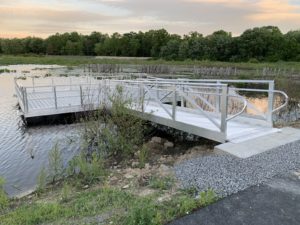
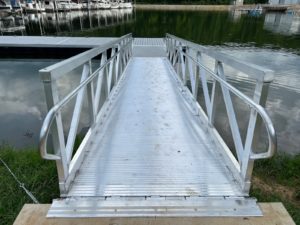
Minsi Lake, Mt. Bethel, PA Pickwick Lake, TN
Compliance with laws In the United States, the Americans with Disabilities Act (ADA) requires new construction and alterations of public accommodations, commercial facilities, and state and local government facilities, to be accessible to people with disabilities.
Cost-effective An accessible dock can be designed to be cost-effective. It can include features that are relatively easy and inexpensive to install, such as a ramp or handrails, and can be incorporated into the design of the dock.
Community benefit An accessible dock can benefit the entire community. It not only improves the recreational opportunities for people with disabilities, it also promotes a more inclusive community and encourages people of all abilities to enjoy the water.
Increase in visitors Making a dock accessible can increase the number of visitors to the area, because people with disabilities and their families and friends may be more likely to visit if the dock is accessible.
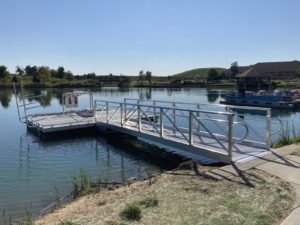
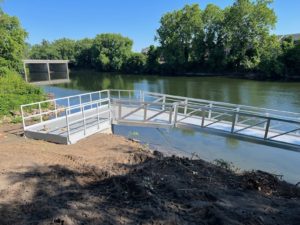
Voice of America Metroparks, OH North Coventry Twp, PA
Statistics from the World Health Organization (WHO), reveal that about 15% of the world's population, or more than 1 billion people, live with some form of disability. Of those, approximately 2–4% have a mobility impairment, which could make it difficult for them to access traditional trails, kayak launches, and other water access points.
Accessible designs benefit a significant portion of the population, including people with mobility impairments, and physical disabilities, older adults, and people with temporary injuries or similar conditions.
Gangways are important access areas for waterfront design and construction because they comply with ADA laws, allow people with disabilities to participate in water-based activities, promote a more inclusive community, increase the number of visitors to the area, offer safe access, and provide cost-effective options for community benefit.
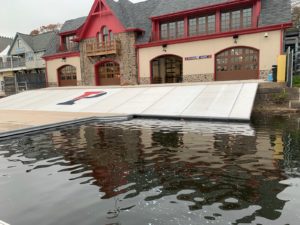
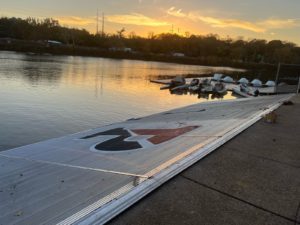
The University of PA Rowing Center The University of PA Rowing Center
BoardSafe Docks is also the expert for many Division I rowing centers and boathouses where specialty gangways are used to get racing sculls into the water safely and efficiently.
What length gangway do I need?
To help determine the gangway needed for your project, here are two articles that will guide you in determining the length of your gangway.
https://boardsafedocks.com/adaptive-launch/what-length-gangway-provides-handicap-access/
https://boardsafedocks.com/adaptive-launch/how-to-calculate-ada-gangway-length/
When your project requires structural integrity, non-polluting materials, corrosion resistance, strength, and safety, a BoardSafe gangway will meet your standards.
Explore your options with a BoardSafe aluminum-welded gangway, ramp, floating dock, kayak launch, fishing pier, or other water access products.
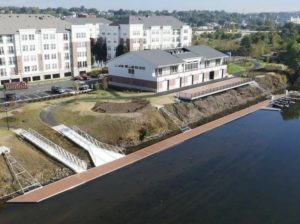
Conshohocken, PA, Rowing Center
BoardSafe Docks is a leading national manufacturer of high-quality aluminum-welded floating docks, gangways, fishing piers, kayak launches, rowing centers, pedestrian bridges, and other accessible water access products. Whatever type of access your project may need, BoardSafe Docks provides a turn-key service, from product design and inception through delivery.
BoardSafe’s sales team is available for questions and consultation and will assist you with finding your optimal waterfront solution. You may learn more about BoardSafe Dock’s projects through their website at BoardSafeDocks.com or by calling 610-899-0286.
Available Grants for ADA Accessible & Adaptive ADA Kayak Launches
Local nonprofit, state, and federal grants are proliferating to increase outdoor accessibility with adaptive kayak launches and other ADA recreational products.
As many advocates and community groups seek to expand outdoor recreation opportunities and water access for those living with disabilities, or who have mobility challenges, funding and initiatives are becoming available to help secure investments in accessibility. If you are seeking to make your park, lake, river, stream, or other marina location ADA accessible with an adaptive kayak launch or fishing pier, then you may benefit from the following list.
Investing in accessibility can be expensive, but it is worth the time and effort. To help raise money more quickly or help decrease the financial burden on community groups, BoardSafe Docks has created a list of potential grant funding organizations to offset the cost of outdoor accessibility products like an adaptive kayak launch.
Please review the list of organizations and contact them directly to see if your project qualifies. If you know of an organization that could be added to our list, please contact us to submit the information. Together, we can expand the world of outdoor recreation for people of all abilities!
[table id=5/]
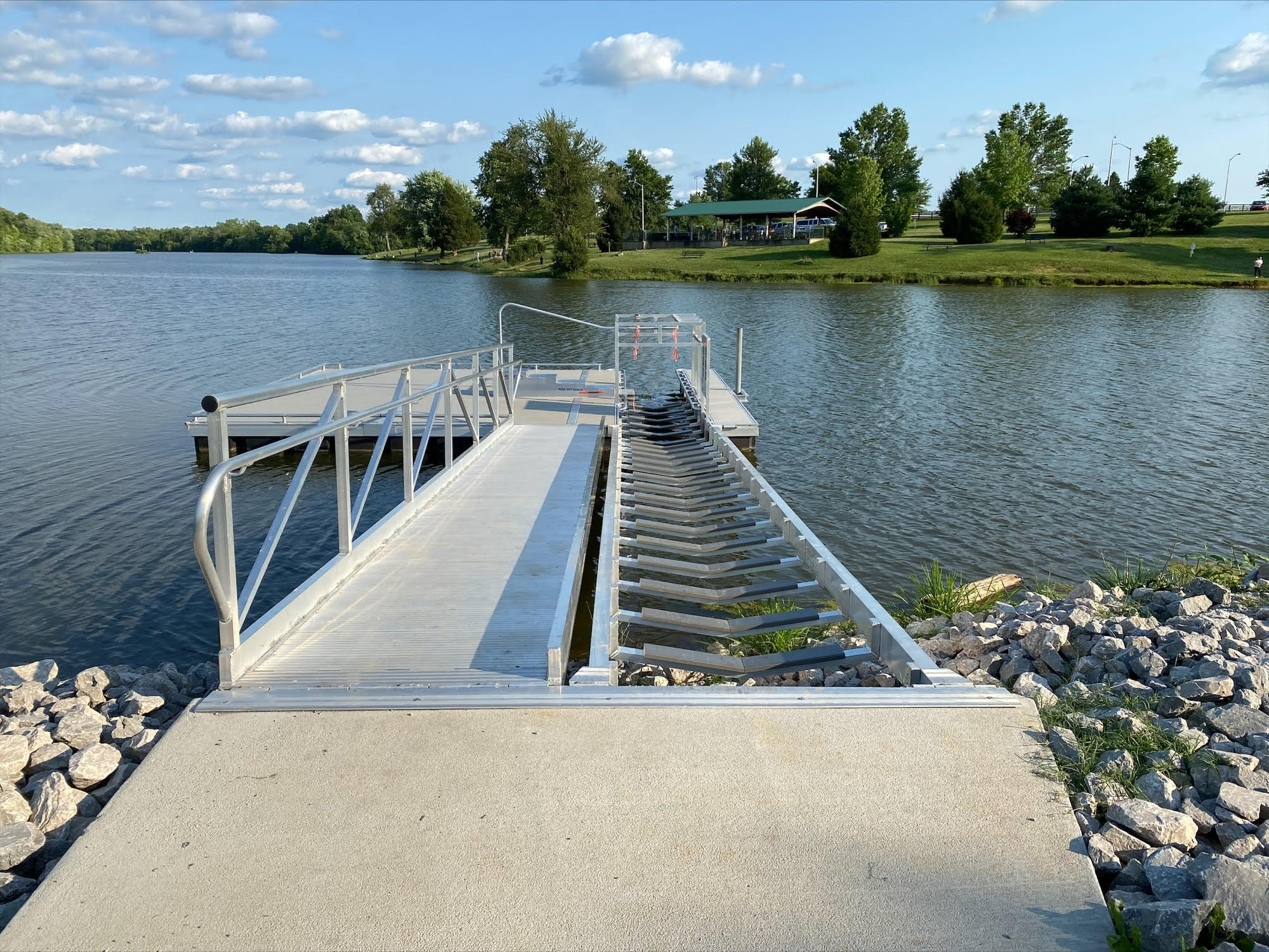
Richmond Kentucky Unveils Accessible Kayak Launch at Lake Reba
Nature lovers have a multitude of fun venues for various activities for all ages. The BoardSafe adaptive, accessible kayak launch opens up the joys of kayaking on Lake Reba to a new level of participation for the mobility-challenged population.
You can find more details about this project in this article in the Richmond Register:
Richmond unveils kayak launch at Lake Reba


