


6 Reasons for Designing a Universal Access Kayak Launch
When you step into a kayak, push off into a canal or a river, and take those first few paddle strokes, nature surrounds you at every level. It’s easy to understand why people are getting hooked on paddle sports.
Paddling and exploring the water bring people and nature together for a mixed blend of relaxation and good physical fun. There are so many reasons propelling around the water is an attractive diversion from today’s fast-paced world. It brings families and friends together, connects people to nature, and most importantly, it promotes exercise, good health, and wellness. Paddling is an activity that almost everyone can participate in—young and old, novice and experienced, and people with mobility limitations.
Kayaking has also become increasingly popular for paddlers with more serious physical disabilities, like amputees and those with paralysis. It offers rehabilitation, exercise, and socialization, and is proven to improve one’s mind, body, and spirit. Most importantly, kayaking gives adaptive paddlers an opportunity to be out on the water like everyone else. They describe the freedom of leaving their wheelchairs and transitioning into a kayak as “liberating.” This can only occur when kayak launches and water access points are designed and engineered from inception for universal access. Adaptive kayak launches include specific features that are often overlooked or not designed to the necessary extent.
The popularity of paddlesports like kayaking is on the rise
According to a report published by the Statista Research Department, nearly 18.6 million U.S. Americans went kayaking at least once in 2021, demonstrating an increase in the popularity of paddlesports. In the period of 2010–2021, kayaking participation in the United States grew by 87.3 percent. Kayaking, canoeing, and all paddlesports, are truly inclusive recreational activities when kayak launches and their accommodations (gangway, chute, boarding bench, hand straps, and grab bars) are included in the design plans.
Water access points need accessibility and additional adaptive features
When civil engineers design neighborhoods and street crossings, curb ramps are now automatically included. However, before January 1992 when the Americans with Disabilities Act was passed, they were not. Curb ramps are now required anywhere a sidewalk or other pedestrian walkway crosses over a curb. Prior to 1992, it was difficult or impossible for a person using a wheelchair, walker, or other mobility device, to cross a street safely or with ease due to raised sidewalks. It was also dangerous. Before curb ramps, individuals were forced to make the difficult decision to stay home or risk personal safety by using their wheelchairs or walkers to travel alongside cars and other vehicles on the street; an unfortunate choice for people with disabilities to make. The same holds true for water access at recreational sites today. Those planning water access points should ensure truly accessible launches are designed from the start. While there has been a steady increase in ADA accessibility at public parks and recreational facilities, water access points need additional attention to ensure they are planned beyond minimum ADA standards. This is the only way to make certain they will be inclusive to all.
More important than the number of access points is the quality of the accommodations at these sites. All too often, when a location is deemed accessible, it still cannot be used by paddlers with moderate to more severe disabilities because most waterfront products are designed by able-bodied people. Many accessible launches may look good, but end up being exclusive, rather than inclusive, due to a lack of adaptive features. Despite good intentions, if gaps in diversity, equity, and inclusion are to be bridged, then the best solutions should come from those who experience the challenges or at the least, designs should include their input on the necessary adaptations.
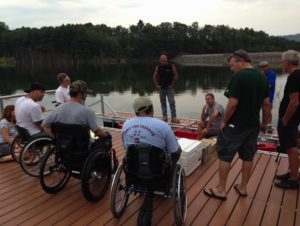
How do we continue to make kayaking appealing and accessible for older adults, and ensure those with mobility limitations or physical disabilities are included?
To attract paddlers to return to the water and build legacies for people to use and enjoy for many years to come, designers, architects, and engineers must include features that get paddlers in and out of the water safely and with minimal discomfort.
Reportedly, the greatest difficulty for almost all paddlers is getting in and out of their vessels (Just ask!). Upon entry, kayaks and canoes can tip, shift, or roll over. Adaptive features can ensure safe access in and out of the water. It’s very encouraging to see leaders and planners striving to create a more inclusive society. They understand the importance of inclusive outdoor recreation. As recreation stakeholders, we all share responsibility for shaping the future of our country’s outdoor spaces and inclusive lifestyle, and improving the quality of life for all.
Here are six reasons why designing docks for universal access is important.
- Inclusion Making docks accessible with inclusive features allows individuals with disabilities to participate in water-based activities and access the recreational opportunities that the water provides.
- Safety An accessible dock with inclusive features is designed to provide a safe and stable environment, allowing people with disabilities to board and disembark from boats. This can include features such as ramps, handrails, and non-slip surfaces.
- Compliance with laws In the United States, the Americans with Disabilities Act (ADA) requires that new construction and alterations of public accommodations, commercial facilities, and state and local government facilities, be accessible to people with disabilities.
- Cost-effectiveness An accessible dock with adaptive features can be designed to be cost-effective. It can include features that are relatively easy and inexpensive to install. Features include a minimally-sloped gangway and stabilizing kayak chute, an adaptive kit with overhead grab bars and hand straps, handrails, pull bars, and a step-down boarding bench. All can be incorporated into a floating dock design that ensures universal access.
- Community benefits An accessible dock with adaptive features can benefit the entire community. It not only improves recreational opportunities for people with disabilities; it also promotes a more inclusive community and encourages people of all abilities to enjoy the water. It can also support the economic growth of the community.
- Increase in visitors An accessible kayak launch with adaptive features can also increase the number of visitors to the area because people with disabilities, their families, and friends may be more likely to visit if the floating dock system and launch are inclusive.
According to the World Health Organization (WHO) fact sheet on Disability, an estimated 1.3 billion people experience significant disabilities. This represents 16% of the world’s population, or 1 in 6 people.
According to the CDC Disability Impacts All of Us Infographic, 11.1 percent of U.S. adults have a mobility disability with serious difficulty walking or climbing stairs.
Therefore, an accessible kayak launch with additional adaptive features would benefit a significant portion of the population, including people with mobility impairments, older adults, and people with temporary injuries or permanent conditions.
Ask any adaptive kayaker about their feelings of enjoyment, liberation, and empowerment after they complete a paddle. Many will tell you they cannot wait to get back out in the water!
Kayaking promotes healthy living, connects friends and families with each other and with nature, and ensures that we are being good stewards caring for our natural resources.
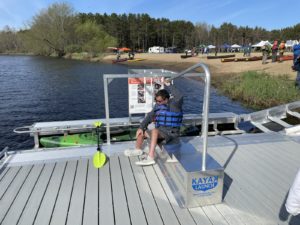
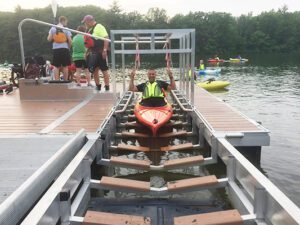
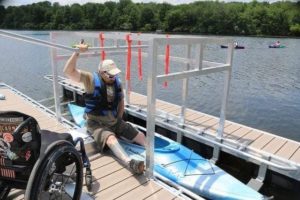
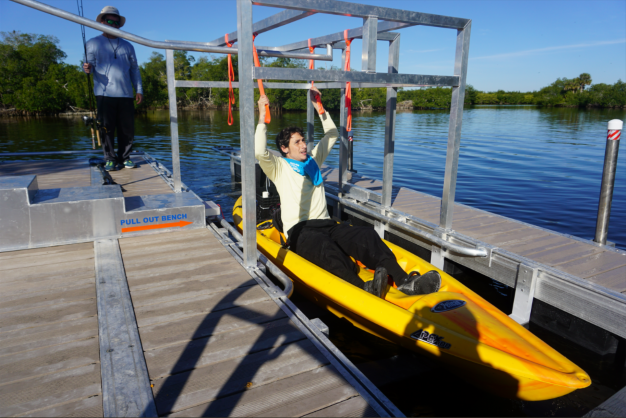
Adaptive paddlers using the inclusive features of a BoardSafe Adaptive Kayak Launch
What adaptive features offer accessibility to paddlers in wheelchairs?
One of the easiest ways to ensure accessibility and safety is by investing in a BoardSafe Adaptive Kayak Launch.
Following is a list of special features found only in a BoardSafe Launch.
- A paved egress from the parking lot to the kayak launch site.
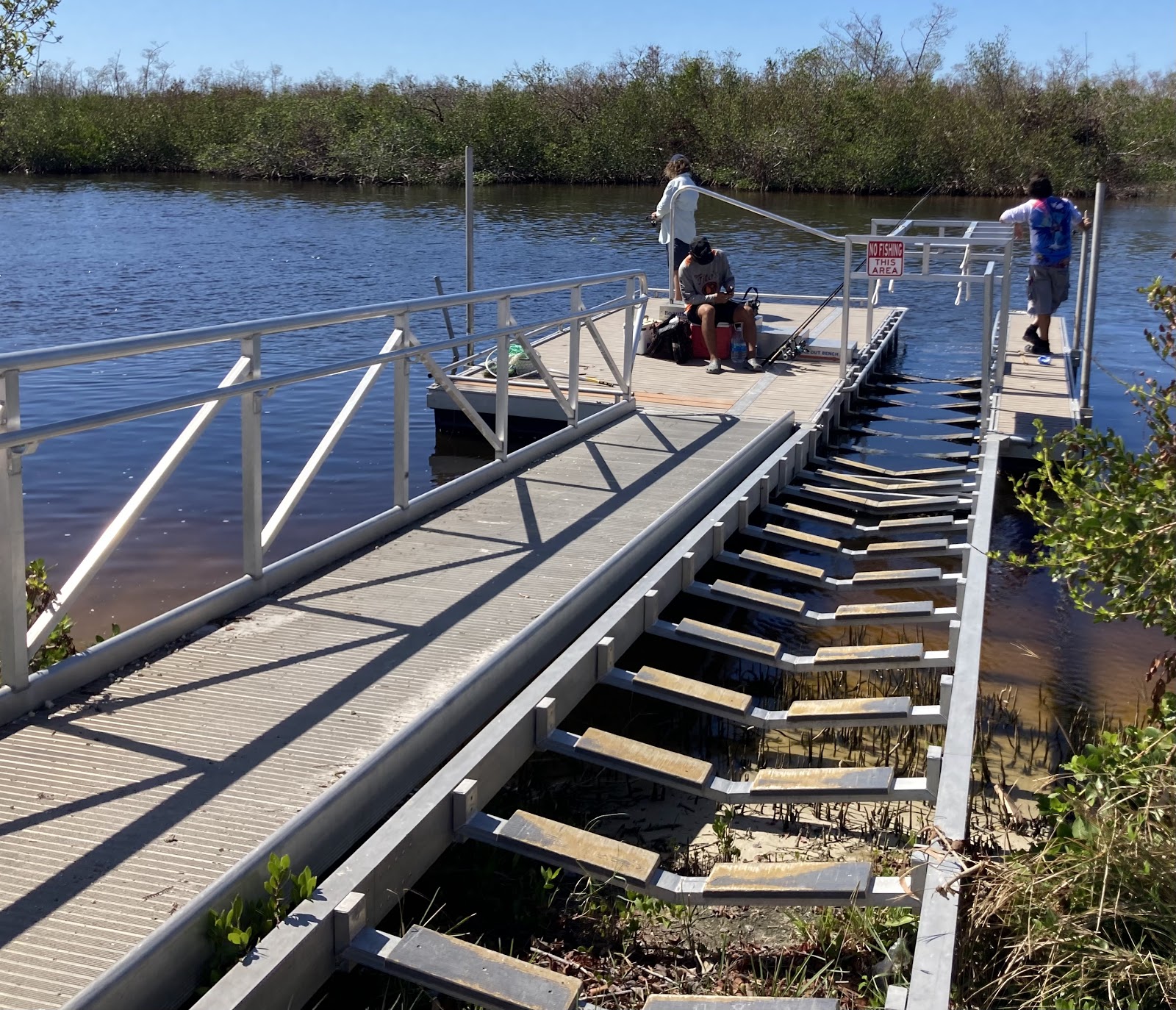
- A gangway that offers adaptive paddlers a way of moving from land to the launch area and vice versa. The gangway should have a maximum of 1:12 pitch.
- A parallel kayak chute large enough to accommodate kayaks with outriggers. If the chute is too wide, it will create too great a distance between the boarding bench and the cockpit of the vessel and decrease the stability needed for a disabled paddler to get into their vessel.
- An aluminum-welded floating dock should offer sufficient space to maneuver a wheelchair and allow room for additional wheelchairs to be left on the deck. The floating dock should also have a protective toe kick around the perimeter as an added safety feature. This prohibits a wheelchair from accidentally rolling off the dock. Both the gangway and floating launch should include a 36″ continuous handrail around the perimeter, consistent with ADA requirements.
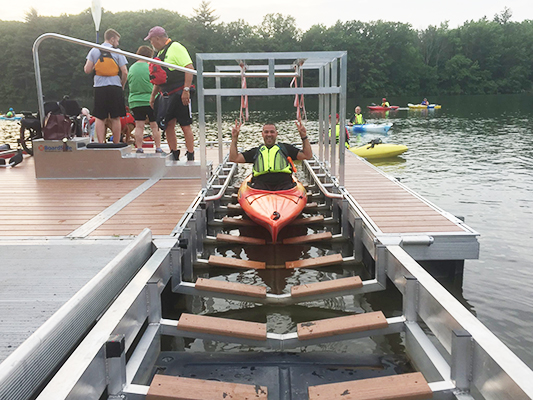
- A tiered boarding bench allows the user to board from their wheelchair. The top step of the bench should be equal to the seat of a wheelchair. The step-down bench should offer a gentle 3.5” drop per step. The bottom step should offer a pull-out bleacher-style seat that slides out over the kayak and directly above the vessel’s cockpit, allowing adaptive paddlers to slide across the seat and lower themselves into the vessel with a minimal drop.
- An adaptive roll cage surrounds the boarding bench. This kit includes a frame of handrails, an overhead grab bar, and hand straps that provide numerous gripping options to lower paddlers into vessels. The overhead handrail runs the length of the bench and offers adaptive paddlers the choice to slide down the bench from either side, depending on their preference.
- Adding to the launch’s stability is a secure chute and saddle. The cradle-like chute holds the kayak securely in place. The chute supports the vessel with a partially-submerged bracket system. The snug fit of the cradle removes any worry about tipping or moving unexpectedly, which is a risk with roller-type launch systems. Adaptive paddlers report roller-type launches don’t hold kayaks in place and can cause the vessel to shift upon entry, making a cradle launch the safest option.
- Once the paddler is securely fitted into the vessel, there should be appropriately-spaced handrails on each side of the cradle to pull the kayak into the water.
Learn about this club’s effort to meet the needs of all paddlers and its impact: Lions Club Raises Money for ADA Fishing Pier & Adaptive Boat Launch
Working with adaptive paddling groups has been a continuous educational experience for the team at BoardSafe Docks. Understanding the difference between an accessible launch and an adaptive kayak launch with additional adaptive features has helped us become the trusted expert when building a launch for the widest range of users. Understanding the difference and knowing what additional features must be included is imperative for anyone wanting a truly inclusive launch for their community. Just remember, “accessible” is not synonymous with “adaptive”! Most accessible launches alone will not work for paddlers in wheelchairs without a lot of lifting, tugging, and pulling, and the chance of someone getting hurt along the way is greater.
To discuss your project’s vision and learn more about BoardSafe Docks, our Adaptive Kayak Launch and Fishing Pier, its durable construction, and the long-term value it will bring to your community, please call us at 610-899-0286 or contact us through our website at BoardSafeDocks.com.
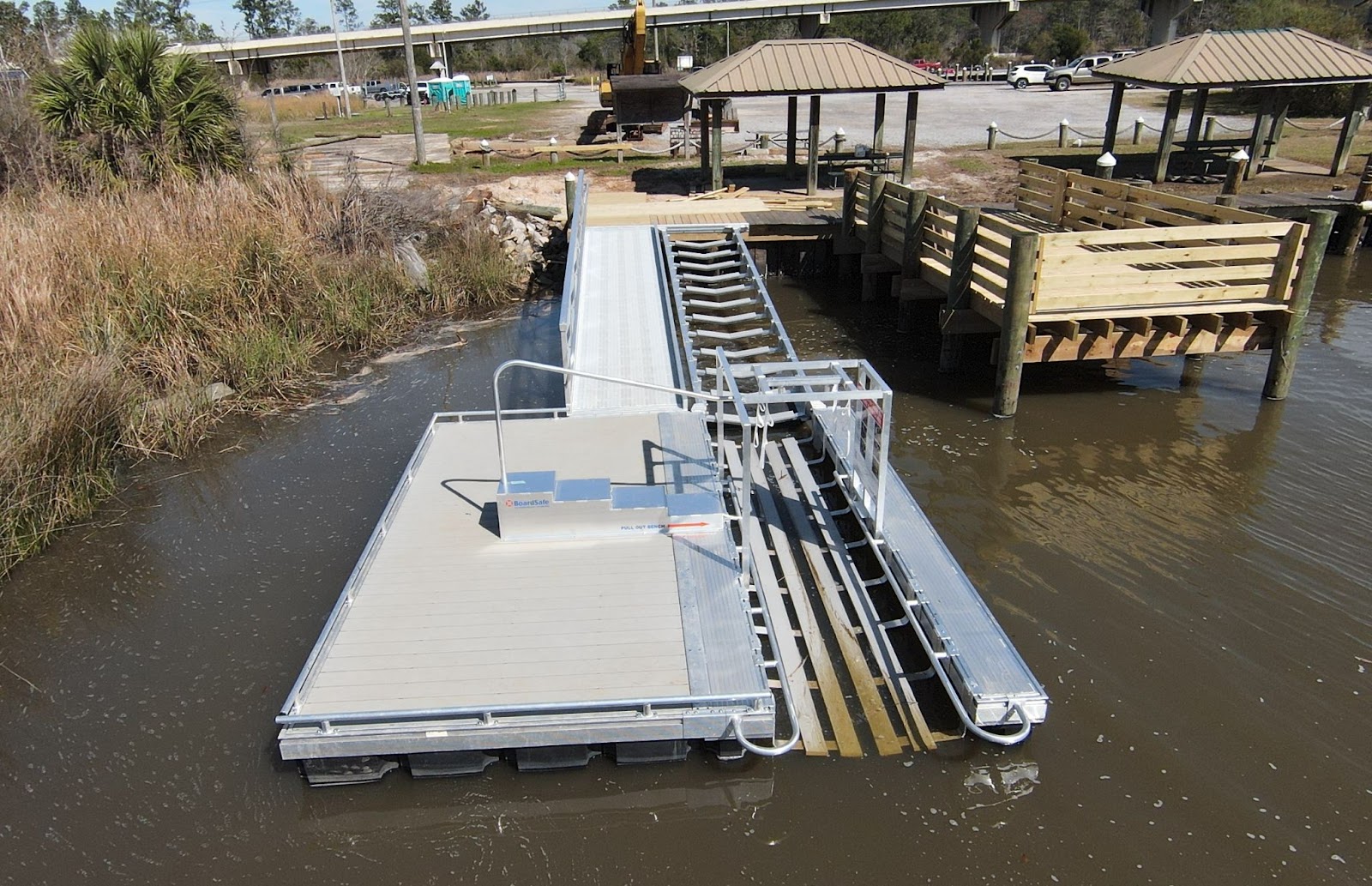
ADA-Accessible Kayak Launch Offers Weeks Bay Adaptive Features
The Weeks Bay National Estuarine Research Reserve in Fairhope, Alabama, recently introduced its inclusive, ADA-compliant kayak launch to its kayakers and canoers so they can enjoy paddling Weeks Bay. What’s most important about the new kayak launch is its unique features that offer inclusivity and the ability for adaptive paddlers and paddlers with disabilities and mobility limitations to enter and exit their vessel safely, and to participate in paddling activities with their non-disabled family and friends.
The Reserve is thankful to multiple organizations and community partners who collaborated, raised funds, and contributed to the new adaptive launch system. The adaptive kayak launch is accessible to all and was designed and manufactured by BoardSafe Docks. To help fund the launch, the Alabama Coastal Area Management Program (ACAMP) used 306a funds designated for low-cost public access improvement projects. Those funds were matched by the Alabama Department of Conservation and Natural Resources (ADCNR). South Alabama Land Trust (SALT), a passionate and community-focused group, also raised funds and donated toward the accessible launch system. Recognition is deserved for all the stakeholders who were involved in this inclusive project which opens up paddling and welcomes everyone to Weeks Bay!
Until recently, Weeks Bay did not have a kayak or canoe launch. Paddlers had to compete with much larger vessels to launch their boats. Their only option was to launch from the motorboat ramp or walk them into the water across jagged rocks and riprap.
The new kayak and canoe launch provides accessibility to non-motorized vessels, and the specialized launch offers adaptive features to include paddlers with disabilities or mobility limitations, making it safe and easy for paddlers of all abilities to paddle on Weeks Bay. It’s a happy day on the bay!
The Weeks Bay Foundation is pleased to share its accessibility for all.
Prior to the installation of the BoardSafe Adaptive Kayak Launch, the bay lacked accessibility for its paddlers. Weeks Bay Reserve takes students and teachers paddling during educational field trips as well as hosts events that attract paddlers to the water. These events allow visitors to connect with nature and socialize with family and friends. The Reserve is happy that these events are now inclusive and accessible for all. One event is a kayak and canoe-based cleanup to remove trash along the Weeks Bay and Fish River shorelines; the shorelines are not accessible by land and must be reached by kayaks, canoes, and other watercraft. The second event occurs during National Estuaries Week when the Reserve hosts multiple paddle eco-tours around the bay. The Reserve is hoping the new launch will attract new paddlers looking to try out the accessible launch.
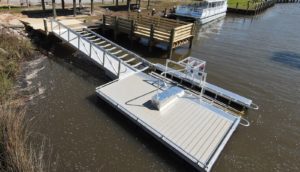
Weeks Bay is well-known for its protected coastline and calm waters. The bay draws thousands of people who enjoy exploring the water by powerboat, sailboat, and paddleboat. Paddling on the bay is a calm, quiet experience that often includes seeing amazing wildlife like manatees and bald eagles. Whether paddling in a kayak, canoe, or stand-up paddleboard, seeing the rare and endangered species adds to the attraction of paddling the bay. The Reserve is proud of its new launch and happy to welcome all interested paddlers to enjoy the beauty of Weeks Bay.
The launch’s unique features are a draw for the adaptive paddling community.
The new ADA adaptive kayak launch allows local paddling groups like Team River Runner, a disabled-veteran and adaptive-paddling group, the inclusive opportunity to get out on the waterway. The Team River Runner group provides paddlers in need of physical exercise the opportunity to get out on the waterway for therapeutic paddling sessions. Team River Runner plans and hosts a number of recreational opportunities for disabled paddlers that improve their quality of life by offering therapeutic, social, inclusive, and community connections to its users. The Reserve is sure the new launch and its features will assist the adaptive paddlers and add to their enjoyment when paddling the bay.
The Reserve is glad to support its community’s equity plan and offer greater opportunities and improved paddling experiences to its disabled veteran community. Paddlers seen using the launch are enjoying the freedom of being on the water. Without safe entry and exit points for people with disabilities and physical limitations, opportunities to experience the beauty of kayaking Weeks Bay would have remained limited.
Where to find the BoardSafe Adaptive Kayak Launch site at Weeks Bay
Paddlers are able to launch their vessels at The Weeks Bay Reserve (just west of the US 98 bridge) that hugs the shoreline going north and south. One may paddle north on Fish River, under the US 98 bridge, and turn left into a little inlet that loops through the back of the Weeks Bay Reserve property and back out to the river a couple of hundred yards above the kayak launch.
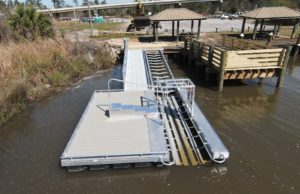
Kayaking and paddle sports' popularity continues to grow.
The latest data from the Research News - Outdoor Industry Association, specific to kayaking, canoeing, and stand-up paddle boarding, found a record number of 37.9 million Americans engaged in paddlesports during 2020, adding 2.5 million new paddlers to America’s waterways. COVID may have contributed to the increase, but a few years later, it appears these numbers are here to stay and continue to grow. The growth in kayaking, kayak fishing, and other paddlesports, has increased the number of paddlers seeking launch sites to access the water. Unfortunately, many access points exclude paddlers with disabilities and those with limited mobility because the infrastructure is outdated or the sites lack the necessary adaptive features to make them truly inclusive launch sites.
BoardSafe Docks is a nationally recognized manufacturer of floating dock systems and a trusted expert who provides education and guidance when planning and designing inclusive water access products, specifically their highly-requested adaptive kayak launch and adaptive fishing pier.
To discuss your inclusive project, or for help designing your non-motorized water access site, contact BoardSafe Docks at 610-899-0286 or through our website at BoardSafeDocks.com.
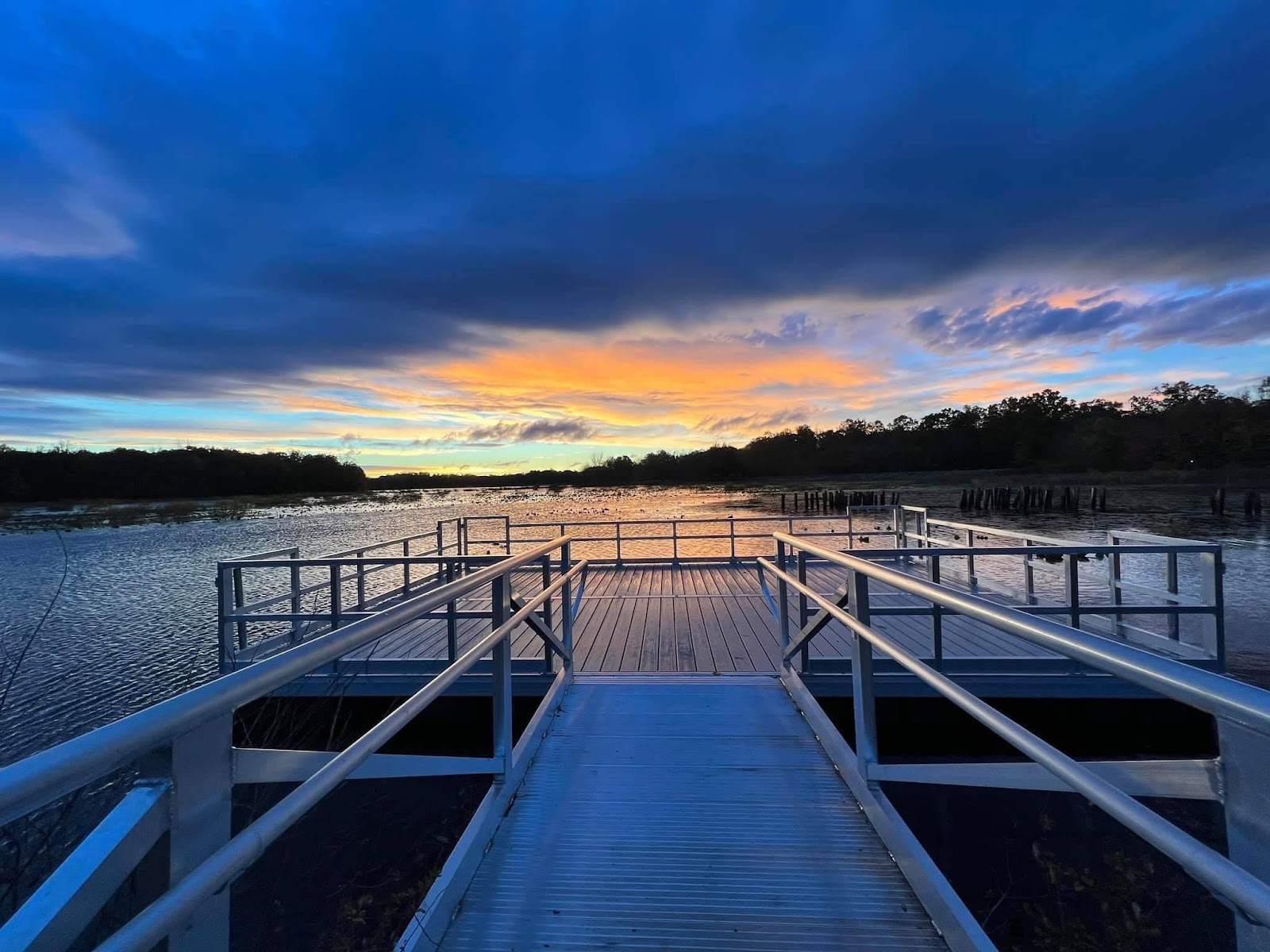
10 Considerations When Choosing a Floating Dock Builder
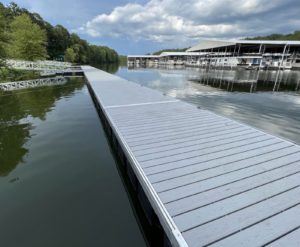
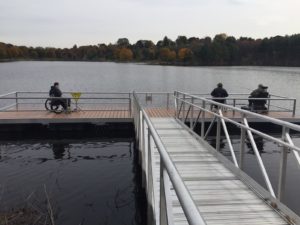
We have listed 10 considerations for prospective buyers to be aware of during the design, engineering, and manufacturing phase of their projects.
If you’ve decided to work with BoardSafe Docks for our industry expertise, you’ve made the right choice. Working with a dock builder you trust will strengthen your professional relationship and translate into a more pleasant building experience.
Following are some key points to learn and understand about the design, engineering, and manufacturing process.
Choose an experienced floating dock builder.
Customers prefer to select a dock builder with prior dock-building experience. Ask how long the dock builder has been doing this type of work. Visit completed dock projects to see what they look like after the installation, as well as jobs they completed five years earlier so you have an idea of their strength, durability, and performance over time. Speak with and review references from prior customers. Since no two waterfronts are ever the same, neither will be floating dock projects. Projects will always vary; therefore, successful prior experience will ensure you’re getting a quality product that lasts. Take the time to research completed projects and reviews before you hire your contractor. Your dock is more than a regular construction project, so don’t waste time with inexperienced or novice builders.
Communicate with your designer-dock builder.
A trusted dock designer will be one you can easily contact and communicate with. Do they respond to your phone calls and emails in a timely manner? Establish in advance your preferred method of communication and the frequency of communication and how payments will be made. Map out a schedule for updates regarding the progress of your project. Dock projects can take time to complete—from designing, engineering, and ordering materials, through fabrication.
Structural integrity of the dock design and materials
You can’t have a quality dock without quality materials! That means asking your floating dock designer about the best type of dock for your environment, its features, and their recommended materials. The kind of dock, its location, and the materials used, will tell you a lot about the quality of their product. If the designer tends to use a certain product or material, you can look up information about the company and decide if you think it’s a good fit. Purchasing a floating dock is a big investment that you want to last for many years to come.
The durability of an aluminum floating dock
Be sure to ask how your dock will stand up against various weather elements. Understand what type of maintenance will be required during the winter months, during changes in tidal conditions, and when there’s flooding or drought. This will reveal the considerations your designer needs to make for your dock regarding the local weather and demands of the waterway. Customers who experience any type of extreme weather, traffic, or tidal conditions, should ensure their designer prepares for it.
Project timeline for the floating dock
When it’s time to really get serious about your project, one of the critical questions you must ask is about your designer’s timeline. Try to zero in on a specific schedule and have some aspect of timeline expectations in your contract.
Site preparation prior to installation
Well before construction even begins, make sure your designer has the plan to protect and prepare your property for the dock’s installation. If trucks and other equipment must be driven through your yard, make sure you know how you want your dock builder to access your property from both land and water. Understand what site work may need to be completed prior to the installation of your floating dock system and who is responsible for that site work. Make sure it is completed prior to the arrival of your dock.
Permits for your water access project
Find out what regulations govern your property prior to starting any waterfront access project. Start with your town building code department and work your way up. Also check for the county, state, and federal regulations that might affect your property. Know who is responsible for obtaining your permits—your landscape architect, the engineer, the dock builder, or the property owner.
Unexpected change orders
There are always unintended changes that may arise during the construction of your project. Ask your designer what the process will be if changes to the design are necessary—especially if they will result in changes in cost. Make it clear that you want to know about changes and any additional costs in advance if necessary.
Consider the end goal early in your floating dock project.
It’s important to consider the entirety of your floating dock project at the start of your project. If you have questions, ask them. If you have your eye set on additional dock accessories, communicate that in advance. Customers who change their design ideas in the middle of the project need to expect additional costs and additional time for completion. These little steps can make a big impact on the timing of construction and your overall satisfaction with your completed boat dock.
Understand the warranty of your floating dock system.
Asking these questions will set you up for an extremely successful relationship with your dock designer. You’re much less likely to face setbacks and disappointments if you set up a good foundation of understanding from the beginning.
When you find a professional dock builder, ask if they provide annual maintenance packages for your floating dock system, especially if you live in an area where docks need to be removed for the winter months. If they do, it’s a good idea to establish a recurring maintenance schedule.
BoardSafe Docks understands the benefits and impact their floating dock systems offer to communities and park systems. Their inclusive launch is fitted for kayaks, canoes, and SUPS, and gets everyone in the water safely and easily. We know paddlers want close-to-home recreation; safe, easy, and inclusive access to the water; and the ability to connect their families to nature and their local community. BoardSafe’s fishing piers allow their users to enjoy the outdoors safely away from active boat launches and access points. Our floating dock systems for marinas enhance the ability to safely secure vessels in the water, allowing boaters to come onto land for dining and other recreational activities.
To discuss your project and create a water entry site that offers safe and easy access with inclusive and adaptive features, contact us at 610-899-0286 or through our website at BoardSafeDocks.com.
Seven Advantages of a BoardSafe Aluminum Floating Dock
BoardSafe Docks’ customers often ask about the advantages of using an aluminum floating dock system. BoardSafe Docks are used for municipal, commercial, and private projects. While traditional piling structures support stationary, fixed docks, floating docks are supported by flotation and rest on the water’s surface. Though fixed docks are a popular choice, floating docks offer advantages and benefits that cannot be offered with a stationary pier. These benefits may be ideal for your docking system project. Here are the unique advantages of a BoardSafe floating dock.
BoardSafe Aluminum Floating Docks Adjust to Tidal Conditions
Floating docks provide an ideal solution for projects that experience vast changes in water levels. During the change in seasons, tides may rise and fall, allowing floating docks to remain level with your boating vessel. When water levels drop too far below a stationary dock, boaters may experience difficulty boarding. When water levels rise too high, fixed docks become submerged. Floating docks will self-adjust with water levels and provide safe, constant access to your vessel. So whether you experience drought or flooding conditions, a BoardSafe aluminum floating dock maintains the same freeboard.
Click the following link to read and learn more about freeboard:
Five Most-Commonly-Asked Questions About Floating Dock and Rowing Dock Freeboard
BoardSafe Aluminum Floating Docks Offer Structural Integrity
According to the Federal Emergency Management Agency (FEMA), floating docks acclimate to weather conditions and provide greater protection for boats. During a storm or hurricane, stationary docks may succumb to submersion, damage, and collapse. Floating docks move with the water, and their elasticity reduces damage due to inclement weather.
[table id=3 /]
Sirenia Vista Kayak Launch and Park, three weeks after Hurricane Ian, 10/22/22. BoardSafe’s Kayak Launch system floated with the rising waters and maintained its structural integrity, withstanding sustained winds reaching 100–140 mph with significant tidal flooding.
BoardSafe Docks Are Built for Versatility
Floating docks offer increased versatility compared to stationary docks. With more options for customization, BoardSafe Docks can design floating dock configurations to meet their customer’s needs. They can reposition, remove, and add additional floating docks with ease. BoardSafe Docks are designed with proprietary extrusions and connecting hinge pins that allow them to be easily dismantled and stored for the winter.
User groups in the northern United States and Canada will be happy to know that BoardSafe’s docks and launches can remain in the water for the winter as long as there is no fluctuation in the body of water where the launch is located and there are no ice pack movements that could damage the floating dock system. That said, a floating dock, fishing pier, or adaptive launch that has a steady level and flow of water around it will endure the winter and can be left in the water. However, this decision should not be made in isolation without having conversations about winter weather conditions with both the park operations manager and BoardSafe Docks. The adaptability of floating docks makes modifying your space and dock easier and less expensive than a stationary dock.
BoardSafe Docks Offers Quick, Affordable Installation
Municipalities and park systems can install floating docks quickly and more affordably than stationary docks. Floating docks do not require pilings or substructures for support, making them simpler to install and potentially cheaper. For projects in deep waters, buyers can avoid the cost of expensive, lengthy pilings. Floating docks usually take less time to install than stationary docks, and some floating docks can even be installed and be ready to use in a day. BoardSafe Docks provides installation guidance and manuals to its customers and will even send an installation specialist to assist your crew with the floating dock system’s installation.
BoardSafe Aluminum Floating Docks Are Easy To Expand
For projects tight on space, floating docks grant a convenient opportunity for expansion. Marinas often choose to incorporate floating docks among stationary docks to increase boat docking capacity, or to separate their boat launch and docking areas from fishing piers and kayak launches. Should you desire more dock space, you can simply add another section of floating docks with a floating finger pier. BoardSafe Docks designs multiple configurations for its adaptive kayak launch.
![KA-2003 Sheet 1[4]- 20 std layouts](https://boardsafedocks.com/wp-content/uploads/2023/02/KA-2003-Sheet-14-20-std-layouts-300x232.jpg)
BoardSafe Docks Offers Accessibility and Inclusivity to Adaptive Paddlers
BoardSafe Docks works regularly with adaptive paddling groups, veterans groups, parks and recreation departments, government leaders, landscape architects, and design engineers looking to make their waterfront accessible to all. While the launch system is designed with adaptive paddlers in mind, it creates safer and easier access for novice paddlers, children, and paddlers with joint and mobility issues looking for an easier way in and out of their vessels. The features and stability offered by BoardSafe’s Adaptive Kayak Launch are truly a model for universal access to the water.
BoardSafe Docks understands the benefits and impact their adaptive launch system offers communities and park systems. Their inclusive launch is fitted for kayaks, canoes, and SUPS, and gets everyone in the water safely and easily. It is evident that paddlers want close-to-home recreation, safe, easy, and inclusive access to the water, and the ability to connect their families to nature and their local community.
Universal access is key to any program’s success. All too often, accessible docks are built to minimum standards and do not take into consideration the needs and abilities of the disabled paddlers using the launch system. BoardSafe Docks seeks continuous input and feedback from paddling groups and end users, making BoardSafe an industry leader in the design and manufacture of an all-inclusive launch system with specific adaptive features that will work for the widest range of users.
BoardSafe Docks Are a Floating Dock System Designed and Built To Last
In addition to structural integrity, versatility, safety, expandability, and inclusivity, BoardSafe’s aluminum-welded floating docks are manufactured with non-polluting materials, are corrosion-resistant, and require minimal maintenance.
BoardSafe is a leading national manufacturer of high-quality aluminum-welded adaptive kayak launches, fishing piers, marinas, rowing centers, gangways, pedestrian bridges, and other water access products. Whatever type of access your project needs, BoardSafe Docks provides turn-key service, from product design and inception through delivery.
BoardSafe’s sales team is available for questions and consultation and will assist you with finding your optimal waterfront solution. You can learn more about BoardSafe Docks’ projects at our website, BoardSafeDocks.com, or by calling 610-899-0286.
Available Grants for ADA Accessible & Adaptive ADA Kayak Launches
Local nonprofit, state, and federal grants are proliferating to increase outdoor accessibility with adaptive kayak launches and other ADA recreational products.
As many advocates and community groups seek to expand outdoor recreation opportunities and water access for those living with disabilities, or who have mobility challenges, funding and initiatives are becoming available to help secure investments in accessibility. If you are seeking to make your park, lake, river, stream, or other marina location ADA accessible with an adaptive kayak launch or fishing pier, then you may benefit from the following list.
Investing in accessibility can be expensive, but it is worth the time and effort. To help raise money more quickly or help decrease the financial burden on community groups, BoardSafe Docks has created a list of potential grant funding organizations to offset the cost of outdoor accessibility products like an adaptive kayak launch.
Please review the list of organizations and contact them directly to see if your project qualifies. If you know of an organization that could be added to our list, please contact us to submit the information. Together, we can expand the world of outdoor recreation for people of all abilities!
[table id=5/]
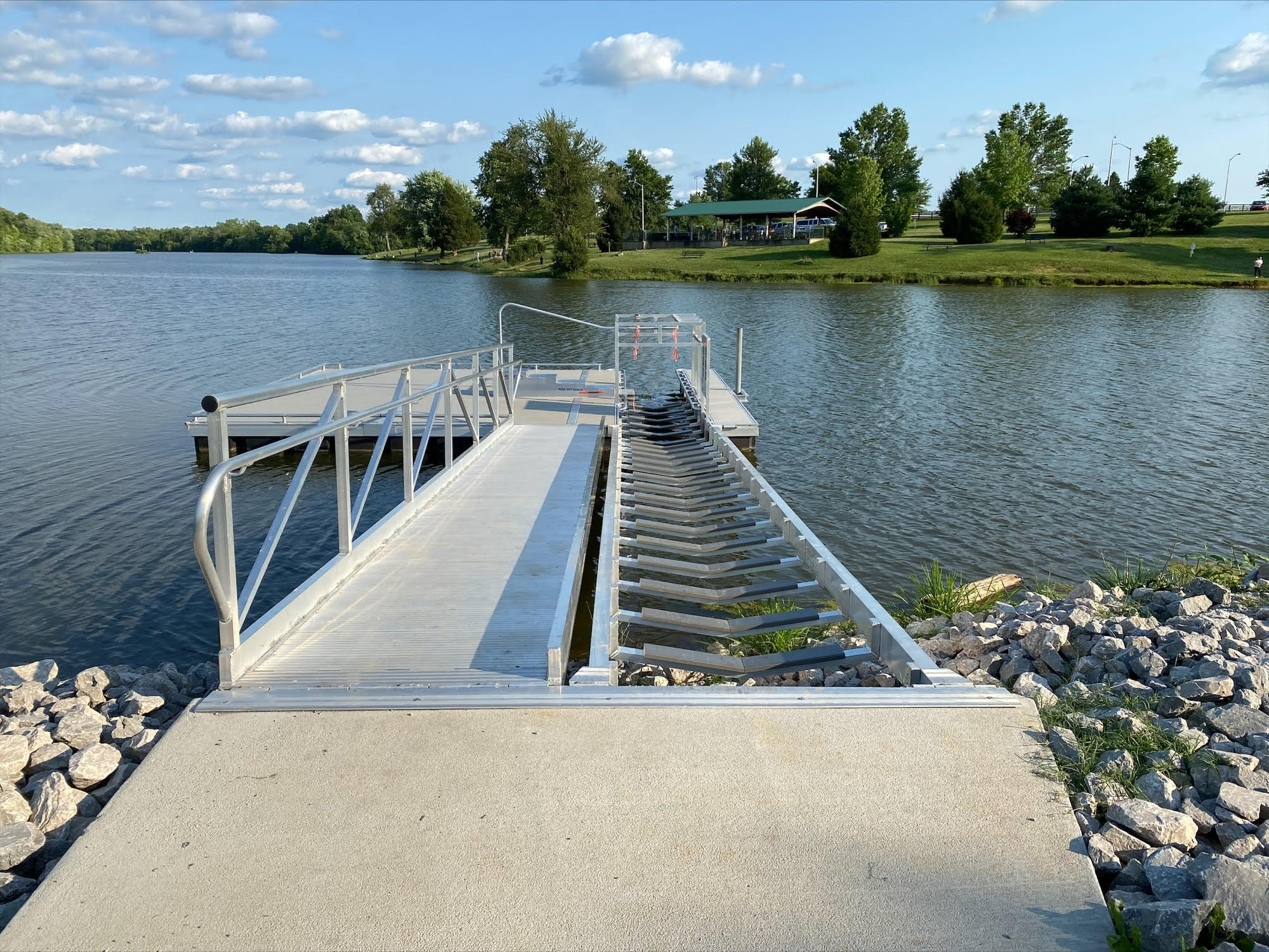
Richmond Kentucky Unveils Accessible Kayak Launch at Lake Reba
Nature lovers have a multitude of fun venues for various activities for all ages. The BoardSafe adaptive, accessible kayak launch opens up the joys of kayaking on Lake Reba to a new level of participation for the mobility-challenged population.
You can find more details about this project in this article in the Richmond Register:
Richmond unveils kayak launch at Lake Reba


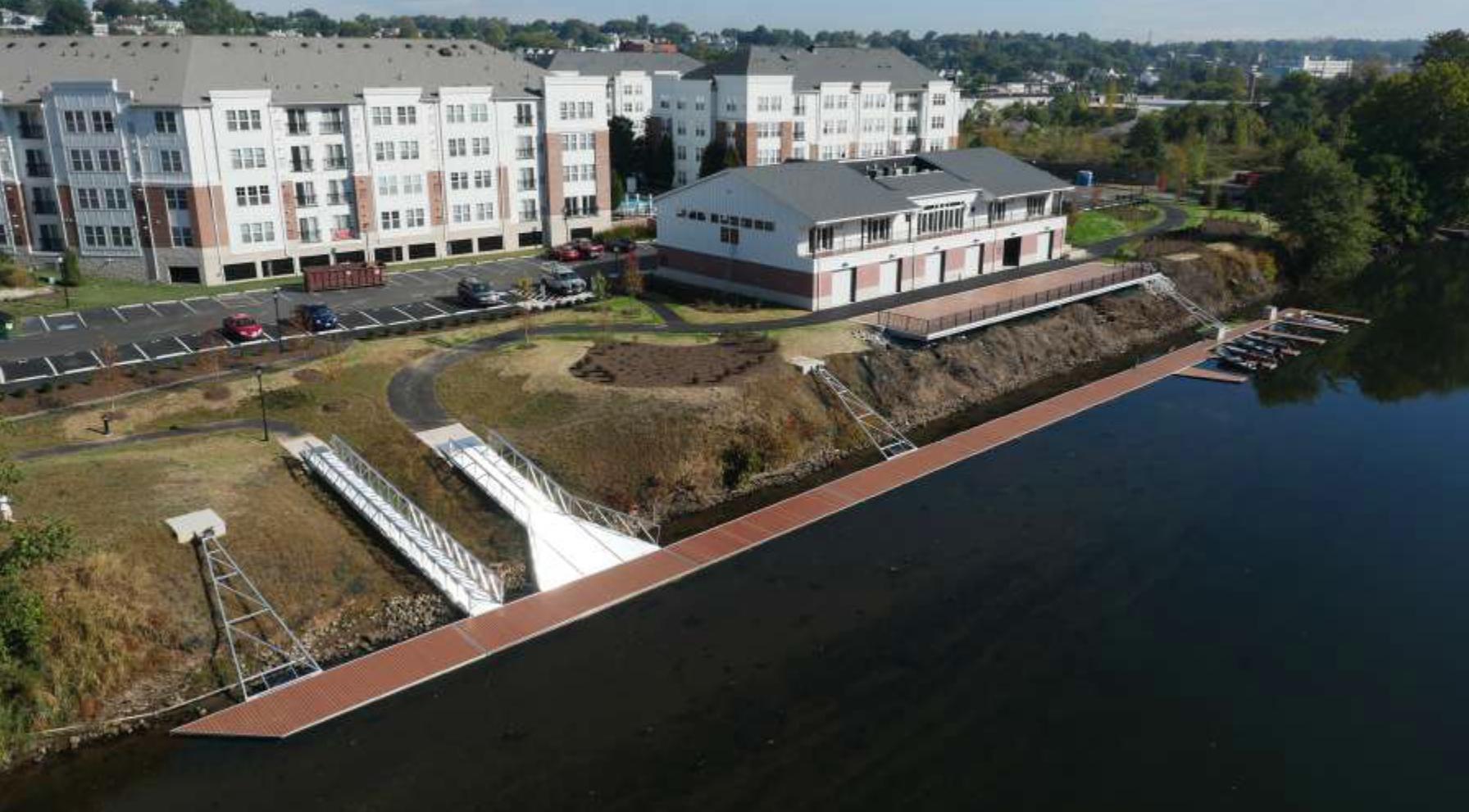
BoardSafe Manufactures Marinas, Rowing Centers, Adaptive Launches, Gangways and Bridges
Since 2009, BoardSafe Docks has designed, manufactured, and installed high-quality floating docks, aluminum gangways, pedestrian bridges, adaptive kayak launches, and other marine access products.
Their projects cover a variety of locations including urban projects found in Austin, Dallas, Houston, Philadelphia, Baltimore, Jacksonville, Chicago, Manhattan, and Boston Harbor. They have also undertaken numerous rural projects on lakes, rivers, streams, and coastal environments. Regardless of the setting, BoardSafe’s innovative process to understand clients’ needs and configure their standardized products into a custom solution for each client is a winning formula.
Please watch the following video that highlights how BoardSafe Docks exceeds the expectations of its diverse clientele:
BoardSafe’s experience in construction and manufacturing gives them unparalleled expertise and innovative solutions to address the dynamic conditions of tides, currents, and other water fluctuations ranging from severe flooding to drought conditions. This has made BoardSafe the trusted expert for park directors, civil engineers, landscape architects, and other professionals who desire only the best-engineered and highest-quality aluminum floating docks and launch systems for their rowing centers, marinas, and water access points.
BoardSafe is the trusted expert for Division I rowing programs, regatta centers, and iconic clubs like those along Boathouse Row in Philadelphia.
In fact, BoardSafe’s desire to maximize each user’s ability led to the creation of their adaptive kayak launch products and accessories. They also work with state and local park systems, municipalities, and community groups interested in universal access to their waterfront. BoardSafe also works for numerous smaller venues and community groups.
In 2012, a group of adaptive paddlers partnered with BoardSafe to make a lake accessible for adaptive paddlers. From this collaboration, BoardSafe created numerous adaptive product innovations to empower paddlers to transition safely and easily in and out of their vessels.
Since then, BoardSafe continues to champion adaptive accessibility for waterfronts across the USA. This commitment to education and advocacy has made BoardSafe a leading voice in aquatic recreation accessibility, as well as the manufacturing source for the best-performing and highest-quality launch systems available. With BoardSafe’s expertise in engineering and manufacturing, they were able to expand into aluminum pedestrian bridges to meet growing customer demand.
BoardSafe’s recipe for success is simple—it is all about their process. First, they assess their clients’ individual objectives and evaluate the site conditions for the desired use. This is where BoardSafe Docks’ experience plays a vital role in evaluating the unique physical conditions located at each site. Second, BoardSafe proposes design and engineering solutions to address the requirements of each site and ultimately achieve each client’s project goals. And finally, systematic processes during product manufacturing ensure quality, long-term durability, and performance. BoardSafe’s standardized products are customized into unique configurations to meet and exceed performance expectations.
Simply put, BoardSafe products are designed to meet the requirements of civil engineers, structural engineers, architects, and landscape architects, as well as the wishes of competitive rowers and adaptive paddlers.
BSD understands what investing in this type of recreation means for communities and how they can empower individuals. If you share this vision, call us to discuss your project.
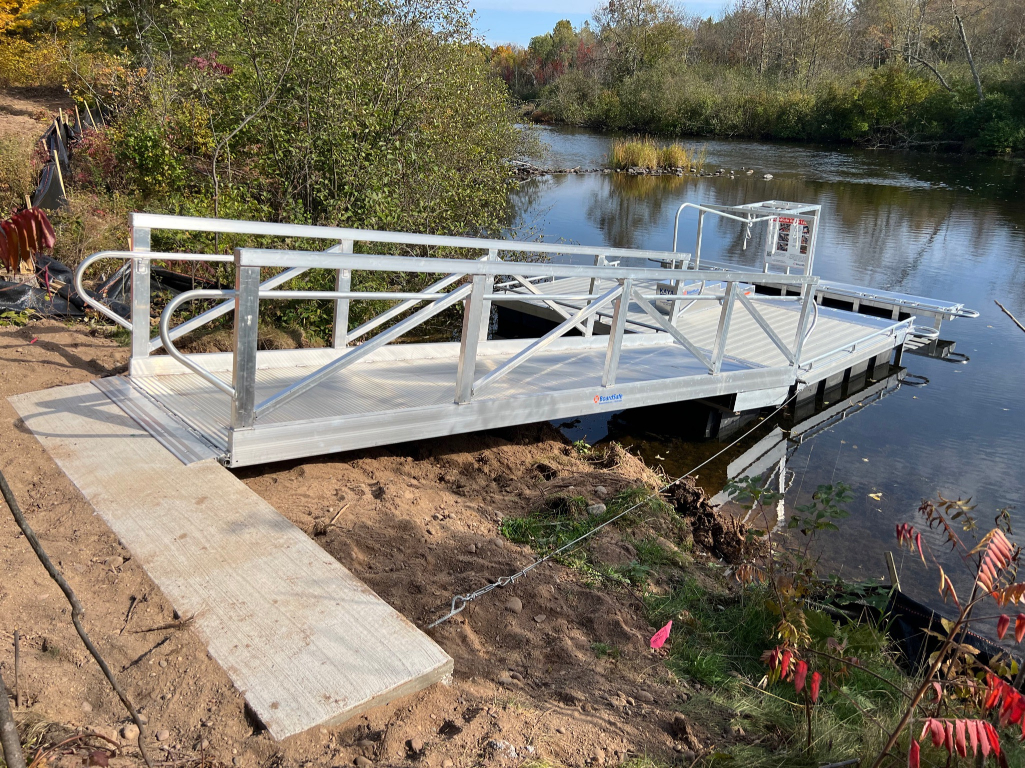
Accessible Launch with Adaptive Features Welcomed in Couderay, WI
The Wisconsin Department of Natural Resources, Bureau of Fisheries, recently installed two BoardSafe Adaptive Kayak Launches along the Couderay River in Couderay and Radisson, Wisconsin. The installation was part of the collaboration between Wisconsin DNR and BoardSafe Docks. Their goal was to provide inclusive access to the river for paddlers with disabilities, fishermen, residents, and visitors, who enjoy the prolific fishing and paddling in their clean and nature-filled waters.
Wisconsin DNR developed a plan to provide paddle craft access to the Couderay River where it did not previously exist. They had two sites in mind for a put-in and take-out, but each location had design challenges that needed to be overcome. “Working with BoardSafe allowed us to identify creative designs and solutions for each site that made this project possible,” said Max Wolter, project coordinator for the adaptive launches.
Below is BoardSafe’s drawing of Couderay’s project:
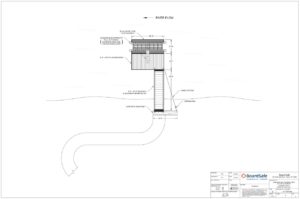
The Couderay project included:
- customer-installed bulkhead
- 5-foot by 20-foot aluminum gangway
- one (1) 8 x 16 aluminum floating dock, composite decking, plastic encapsulated flotation, and BoardSafe proprietary extrusions
- BoardSafe’s Adaptive Kayak Launch with Boarding Kit
[smartslider3 slider="9"]
Videos of the Couderay and Radisson project can be viewed here:
- Couderay River Accessible and Adaptive Kayak Launch in Couderay Wisconsin
- Adaptive and Accessible Kayak Launches Installed for the Wisconsin Department of Natural Resources
[smartslider3 slider="10"]
The uniqueness of this accessible project
The Couderay River never had formal access points for paddle craft. BoardSafe Docks, a leader in the design, engineering, and manufacturing of accessible floating docks, came up with a design solution that would allow the Wisconsin DNR to offer its communities and tourists accessible locations to fish and kayak and enjoy the beauty of the river. BoardSafe’s solution allows people of all abilities to confidently plan a day trip down the river knowing they will have quality infrastructure for launching and taking out their vessels.
Couderay serves as headquarters for an organization called "Fishing Has No Boundaries," which hosts fishing events for people living with disabilities. Fishing Has No Boundaries was an appreciated contributing partner to the project and a stakeholder in wanting to provide inclusive launches for the disabled angling community. The adaptive launches installed in Couderay and Radisson will help them better serve their mission.
What adaptive features make the launches accessible to all?
The adaptive features found in the BoardSafe Adaptive Kayak Launch make it accessible to a broader range of users. The launch was designed for adaptive paddlers with input from paddlers in wheelchairs who were looking for an easier way to access the water. The empowering features include an ADA-compliant gangway (less than a 1/12 pitch), a protective toe-kick around the perimeter of the floating dock, an adaptive roll cage that starts with a seat equal to the height of a wheelchair and includes a 3.5-inch step-down bench, a pullout, bleacher-style seat, an overhead grab bar that allows the user to slide down either side of the bench of their preference, overhead grab straps to lower oneself into the vessel, a cradle that keeps the kayak level and stable upon entry, and pull-bars to enter into the water with a controlled entry.
What makes Couderay worth a visit?
Couderay is a small, sleepy town with less than 100 permanent, year-round residents as noted in the latest U.S. Census. The name "Couderay" was derived from the name given to the area by French explorers: Lac Courte Oreilles.
Kayaking isn’t the only attraction along the Couderay River; kayak fishing is another very popular attraction in the area. Their new inclusive launches will offer access to outdoor enthusiasts, residents, and visitors, who enjoy the prolific fishing and paddling along their beautiful waterway.
Nature abounds in Couderay, where they keep their waters clean for nature lovers and work hard to protect their fish and wildlife. The following videos capture the beauty offered to its visitors:
- Mama Bear and 3 Cubs - Chippewa Flowage, Couderay Wi.
- Couderay Waters Watershed Paddle Tour Couderay Waters Watershed Paddle Tour protects, preserves, and promotes the natural history and beauty of the water.
Visitors to the area may also wish to visit the National Fresh Water Fishing Hall of Fame, the LumberJack World Championships, and Al Capone’s Hideout, all close by.
BoardSafe Docks understands the benefits and impact their adaptive launch system offers to communities and park systems. The feature-rich launch offers safe, easy, and inclusive access to the water. It is fitted for both kayaks and canoes and has an available option designed to work for SUPS.
BoardSafe Docks is the trusted expert for those who desire only the best-engineered and highest-quality aluminum floating docks, gangways, and launch systems. BoardSafe’s design, engineering, and quality manufacturing make them an industry leader for commercial aluminum floating docks, adaptive kayak launches, gangways, and pedestrian bridges. Their product line is recognized by customers seeking long-term value, reliability, and durability in order to access the great outdoors.
For more information about this project and others, visit us at boardsafedocks.com or call us at 610-899-0286.
BoardSafe Celebrates Cape Coral's Voice of the People Awards
November 8, 2022—The City of Cape Coral, Florida, was recognized with two Voice of the People Awards for "Transformation in Economy" and "Transformation in Mobility."
The Voice of the People Awards (VOP) are the only local government awards based on residents' opinions. They are presented jointly by the National Research Center (NRC) at Polco and the International City-County Management Association (ICMA).
Based on results from the National Community Survey, Cape Coral's residents agree that the city has significantly improved its mobility and economy. The survey measured resident opinions about the quality of life in their community.
Factors that led to winning the "Transformation in Mobility" award include a citywide effort to provide overall ease of travel, and to include additional, interconnecting paths, walking trails, and bicycle paths. Cape Coral is the only City in Southwest Florida with ADA-accessible kayak launches.
The City has two ADA-compatible kayak launches: One is at Sirenia Vista Park and the other is at Saratoga Lake Park. BoardSafe manufactured the two ADA-compliant kayak launches at the above-mentioned parks, and contracted with the city for their fabrication and installation.
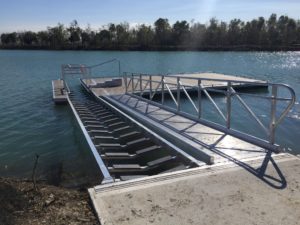
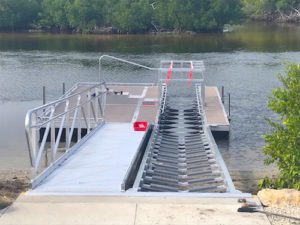
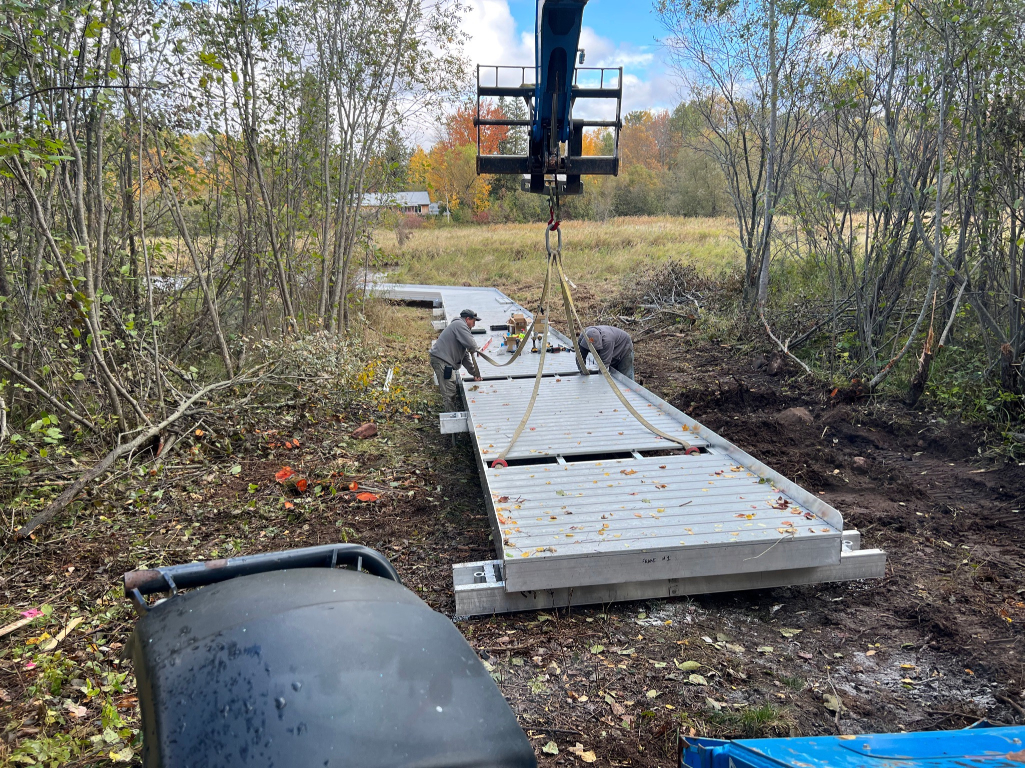
Radisson, WI, Residents Gain ADA Access with BoardSafe Docks
Along the Couderay River in Radisson, Wisconsin, an adaptive and accessible kayak launch was installed in October 2022. It provides universal access to the river regardless of ability or disability and has numerous ADA-inspired features.
The installation was the culmination of a 2-year collaboration between BoardSafe Docks and the Wisconsin Department of Natural Resources, Bureau of Fisheries.
Wisconsin DNR has been committed to improving outdoor recreation opportunities for people of all abilities. Whether on land or on the water, the DNR is hopeful that everyone will find their niche and enjoy new recreational opportunities. The DNR has been promoting access, inclusion, equity, and healthy living, and encouraging residents and visitors to explore the great outdoors. The BoardSafe Adaptive Kayak Launch will help increase dignity and freedom for individuals with mobility issues and build closer connections among friends and family while increasing accessibility and participation for adaptive paddlers at their parks. See photos below.
Not only does the kayak launch help paddlers into the water; there is also a 120-foot-long accessible composite boardwalk that is leading from a trailhead access area. The boardwalk is supported by fiberglass pilings and consists of prefabricated aluminum deck sections. The frame of the boardwalk is an aluminum tube frame with composite decking featuring the TimberStrong fastening system.
There is an aluminum toe kick along the boardwalk as well as an integrated hinge for attachment to the gangway. The boardwalk leads to a BoardSafe Adaptive Kayak Launch on the Couderay River.
The aluminum gangway measures 5’ wide x 8’ long and is attached to an aluminum floating dock that is 8’ x 16’. The kayak launch has BoardSafe’s adaptive boarding kit for an easy transition in and out of vessels.

- Installed October 2022
- 120-foot-long composite boardwalk
- Fiberglass pilings
- Prefabricated aluminum deck sections
- Aluminum tube frame
- Composite decking featuring the TimberStrong fastening system
- Aluminum toe kick
- Integrated hinge for attachment of gangway
- BoardSafe Adaptive Kayak Launch
- 5’ x 8’ gangway
- 8’ x 16’ floating dock
- BoardSafe Adaptive Kayak Launch
- Adaptive boarding kit
The uniqueness of this accessible project
The accessibility of this project not only assists adaptive paddlers getting to the kayak launch, into their vessel, and out onto the water by utilizing the adaptive features designed to accommodate paddlers in wheelchairs, but boasts a 120-foot long accessible, composite boardwalk leading from the trailhead access area to the river. The 120-ft. boardwalk is supported by fiberglass pilings with prefabricated aluminum deck sections. The frame of the boardwalk is an aluminum tube frame using composite decking connected with the hidden, TimberStrong fastening system. An aluminum, protective toe kick is found along the boardwalk’s edge and an integrated hinge attaches the gangway to its concrete foundation. This custom walkway offers accessibility to the adaptive launch inviting those with physical limitations a safer and easier way to access and paddler on the river. This project models inclusivity and accessibility for all.
Radisson’s hope
Radisson is a small town with less than 300 permanent, year-round residents noted by the latest US Census. Why would a small town invest in a BoardSafe Adaptive Kayak Launch? BoardSafe Docks understands the benefits and impact their adaptive launch system offers to communities and park systems. It offers the safe, easy, and inclusive access to the water. The inclusive launch is fitted for kayaks, canoes, and can also work for SUPS. Kayaking isn’t the only attraction along Radisson’s waterway; kayak fishing is another very popular attraction to the park. Radisson may now offer their inclusive access to various outdoor enthusiasts and become a local treasure for residents and visitors to enjoy for generations to come.
Benefits of River Access
River access points are known to be gateways of opportunities for paddlers to enjoy the experience of being on the water. Accessible river access offers socialization; it brings people together and affords the ability to connect families and friends to nature and to their community.
River access points also offer economic benefit to local communties. Investments in river access can increase visitor spending, create jobs, and support local businesses and government. Diverse partnerships have the potential to develop along river communities and there is demonstrated success for communities who’ve made the investment.
A second Adaptive Kayak Launch was also installed in Couderay, WI, and can be viewed here.
The adaptive features found in BoardSafe’s kayak launch offer safer and easier access to the water and work for a wider range of users. Features typically include a paved pathway from the parking lot to the launch, an ADA-compliant gangway (less than a 1/12 pitch), a protective toe-kick around the perimeter of the floating dock, an adaptive roll cage that includes a 3.5-inch step-down bench, a pullout seat, an overhead grab bar that allows the user to slide down either side of the bench of their preference, optional overhead grab straps to lower oneself into the vessel, a cradle the keeps the kayak level and stable upon entry, and pull bars to enter into the water through a controlled entry.
"The aluminum floating kayak launch system has unique adaptive features that offer paddlers with disabilities or mobility limitations the opportunity to get safely from their wheelchair and into a kayak and back out again," says Scott Tihansky, of BoardSafe Docks.
BoardSafe Docks works regularly with adaptive paddling groups, veteran groups, park and recreation departments, governmental leaders, landscape architects, and design engineers looking to make their waterfront accessible to all.
BoardSafe Docks is the trusted expert for those who desire only the best-engineered and highest-quality aluminum floating docks, gangways, and launch systems.
If you’re looking to make your community's parks, rivers, lakes, and other natural areas more accessible for people of all abilities, contact BoardSafe Docks at 610-899-0286. You may also visit the BoardSafeDocks.com website to see other project profiles to learn how BoardSafe Docks has the capability to design, engineer, and manufacture accessible and adaptive products for those who appreciate the outdoors and want to ensure all will be able to access the great outdoors.
Testimonial
Just made it down to see the fully completed project at Radisson. WOW! Both look fantastic. I’m going to be showing these off to lots of folks around the state and telling the tale of how nice it was working with your outfit. I have a feeling you’ll be back in Wisconsin for many more jobs!
Please let me know if there is any other follow-up needed from us or if there are any snafus with getting payments. I’m with you all the way to the finish line on this one! Very relieved and happy to have the big install step done though!
P Max H. Wolter, Fisheries Biologist
Hayward Service Center
To make your community's parks, rivers, lakes, and other natural areas more accessible for all abilities, visit BoardSafeDocks.com.